
英语单词的前缀
- 格式:ppt
- 大小:121.00 KB
- 文档页数:27


常见的英语单词前缀整理常见的英语单词前缀整理英语是一种西日耳曼语支,最早被中世纪的英国使用,并因其广阔的殖民地而成为世界使用面积最广的语言。
下面是店铺帮大家整理的常见的英语单词前缀整理,仅供参考,大家一起来看看吧。
常见的.英语单词前缀整理11.表示否定意义的前缀1)纯否定前缀a-, an-, asymmetry(不对称)anhydrous(无水的)dis- dishonest, dislikein-, ig-, il, im, ir, incapable, inability, ignoble, impossible, immoral, illegal, irregularne-, n-, none, neither, nevernon-, noesenseneg-, neglectun- unable, unemployment2)表示错误的意义male-, mal-, malfunction, maladjustment(失调)mis-, mistake, misleadpseudo-, pseudonym(假名), pseudoscience3)表示反动作的意思de-, defend, demodulation(解调)dis-, disarm, disconnectun-, unload, uncover4)表示相反,相互对立意思anti-, ant- antiknock( 防震), antiforeign ,(排外的)contra-, contre-, contro-, contradiction, controflow(逆流)counter-, counterreaction, counterbalanceob-, oc-, of-, op-, object, oppose, occupywith-, withdraw, withstand2. 表示空间位置,方向关系的前缀1)a- 表示“在……之上”,“向……”aboard, aside,2)by- 表示“附近,邻近,边侧”bypath, bypass(弯路)3)circum-, circu-, 表示“周围,环绕,回转”circumstance, circuit4)de-, 表示“在下,向下”descend, degrade5)en-, 表示“在内,进入”encage, enbed(上床)6)ex-, ec-, es-, 表示“外部,外”exit, eclipse, expand, export7)extra-, 表示“额外”extraction (提取)8)fore- 表示“在前面”forehead, foreground9)in-, il-, im-, ir-, 表示“向内,在内,背于”inland, invade, inside, import10)inter-, intel-, 表示“在……间,相互”international, interaction, internet11)intro-, 表示“向内,在内,内侧”introduce, introduce12)medi-, med-, mid-, 表示“中,中间”Mediterranean, midposition13)out-, 表示“在上面,在外部,在外”outline, outside, outward14)over-, 表示“在上面,在外部,向上”overlook, overhead, overboard15)post-, 表示"向后,在后边,次”postscript(附言),16)pre-, 表示"在前”在前面”prefix, preface, preposition17)pro-, 表示“在前,向前”progress, proceed,18)sub-, suc-, suf-, sug-, sum-, sup-, sur-, sus-, 表示“在下面,下”subway, submarine, suffix, suppress, supplement19)super-, sur-, 表示“在…..之上”superficial, surface, superstructure20)trans-, 表示“移上,转上,在那一边”translate, transform, transoceanic21)under-, 表示“在…..下面,下的”underline, underground, underwater22)up-, 表示“向上,向上面,在上”upward, uphold, uphill(上坡)3. 表示时间,序列关系的前缀1)ante-, anti-, 表示“先前,早于,预先”antecedent, anticipate,2)ex-, 表示“先,故,旧”expresident, exhusband3)fore-, 表示“在前面,先前,前面”foreward, dorecast, foretell(预言)4)mid-, medi-, 表示“中,中间”midnight, midsummer5)post-"表示“在后,后”postwar,6)pre-, pri-, 表示“在前,事先,预先”preheat, prewar, prehistory7)pro-, 表示“在前,先,前”prologue (序幕),prophet(预言家)8)re-, 表示“再一次,重新”retell, rewrite4. 表示比较程度差别关系的前缀1)by-, 表示“副,次要的”byproduct, bywork(副业)2)extra-,表示“超越,额外”extraordinary,3)hyper- 表示“超过,极度”hypersonic(超声波), hypertesion(高血压)4)out-,表示“超过,过分”outdo(超过), outbid(出价过高的人)5)over-,表示“超过,过度,太”overeat, overdress, oversleep6) sub-, suc-, sur-, 表示“低,次,副,亚”subeditor, subordinate, subtropical(亚热带)7)super-, sur- 表示“超过”supernature, superpower, surplus, surpass8)under-,表示“低劣,低下”undersize, undergrown, underproduction(生产不足) 9)vice- 表示“副,次”vicepresident, vicechairman5. 表示共同,相等意思的前缀1)com-, cop-, con-, cor-, co- 表示“共同,一起”。

英语单词前缀后缀词根表1、英语单词的前缀a-:表示“不、无”,如:Amorphous(无定形的)anti-:表示“反、对抗”,如:antiseptic(杀菌剂)bi-:表示“二、两个”,如:Bilateral(双边的)dys-:表示“不良、恶劣”,如:dyslexia(阅读障碍)extra-:表示“超出正常范围”,如:extramural(校外的)hyper-:表示“过多或过分”,如:hypercritical(极挑剔的)in-:表示“狭义、不”,如:inactive(不活跃的)inter-:表示“在……之间”,如:intercultural(跨文化的)iso-:表示“同等、相等”,如:isotope(同位素)macro-:表示“大规模或宏观”,如:macroeconomics(宏观经济学)micro-:表示“小规模或微观”,如:microphone(麦克风)multi-:表示“多个”,如:multifaceted(多方面的)non-:表示“不、非”,如:nonfiction(非小说)omni-:表示“全部的或普遍的”,如:omniscient(全知的)pre-:表示“在……之前”,如:preparation(准备)pro-:表示“赞成、支持”,如:progressive(进步的)pseudo-:表示“假、伪”,如:pseudopod(虚脓胞)re-:表示“对……重复”,如:replay(重播)sel-:表示“自己的、其自身的”,如:selective(选择性的)self-:表示“自己的、其自身的”,如:selfish(自私的)super-:表示“超越常规”,如:supervise(监督)trans-:表示“跨越边界”,如:transmit(传送)un-:表示“不、非”,如:unprecedented(史无前例的)2、英语单词的后缀-acy:表示“性质、特征”,如:sovereignty(主权)-age:表示“行为或行动”,如:encourage(鼓励)-al:表示“形容词”,如:national(国家的)-ful:表示“有……的”,如:beautiful(美丽的)-ible:表示“可以……的”,如:possible(可能的)-ion:表示“状态或过程”,如:invention(发明)-ist:表示“具有……性质的人”,如:capitalist(资本家)-ize:表示“使变成或以……处理”,如:organize(组织)-less:表示“无……特性的”,如:harmless(无害的)-ion:表示“状态或过程”,如:invention(发明)-ship:表示“职位、处所”,如:friendship(友谊)-ure:表示“行为或结果”,如:failure(失败)-y:表示“状态”,如:happy(开心的)3、英语单词的词根Amorph:表示“无定形的”,如:amorphous(无定形的)Arch-:表示“最高的”,如:archetype(原型)bio-:表示“生物的”,如:biologist(生物学家)centr–:表示“中心”,如:central(中心的)chrom-:表示“色彩”,如:chromosome(染色体)chron-:表示“时间”,如:chronological(时间的)dem-:表示。
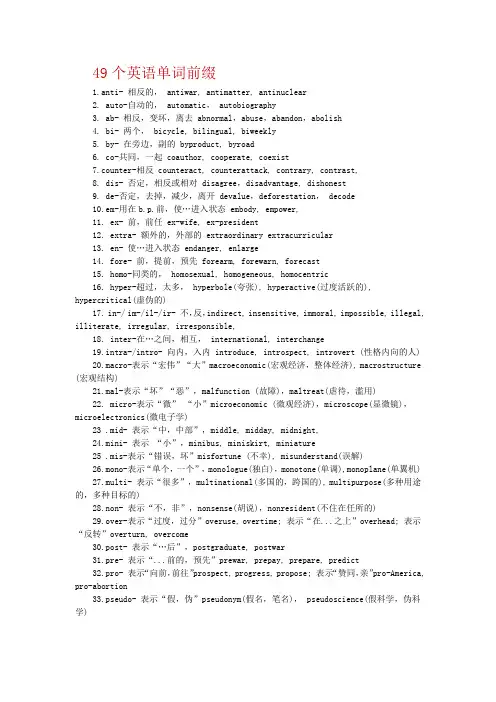
49个英语单词前缀1.anti- 相反的, antiwar, antimatter, antinuclear2. auto-自动的, automatic, autobiography3. ab- 相反,变坏,离去 abnormal,abuse,abandon,abolish4. bi- 两个, bicycle, bilingual, biweekly5. by- 在旁边,副的 byproduct, byroad6. co-共同,一起 coauthor, cooperate, coexist7.counter-相反 counteract, counterattack, contrary, contrast,8. dis- 否定,相反或相对 disagree,disadvantage, dishonest9. de-否定,去掉,减少,离开 devalue,deforestation, decode10.em-用在b.p.前,使…进入状态 embody, empower,11. ex- 前,前任 ex-wife, ex-president12. extra- 额外的,外部的 extraordinary extracurricular13. en- 使…进入状态 endanger, enlarge14. fore- 前,提前,预先 forearm, forewarn, forecast15. homo-同类的, homosexual, homogeneous, homocentric16. hyper-超过,太多, hyperbole(夸张), hyperactive(过度活跃的),hypercritical(虚伪的)17. in-/ im-/il-/ir- 不,反,indirect, insensitive, immoral, impossible, illegal, illiterate, irregular, irresponsible,18. inter-在…之间,相互, international, interchange19.intra-/intro- 向内,入内 introduce, introspect, introvert (性格内向的人)20.macro-表示“宏伟”“大”macroeconomic(宏观经济,整体经济), macrostructure (宏观结构)21.mal-表示“坏”“恶”,malfunction (故障),maltreat(虐待,滥用)22. micro-表示“微”“小”microeconomic (微观经济),microscope(显微镜),microelectronics(微电子学)23 .mid- 表示“中,中部”,middle, midday, midnight,24.mini- 表示“小”,minibus, miniskirt, miniature25 .mis-表示“错误,坏”misfortune (不幸), misunderstand(误解)26.mono-表示“单个,一个”,monologue(独白),monotone(单调),monoplane(单翼机)27.multi- 表示“很多”,multinational(多国的,跨国的), multipurpose(多种用途的,多种目标的)28.non- 表示“不,非”,nonsense(胡说),nonresident(不住在任所的)29.over-表示“过度,过分”overuse, overtime; 表示“在...之上”overhead; 表示“反转”overturn, overcome30.post- 表示“…后”,postgraduate, postwar31.pre- 表示“...前的,预先”prewar, prepay, prepare, predict32.pro- 表示“向前,前往”prospect, progress, propose; 表示“赞同,亲”pro-America, pro-abortion33.pseudo- 表示“假,伪”pseudonym(假名,笔名), pseudoscience(假科学,伪科学)34.re- 表示“一再,重新”reuse, reunite, rebuild; “向后,相反,不”reject, refuse, rebel35.self-表示“自己,自身”,self-employed(自己经营的),self-taught(自学而成的,自修的)36.semi-表示“半,不完全地”,semicircle(半圆形), semifinal(半决赛)37.step-表示“后,继”stepmother, stepchildren38.sub-表示“下,在下;低于,副,亚,次”subdivide(再分,细分) subsection(分部,小部分), subway39.super- 表示“在…之上,加之”supermarket, supernatural (超自然的)40.sur-表示“超过,在上面”,surface, surpass(超越,胜过),surmount(战胜,克服),surcharge(超载,追加罚款)41.tele-表示“远”,telecommunication(电讯,远程通讯), telescope42.therm(o)-表示“热,热电”,thermometer (温度计,体温计),thermochemistry(热化学)43.trans-表示“横过,穿过”,transplant, transport, transnational, transatlantic(大西洋彼岸的)44.tri-表示“三”,triangle, tricycle45. ultra- 表示“极端,过度” ultramodern (超级现代化),ultrasound(超音,超声波) ultra-democracy(极端民主),46. un- 表示“不,非,无” unreal, uncomfortable, unfortunate, unconditional (无条件的)47. under- 表示“在…之下,次于,不足” underground,underdeveloped, undersea,underline48. uni-表示“单一” uniform, unidirectional (单向的),united (一致的,统一的,团结的)49.vice- 表示“副” vice-chairman,vice-governor , vice-president。

英语单词构词法前后缀一、前缀。
1. un - [ʌn](表示否定,形容词前缀)- 例如:happy(快乐的,[ˈhæpi],adj.)→unhappy(不快乐的,[ʌnˈhæpi],adj.)- 再如:fair(公平的,[feə(r)],adj.)→unfair(不公平的,[ʌnˈfeə(r)],adj.)2. dis - [dɪs](表示否定,动词或形容词前缀)- 动词:like(喜欢,[laɪk],v.)→dislike(不喜欢,[dɪsˈlaɪk],v.)- 形容词:honest(诚实的,[ˈɒnɪst],adj.)→dishonest(不诚实的,[d ɪsˈɒnɪst],adj.)3. re - [riː](表示“再,又”,动词前缀)- 例如:write(写,[raɪt],v.)→rewrite(重写,[riːˈraɪt],v.)- 再如:build(建造,[bɪld],v.)→rebuild(重建,[riːˈbɪld],v.)4. in - [ɪn](表示否定,形容词前缀,在某些以字母l、m、p开头的单词前变为il -、im -、ir -)- 一般情况:active(积极的,[ˈæktɪv],adj.)→inactive(不活跃的,[ɪnˈæktɪv],adj.)- 在l前:legal(合法的,[ˈliːɡl],adj.)→illegal(非法的,[ɪˈliːɡl],adj.)- 在m前:moral(道德的,[ˈmɒrəl],adj.)→immoral(不道德的,[ɪˈm ɒrəl],adj.)- 在r前:regular(规则的,[ˈreɡjələ(r)],adj.)→irregular(不规则的,[ɪˈreɡjələ(r)],adj.)5. pre - [priː](表示“在……之前”,形容词或动词前缀)- 形容词:school(学校,[skuːl])→preschool(学前的,[ˈpriːskuːl],adj.)- 动词:pay(支付,[peɪ],v.)→prepay(预付,[priːˈpeɪ],v.)6. post - [pəʊst](表示“在……之后”,形容词或名词前缀)- 形容词:war(战争,[wɔː(r)])→post - war(战后的,[ˈpəʊst wɔː(r)],adj.)- 名词:graduate(毕业生,[ˈɡrædʒuət])→postgraduate(研究生,[ˌp əʊstˈɡrædʒuət],n.)二、后缀。