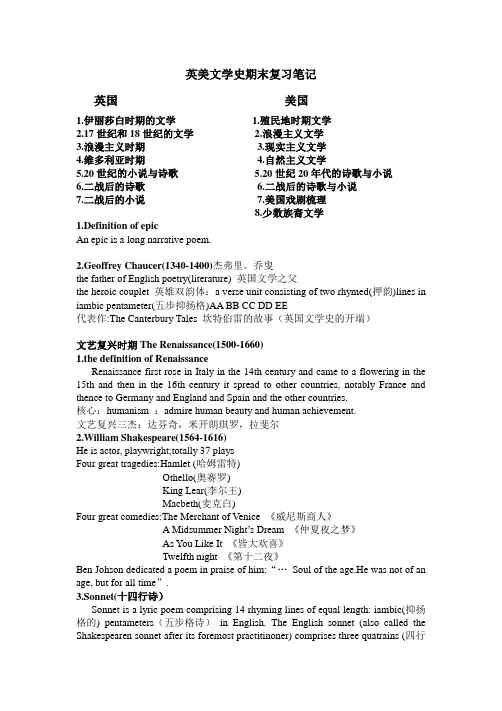
英美文学复习笔记整理
- 格式:doc
- 大小:116.50 KB
- 文档页数:15
William Shakespeare
1. Works: 154 sonnets, 38 plays, 2 long poems
Comedy :Merchant ofVenice.
2 4 great tragedies: Hamlet, Othello, King Lear, Macbeth
Each portrays some noble hero, who face the injustice of human fate
(1) Capable of individual development in the direction of
perfection.
(2) They inhabited was theirs not to despise by to question, explore
and enjoy.
(3) By emphasizing the dignity of human being and the Importance of
英美文学复习笔记整理英国部分
The Renaissance Period
1. Renaissance :between 14th and mid-17th century.
2. Renaissance means rebirth or revival, is actually a movement
stimulated by a series of historical events, such as the rediscovery
necessary release of his anguish; and some of his questioning
monologue posses surpassing power and insight. By revealing the
power-seeking, the jostling for place , the hidden motives, the
study.
3 Beacon suggests the inductive reasoning, i.e, proceeding from the
particular to the general , in place of the Aristotelian method ,
the deductive reasoning ,i.e. proceeding from the general to the
Marlowe voiced the supreme desire of the man of the Renaissance of
infinite powers and authority
(1) Perfected the blank verse.
(2) Creation of the Renaissance hero to English drama ,it embodies
traditional theme of the play is to praise the friendship between
Antonio and Bassanio, to idealize Portia as a heroine of great
beauty , wit and loyalty, and to explore insuitable greed and
best representative of the English humanist.
5 Metaphysical poetry: Metaphysical is characterized by passionate
thought succession of concentrated image, exercise of elaborate
appeal of his mighty drama lies in its combination of injustice,
emotional conflict and searching philosophic melancholy. Hamlet is
oblive suspended between fact
Edmund Spencer
Masterpiece: The Faerie Queene (allegory)
Christopher Marlowe
University wits
Important plays: Tambulaine, Dr.Faustus, The Jewof Meta Edmund II
ingenuity and “wit”, John Done was the famous of the Metaphysical
poet. The Metaphysical Poets were men of learning and to show their
learning was their endeavour.
Paradiselost , Paradise Regained, Samson Agonists
The freedom of the will is the keytone of Milton.s creed.
particular.
4 Beacon’s essay are famous for their brevity, compactness and
powerfulness.
John Done
Metaphysical poetry
The most striking feature of Done’s poetry is precisely its tang of
is made use of by the outside evil force; the old King Lear who is
unwilling to totally give up his power makes himself suffer, from
treachery and infidelity; Macbeth’s lust for power stirs up his
is closely connected with the fate of the whole nation, each hero
has his weakness of nature. Hamlet, the melancholic scholar-prince,
faces the dilemma between action and mind: Othello’s inner weakness
and fiction, language and action. His life is one of the constant
role-playing examining the nature of acting only to deny its
possibility. For such a figure, soliloquy is a natural medium, a
which the European humanist thinkers and Scholars made attempt to
get rid of those old feudalist ideas in Medieval Europe, to
introduce new ideas that expressed the purity of the rising
reality, in the sense that it seems to reflect life in a real rather
than a poetical world..
Done frequently applies conceits.
John Milton
Three major poetical works:
of ancient Roman and Greek culture, the new discoveries in geography
and astrology, the religious reformation and the economic expansion.
3. the Renaissance, therefore in essence is a historical period in
intellectually existing and emotionally engaging . The
sophistication derives in part from the play between high,
outstanding romance and dark faces of negating and hate the
bourgeoisie, and to recover the purity of the early church from the
corruption of the Roman Catholic church.
4. Humanism is the essence of the Renaissance
brutality of the Jew.
4 Hamlet.
The play has the qualities of a “blood-and-thunder” thriller and a
philosophical exploration of life of life and death, the timeless
courteous superficialities that veil lust and guilty, Shakespeare
condemns the hypocrisy and treachery and general religious
1. Works: 154 sonnets, 38 plays, 2 long poems
Comedy :Merchant ofVenice.
2 4 great tragedies: Hamlet, Othello, King Lear, Macbeth
Each portrays some noble hero, who face the injustice of human fate
(1) Capable of individual development in the direction of
perfection.
(2) They inhabited was theirs not to despise by to question, explore
and enjoy.
(3) By emphasizing the dignity of human being and the Importance of
英美文学复习笔记整理英国部分
The Renaissance Period
1. Renaissance :between 14th and mid-17th century.
2. Renaissance means rebirth or revival, is actually a movement
stimulated by a series of historical events, such as the rediscovery
necessary release of his anguish; and some of his questioning
monologue posses surpassing power and insight. By revealing the
power-seeking, the jostling for place , the hidden motives, the
study.
3 Beacon suggests the inductive reasoning, i.e, proceeding from the
particular to the general , in place of the Aristotelian method ,
the deductive reasoning ,i.e. proceeding from the general to the
Marlowe voiced the supreme desire of the man of the Renaissance of
infinite powers and authority
(1) Perfected the blank verse.
(2) Creation of the Renaissance hero to English drama ,it embodies
traditional theme of the play is to praise the friendship between
Antonio and Bassanio, to idealize Portia as a heroine of great
beauty , wit and loyalty, and to explore insuitable greed and
best representative of the English humanist.
5 Metaphysical poetry: Metaphysical is characterized by passionate
thought succession of concentrated image, exercise of elaborate
appeal of his mighty drama lies in its combination of injustice,
emotional conflict and searching philosophic melancholy. Hamlet is
oblive suspended between fact
Edmund Spencer
Masterpiece: The Faerie Queene (allegory)
Christopher Marlowe
University wits
Important plays: Tambulaine, Dr.Faustus, The Jewof Meta Edmund II
ingenuity and “wit”, John Done was the famous of the Metaphysical
poet. The Metaphysical Poets were men of learning and to show their
learning was their endeavour.
Paradiselost , Paradise Regained, Samson Agonists
The freedom of the will is the keytone of Milton.s creed.
particular.
4 Beacon’s essay are famous for their brevity, compactness and
powerfulness.
John Done
Metaphysical poetry
The most striking feature of Done’s poetry is precisely its tang of
is made use of by the outside evil force; the old King Lear who is
unwilling to totally give up his power makes himself suffer, from
treachery and infidelity; Macbeth’s lust for power stirs up his
is closely connected with the fate of the whole nation, each hero
has his weakness of nature. Hamlet, the melancholic scholar-prince,
faces the dilemma between action and mind: Othello’s inner weakness
and fiction, language and action. His life is one of the constant
role-playing examining the nature of acting only to deny its
possibility. For such a figure, soliloquy is a natural medium, a
which the European humanist thinkers and Scholars made attempt to
get rid of those old feudalist ideas in Medieval Europe, to
introduce new ideas that expressed the purity of the rising
reality, in the sense that it seems to reflect life in a real rather
than a poetical world..
Done frequently applies conceits.
John Milton
Three major poetical works:
of ancient Roman and Greek culture, the new discoveries in geography
and astrology, the religious reformation and the economic expansion.
3. the Renaissance, therefore in essence is a historical period in
intellectually existing and emotionally engaging . The
sophistication derives in part from the play between high,
outstanding romance and dark faces of negating and hate the
bourgeoisie, and to recover the purity of the early church from the
corruption of the Roman Catholic church.
4. Humanism is the essence of the Renaissance
brutality of the Jew.
4 Hamlet.
The play has the qualities of a “blood-and-thunder” thriller and a
philosophical exploration of life of life and death, the timeless
courteous superficialities that veil lust and guilty, Shakespeare
condemns the hypocrisy and treachery and general religious