英语use的用法
- 格式:docx
- 大小:13.17 KB
- 文档页数:6
英语use的用法
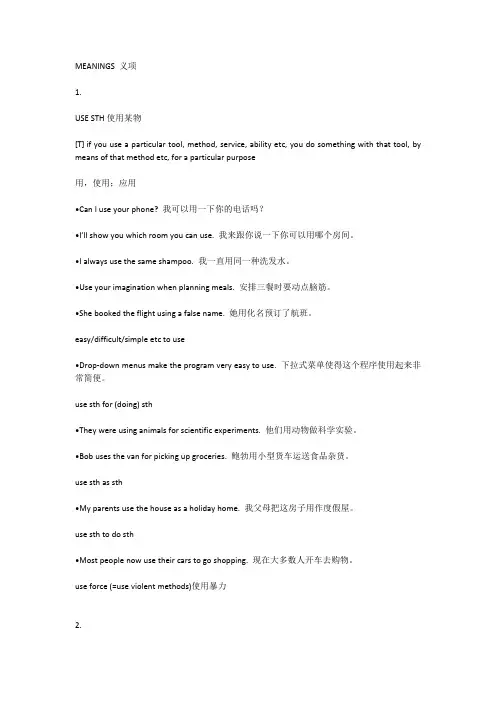
英语 “use” 的用法
“Use” 是一个常用的英语动词,它有很多用法,以下是一些常见的用法及详细解释:
1. 作为动词使用
• “Use” 可以用来表示使用或利用某物来完成某个目的。 例如:
– She uses her computer to write articles.(她用电脑写文章。)
– I use this app to learn languages.(我用这个应用程序学习语言。)
• “Use” 还可以表示习惯或经常使用某物。 例如:
– My grandfather uses a typewriter for writing
letters.(我爷爷习惯用打字机写信。)
– I use my phone to check emails every day.(我每天都用手机查看邮件。)
• “Use” 还可以表示使用某种方法或手段来完成某事。 例如:
– You can use a knife to cut the vegetables.(你可以用刀子切蔬菜。) – They used a ladder to reach the roof.(他们用梯子到达房顶。)
2. 作为名词使用
• “Use” 在名词形式下,表示使用或利用某物的行为或状态。
例如:
– She made good use of her time.(她充分利用了她的时间。)
– The book is of no use anymore.(这本书已经没用了。)
• “Use” 还可以表示某物的目的、功能或效果。 例如:
– The main use of a hammer is for pounding nails.(锤子的主要用途是敲钉子。)
– The medicine has many uses.(这药有很多用途。)
3. 常见短语和搭配
• “Make use of” 表示利用或使用某物。 例如:
– You should make use of this opportunity.(你应该利用这个机会。)
– The teacher made good use of technology in the
classroom.(老师在课堂上充分利用了技术。)
• “Use up” 表示使用完或耗尽某物。 例如: – I used up all my savings on traveling.(我把所有的积蓄都用在旅行上了。)
– Don’t use up all the ink in the printer.(别用完打印机里的墨水。)
• “Useful” 是 “use” 的形容词形式,表示有用的或有益的。
例如:
– This book is really useful for learning English.(这本书对学习英语很有用。)
– He gave me some useful advice.(他给了我一些建设性的建议。)
• “Useless” 是 “use” 的形容词形式,表示无用的或无效的。
例如:
– The broken phone is useless now.(这个坏掉的手机现在没用了。)
– His suggestions were completely useless.(他的建议完全没用。)
总结
“Use” 是一个非常常用的英语动词,它可以表示使用某物、利用方法或手段来完成某事,也可以作为名词表示使用的行为、状态或某物的目的、功能。同时,还有一些常见的短语和搭配与 “use” 相关联,如 “make use of”、“use up”、“useful” 和
“useless”。熟练掌握这些用法,能够更准确地表达自己的意思。
4. “Used to” 的用法
• “Used to” 表示过去经常或习惯性地做某事,现在已经不再这样。 例如:
– I used to smoke, but I quit last year.(我过去常抽烟,但去年戒了。)
– Sarah used to live in New York, but she moved to
Los Angeles.(Sarah过去住在纽约,但她搬到了洛杉矶。)
• “Used to” 也可以表示过去具有某种状态或条件,现在不再是这样。 例如:
– This used to be a small village, but now it’s a
bustling city.(这过去是个小村庄,但现在是一个繁华的城市。)
– He used to be overweight, but now he’s in great
shape.(他以前超重,但现在身材很好。)
• 注意,在否定句和疑问句中,要使用 “did” 或 “didn’t”
来强调动作的发生与过去的关系。 例如: – Did you use to play the piano when you were young?(你小时候会弹钢琴吗?)
– He didn’t use to like spicy food, but now he loves
it.(他过去不喜欢辣食,但现在却爱吃。)
5. “Use of” 和 “Usage of” 的区别
• “Use of” 和 “Usage of” 都表示使用某物或某种方法的行为。
– “Use of” 更常见,表示实际的应用或利用行为。 例如:
• The use of technology has greatly improved our
lives.(科技的应用大大改善了我们的生活。)
• The use of this tool requires careful training.(使用这个工具需要仔细的培训。)
– “Usage of” 更偏向于一种规定或准则的使用。 例如:
• The proper usage of grammar is important for
effective communication.(正确使用语法对于有效沟通很重要。)
• The company has strict guidelines on the usage
of company vehicles.(公司对于使用公司车辆有严格的规定。) 6. “Use” 的其他用法
• “Use” 还可以表示服用药物。 例如:
– Don’t forget to use the medicine three times a day.(不要忘记每天服用药物三次。)
• “Use” 也可以表示某人或某物有工具、机器等的潜力或威力。
例如:
– He has a lot of potential, but he needs to use it
wisely.(他有很大的潜力,但他需要明智地利用它。)
– The new machine can be used for various purposes.(这台新机器可用于各种目的。)
• “Have no use for” 表示对某事物没有兴趣或不需要。 例如:
– I have no use for this old furniture, so I’m
getting rid of it.(我对这些旧家具没有兴趣,所以要处理掉。)
– He has no use for expensive clothing.(他对昂贵的服装不感兴趣。)
以上是关于 “use” 的一些常见用法及详细解释。通过学习这些用法,我们可以更准确地运用 “use” 来表达自己的意思。