chapter 7 cohesion
- 格式:ppt
- 大小:4.67 MB
- 文档页数:35

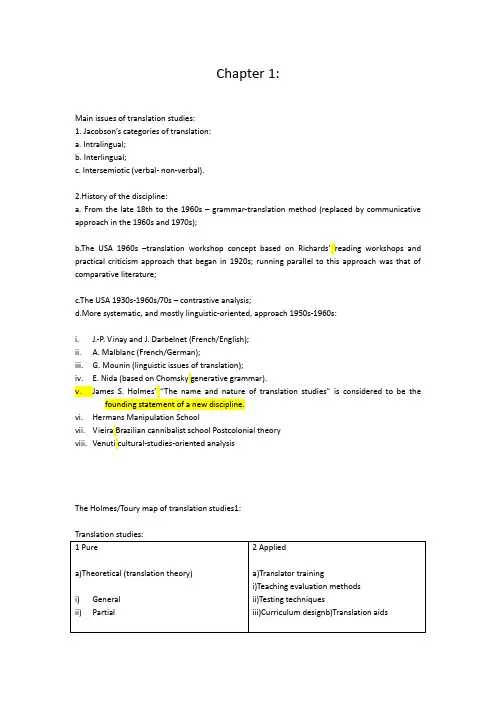
Chapter 1:Main issues of translation studies:1. Jacobson’s categories of translation:a. Intralingual;b. Interlingual;c. Intersemiotic (verbal- non-verbal).2.History of the discipline:a. From the late 18th to the 1960s – grammar-translation method (replaced by communicative approach in the 1960s and 1970s);b.The USA 1960s –translation workshop concept based on Richards’reading workshops and practical criticism approach that began in 1920s; running parallel to this approach was that of comparative literature;c.The USA 1930s-1960s/70s – contrastive analysis;d.More systematic, and mostly linguistic-oriented, approach 1950s-1960s:i.J.-P. Vinay and J. Darbelnet (French/English);ii. A. Malblanc (French/German);iii.G. Mounin (linguistic issues of translation);iv. E. Nida (based on Chomsky generative grammar).v.James S. Holmes’“The name and nature of translation studies”is considered to be the founding statement of a new discipline.vi.Hermans Manipulation Schoolvii.Vieira Brazilian cannibalist school Postcolonial theoryviii.Venuti cultural-studies-oriented analysisThe Holmes/Toury map of translation studies1:Chapter 2: Translation theory before the 20th century:Traduttore, traditore = the translator is a traitorChapter 3: Equivalence and equivalent effect:In the 1950s and 1960s the place of circular debates around literal and free translation took the new debate revolved around certain key linguistic issues, among them those of meaning and equivalence, discussed by R. Jakobson in 1959. Over the following 20 years many further attempts were made to define the nature of equivalence.Jakobson:1.Meaning: the signifier=the signal of the signified (the concept).2.There is no full equivalence between code-units of different languages.3.So, we should substitute not words, but messages.4.Only p oetry is considered ‘untranslatable’ and requires ‘creative transposition’.Nida’s ‘science of translating (subjective):1.Meaning:a.Linguistic;b.Referential (dictionary meaning);c.Emotive (connotative).2.Ways of determining meaning:a.Hierarchical structuring (animal dog, cow etc);ponential analysis (grandmother, mother, cousin etc);c.Semantic structure analysis (spirit can mean demon, angel, god, ghost, ethos, alcohol etc)meaning depending on context.3.3-stage system of translation (Chom sky’s influence: deep/surface structure of a language):SL1 (analysis) X (transfer) Y (restructuring) TL24.Equivalence:a.Formal (form and content);b.Dynamic (equivalent response of: t2 reader on t2 as t1 reader on t1) (closest naturalequivalent).5.Correspondence in meaning must have priority over correspondence in style.6.Reader-based orientation.主要理论1:对等和等效(1950s-1960s)1.代表人物(1)罗曼雅各布逊A.描写了翻译的三类型:语内翻译,语际翻译和符际翻译B.提出语际翻译指用一种语言替换另一种语言种的整个信息C.强调对等的差异性(2)尤金奈达A. 提出形式对等和动态对等B. 提出著名的读者反应理论C. 他的理论以乔姆斯基的转换生成语法为基础(3)皮特纽马克A.提出语义对等和交际对等(4)韦内科勒A.区分了对应和对等B.描写了五种对等:外延意义,隐含意义,文本规则,语用及形式对等Newmark’s semantic and communicative translation:1.Replaces Nida’s division with semantic (resembles formal equivalence) and communicative(resembles dynamic equivalence) translation.2.Nida’s division inoperant if the text is out of TL space and time.3.Dynamic equivalence: are readers ‘to be handed everything on a plate’?4.Semantic translation differs from literal in that it ‘respects context’, interp rets and explains(metaphors). Literal translation is to be the best approach in both semantic and communicative translation. If semantic translation would result in an ‘abnormal’ TT or would not secure equivalent effect in the TL, then communicative translation should win out.Tertium comparationis, an invariant against which 2 text segments can be measured to determine variation.Chapter 4: The translation shift approach:1.Vinay and Darbelnet’s taxonomy:a)Direct (=literal) translation:(1).Borrowing(2).Calque(3).literal translation (word-for-word)b).Oblique translation:(4).Transposition(5).modulation6(6)..equivalence(7).adaptationc)The 7 categories operate on 3 levels:1.the lexicon2. 2.syntactic structures3. 3.the message 9context)4. 4.word order and thematic structure5. 5.connectors [cohesive links, discourse markers, deixis (pronouns anddemonstrative pronouns) and punctuation]d)2 possibilities:1.servitude (obligatory 4 and 5)2. 2.option (non-obligatory)2.Catford’s linguis tic approach (shifts)a.Distinction between: formal correspondence (a particular ST-TT pair) and textualequivalence (a pair of lgs).b.When the 2 concepts diverge, a translation shift occurs –a departure from formalcorrespondence in the process of going from the SL to the TL. There are 2 kinds of shift:1. A level shift (sth is expressed by grammar in one lg and by lexis in another)2. A category shift:i.Structural shifts; ii.Class shifts (word category); iii.Unit/rank shifts (sentence, clause,group, word, morpheme);iv.Intra-system shifts (systems are similar, but not always corresponding).3. van Leuven-Zwart’s microlevel/macrolever translation shifts:a.The comparative model (a detailed comparison of ST and TT and classification of allthe microstructural shifts within sentences, clauses and phrases);b.The descriptive model (a macrostructural model, designed for the analysis oftranslated literature)Chapter 5: Functional theories of translation:K. Reiss’s text typesNord adds to 3 types of language function a fourth ‘phatic’ function, covering lg that establishes or maintains contact between parties involved in the communication (e.g. greetings).Holz-Manttari’s translational action model for non-literary translations with1.its roles and players:a The initiator;b b.The commissioner (contacts the translator);c.The ST producer;d.The TTproducer;e.The TT user;f.The TT receiver.2.Content:a Factual information; b.Overall communicative strategy.3.Form: a.Terminology; b.Cohesive elements.J. Vermeer’s skopos theory: knowing the purpose and the function of translation is crucial (adequacy over equivalence).Ch. Nord’s translation-oriented text analysis:1.2 kinds of translation: a.Documentary translation(a)reader knows that he’s reading a translation;(b)Instrumental translation (a reader doesn’t know that).2.3 aspects of functionalist approaches particularly useful in translator training:a)The importance of the translation commission;b)The role of ST analysis;c)The functional hierarchy of translation problemsChapter 6: Discourse and register approaches:Halliday’s model of language and discourse b ased on systemic functional grammar (lg=communication):Influence:House’s model of translation qu ality assessment:1.Scheme for analyzing and comparing original and translation texts:Translation: a.Overt;b.Covert.Baker’s text and pragmatic level analysis:1.Textual function2.Cohesion3.Pragmatics:a.Coherence (depends on receiver’s expectations and experience of theworld);b.Presupposition (what the speaker supposes a listener shouldknow);c.Implicature (what the speaker implies).Hatim and Mason’s semiotic level of context and discourse:Text elements:1.Stable (translated fairly literally);2.Dynamic (not).Chapter 7: Systems theories:脚注:1.What is being written about.2.Who is communicating and to whom.3.The form of communication e.g. writtenEven-Zohar’s polysystem theory: a literary work as apart of a literary system in the social, cultural, literary and historical framework. It’s important [for choosing the translation strategy] if translated literature has a primary or secondary position in given literature.Toury and descriptive translation studies (DTS):1.Situate the text within the target culture system, looking at its significance oracceptability;2. pare the ST and the TT for shifts, identifying relationships between ‘coupled pairs’of ST and TT segments, and attempting generalizations about the underlying concept of translation;3. 3.Draw implications for decision-making in future translating.Norms of translation behaviour can be reconstructed from:1.The examinations of texts;2. 2.The explicit statement made about norms by translators, publishers, reviewers and otherparticipants in the translation actNorms:1.Initial norm (general translator’s choice):a.Subjection to source culture norms adequate translation;b.Subjection to target culture norms acceptable translation.2.Preliminary norms:a.Translation policy (text selection);b.Directness of translation (ST TT; ST t2 TT).3.Operational norms (the presentation and linguistic matters of the TT):a.Matricial norms (completeness of TT);b.Textual-linguistic norms (TT linguistic material).‘Laws’ of translation:1.Of growing standardization (tending to TT common options);2.Of interference (ST options transferred to TT, negatively or positively).Chesterman’s translation norms:1.Product or expectancy norms;2. 2.Process or professional norms:a.The accountability norm (an ethical norm);b.The communication norm (a social norm);c.The‘relation’ norm (a linguistic norm).Other DTS models:1.Manipulation School (‘a continual interplay between theoretical models and practical casestudies’);mbert and van Gorp – the scheme for the comparison of the ST and TT literary systems andfor the description of relations within them:a.Preliminary data;b.Macro-level;c.Micro-level;d.Systemic context (data compared andnorms identified)Chapter 8 "Varieties of cultural studies" examines Lefevere (1992), who treats translation as "rewriting" and identifies ideological pressures on translated texts. This chapter also looks at the writing of Simon (1996) on gender in translation, and at postcolonial translation theories which stress the part that translation has played in the colonization process and the image of the colonized (cf. Bassnett and Trivedi 1999).Lefevere (1992) treats translation as "rewriting" and identifies ideological and poetological pressures on translated texts. Translation functions are controlled by the following factors:1.Professionals within the literary system;2.Patronage outside the literary system:a.The ideological component;b.The economic component;c.The status component.d.If a-c come from the same source – patronage is undifferentiated; if not – differentiated.3.The dominant poetics:a.Literary devices;b.The concept of the role of literature.Simon compares the status of translation throughout the centuries to that of women’s and presents pro-feminist methods in translation.Postcolonial translation theories:1.Spivak: ‘translationese’ eliminates the identity of politically less powerful individuals andcultures.2. 2.Spivak: compares the status of translation throughout the centuries to that of colonies.3.Power relations : trans lation as the colonizer’s device used against the colonized.4.S. Bassnett and H. Trivedi’s translational linked to transnatio nal (translation=battleground).Brazilian cannibalism: the colonizers and their lg are devoured, their life force invigorating the devourers, who transform it according to their needs.The Irish context: postcolonialism in Europe.Chapter 9: Translating the foreign:the (in)visibility of translation: A. Berman’s ‘negative analytic’ of translation that prevents the foreign coming thr ough. ‘Deforming tendencies’:1.Rationalization;2.Clarification;3.Expansion;4.Ennoblement;5.Qualitative impoverishment;6.Quantitative impoverishment;7.The destruction of rhythms;8.The destruction of underlying networks of signification;9.The destruction of linguistic patternings;10.The destruction of vernacular1 networks or their exoticization;11.The destruction of expressions and idioms;12.The effacement of the superimposition of languages.‘Positive analytic’ = literal translation.Venuti:1.The invisibility of the translator in contemporary Anglo-American culture.2. 2.Domestication (dominant in connection with the translator’s invisibility) –‘the authortowards the reader’.3. 3.Foreignization –‘the reader towards the writer’ – resistancy – minoritizing (desirable).4. 4.‘Call for action’ –‘visibility’ + ‘foreignization’.Chapter 10: Philosophical theories of translation:Steiner’s hermeneutic1 approach to translation as ‘the act of elicitation and appropriate transfer of meaning’. The parts of the hermeneutic moti on:1.Initiative trust;2. 2.Aggression (penetration);3. 3.Incorporation (embodiment);4. pensation (restitution)Ezra Pound’s energy of language: translation as a tool in the cultural struggle, and the revitalization of the past.W. Benjamin’s task of the translator: translation gives the original ‘continued life’; pure language = coexistence of SL and TL; literal rendering of the syntax.J. Derrida’s deconstruction: capturing the meaning? No stability in the signified-signifier (meaning-sign) relationship; the opposition between SL and TL.1.Letter=Judaism=justice;2.Spirit=Christianity=mercy.Chapter 11: Translation studies as an interdiscipline:M. Snell-Hornby’s integrated approach.Harvey’s combination of linguistic analysis and critical theory.。