《英语听力教程3》第二版_Unit9_答案
- 格式:pdf
- 大小:338.24 KB
- 文档页数:5
Part I Getting ready
A.
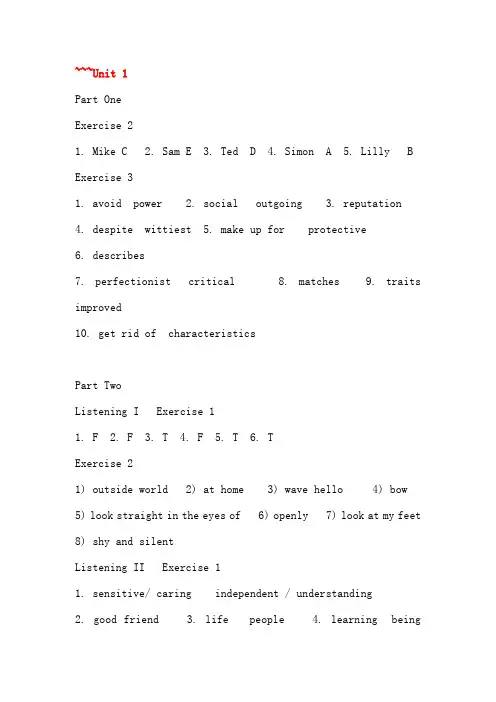
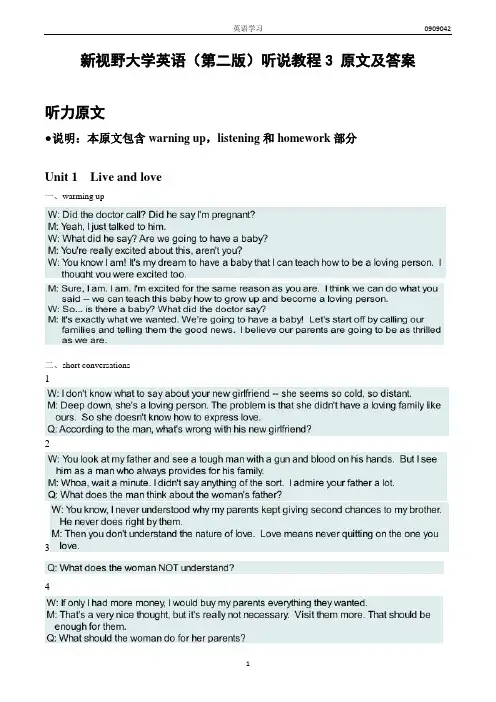
B. Keys: 1: F 2: T 3: F 4: F C. Keys:
1: comedy 2: women 3: scenery 4: One 5: American 6: patriotism 7: European
8: 1920s 9: maturity 10: popular 11: 1943 12: plot 13: hit 14: golden age
15: all over the world 16: mainstay 17: music of Broadway 18: classic Part II Times Square
A. Keys:
1: Because it is the name for the area around where Broadway crosses Forty-Second Street in
Manhattan 2: In 1904, it got its name in an area which was then called Long Acre Square.
3: New York Times newspaper, New Year celebrations, Entertainment, Its huge colorful signs
B. Keys:
1: seedy, drug dealers, pornography or cheap knock-off,
2: be widened, declined, upscale, Times Square clothing and accessories
Part III What is a pub?
A. (Outline) Keys:
1: sign 2: name 3: sale of alcoholic drinks 4: 10:30 a.m. - 3:00 p.m. 5: 6 p.m. - 11 p.m.
6: Sundays 7: 7 p.m. - 10:30 p.m. 8: accommodation B. Keys:
1: That is because they seldom find the word "pub" in the name of a pub. Very often many pubs
have names linked to royalty, sports, popular heroes or great occasions. 2: The first thing to look for is a large sign either hanging over the street or placed on a pole
outside the building. 3: "Saloon Bar" is more comfortably furnished.
4: That means the pub doesn't buy its drinks from one particular brewery only. It isn't tied to a
brewery. C. Keys:
1: coaches welcomed by appointment 2: bar food - lunchtimes only 3: pub accommodation 4: facilities for the disabled 5: a pub of historic interest
Part IV More about the topic: The Song Yankee Doodle
A. Keys:
1: Colonists in the northeast part of America 2: All Americans 3: American soldiers B. Keys:
1: little 2: British 3: British 4: foolish 5: colonists 6: words 7: 1770s
8: soldiers 9: music 10: defeated 11: same 12: represents
Part V Do you know…?
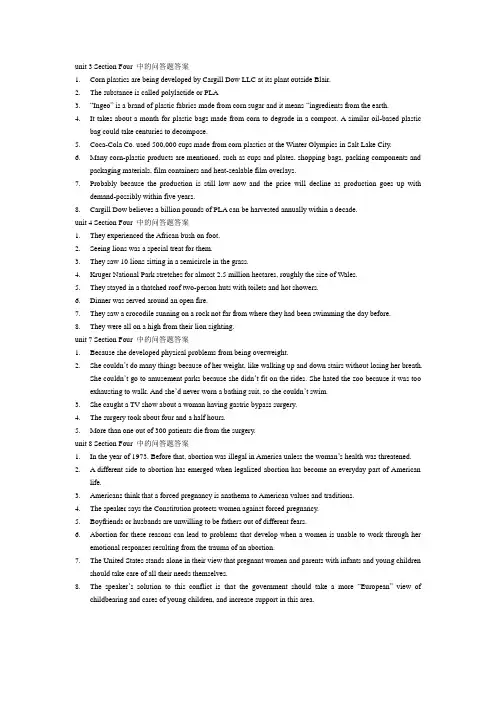
A. Keys: 1:It's Christmas Eve supper. 2:There are 12 traditional dishes on the table.
3:They just break wafers with each other, wishing each other good luck.
4:The children go to the other room, where the big Christmas tree stands. Under the tree there
are some Christmas presents. 5:They go to church at midnight. B. Keys: 1:c 2:a 3:b 4:b 5:c
Tape script
Part I Getting ready
B. A: Are you ready for the trip to the museum in "The Big Apple"? I can hardly wait.
B: "The Big Apple"? What are you talking about?
A: "The Big Apple" is the nickname for New York City. You are going to New York with us, aren't you?
B: Yes, I'm going. I'm especially looking forward to seeing the Museum of Modern Art. There's a
special show of 20th century American painters there. But, tell me, where did the nickname "The
Big Apple" come from?
A: The jazz musicians of the 1920's are responsible for the name. When they played a concert in a city, they called that city an apple. Of course New York was the biggest city in the country and
best place for a jazz concert. So the musicians called it "The Big Apple".
B: Amazing! New York is such a fascinating place and it even has an interesting nickname, one
that it's had for more than 50 years. C.
Most scholars believe that The Black Crook in 1866 marked the beginning of the musical comedy,
integrating music, dance and comedy, with an emphasis on beautiful women and spectacular
scenery. But it was during World War One and after, that the musical developed as a uniquely
American idiom. Song-and-dance man George M. Cohan exploited Americans’ sense of
patriotism, moving away from European influences. In the 1920s, songwriters who included Jerome Kern, George and Ira Gershwin, Richard Rodgers and Oscar Hammerstein II, brought the
musical to maturity with their meticulous crafting of music and lyrics to create the American
popular song.
The modern musical was born in 1943 with Rodgers and Hammerstein’s Oklahoma, which
revolutionized the way dance, music and dialogue was used to develop the plot and characters. Other songwriters of the 1940s, 50s and 60s, including Irving Berlin, Cole Porter, Harold Arlen and
Leonard Bernstein, capitalized on that winning formula to write so many hit musicals, that that
era is now referred to as “Broadway’s golden age.” Since then, American musicals have been
translated and produced on stages all over the world. The music has become a mainstay among
vocalists and jazz musicians, making clear the expression that the music of Broadway is truly “America’s classic music.”