
一般现在时 语法专题讲解
- 格式:pptx
- 大小:2.62 MB
- 文档页数:20


一般现在时1. 一般现在时的用法:表示经常性或习惯性的动作,常与表示频度的时间状语连用。
时间状语:always总是,often经常,usually通常,sometimes有时,hardly几乎不,never 从不,every day/month/year 每天/每月/每年例:I usua lly get up at 7 o’ clock every morning.2. 一般现在时的结构:分为两大类:一类是含有be动词的句子,一类是含有实义动词的句子。
A. Be型be动词的用法:be动词有三种形式is, am, are,I用am,you用are,is连着他(he)她(she)它(it),所有的复数都用are。
1. 肯定句:主语+ am / is / are + 表语They are new students. 他们是新生。
2. 否定句:主语+am/is/are + not + 表语They are not(aren’t) new students.3. 一般疑问句:Are they new students?肯定回答:Yes, they are.否定回答:No, they aren’t.练习:I _____ a boy.Some water ______ in the bottle.I _______a doctor.Helen and I_______in the classroom.Those jackets________my sister’s.含有实义动词B. Do型1.肯定句:主语+行为动词+其它I read English every morning.2.否定句:主语+don’t+动词原形+其它I don’t read English every morning.3.一般:Do +主语+动词原形+其它+?Do you read English every morning?肯定:Yes, I do.否定:No, I don’t.C. Does 型1.肯定:主语+行为动词+其他She gets up at 7 o’ clock every morning.2.否定:主语+doesn’t+动词原形+其他She doesn’t get up at7 o’ clock every morning.3.一般:Does she get up at 7 o’ clock every morning?肯定:Yes, she does.否定:No, she doesn’t.重点:一般现在时的第三人称单数当主语是第三人称单数的时候,谓语动词要变化形式,即动词的第三人称单数形式。
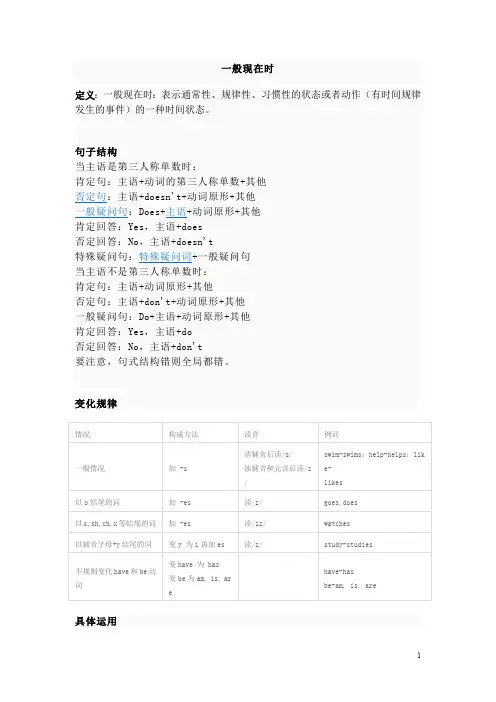

英语学习:一般现在时语法解释大全一、基本构成一般现在时是英语中的一种基本时态,通常用于描述事实、表达习惯、描述计划和预期发生的情况等。
其基本构成如下:1. 主语+ 动词(动词原形)2. 主语+ 动词(第三人称单数形式)+ 宾语二、时态标志一般现在时的时态标志是动词的形式变化,具体如下:1. 动词be的形式:I am, you are, he/she/it is, we/you/they are2. 动词的形式:动词原形(即一般现在时第一人称单数)。
如果是第三人称单数,动词需要加-s或-es(即三人称单数形式)。
例如:he reads books, they like sports等。
三、肯定句肯定句的一般现在时形式是:主语+ 动词原形(或第三人称单数形式)+ 宾语。
例如:I like apples. He goes to school every day.四、否定句否定句的一般现在时形式是在动词前加助动词"do not"(缩写为don't),动词用原型。
例如:I don't like apples. He doesn't go to school every day.五、一般疑问句一般疑问句的一般现在时形式是把助动词"do"或"does"放在句首,动词用原型。
例如:Do you like apples? Does he go to school every day?六、特殊疑问句特殊疑问句的一般现在时形式是以疑问词开头,后面接一般疑问句。
例如:What do you like? Where does he go to school?七、第三人称单数当主语是第三人称单数(he/she/it)时,动词需要变为第三人称单数形式,一般在动词后加-s或-es。
例如:he reads books, she goes to the park等。