介词的用法
- 格式:doc
- 大小:63.50 KB
- 文档页数:14
一、考点聚焦1、介词的分类与语法功能(1)介词是虚词,不能单独作句子成分,必须与名词、代词(或相当于名词的其他词类、短语或从句等)构成介词短语,在句中充当一个成分。
介词分为:简单介词,如at、in、for 等;合成介词,如within、inside、onto、througout等;短语介词,如according to、out of、because of、by means of、in spite of、instead of等。
双重介词,如from behind / above / under、until after等。
分词介词,如considering、including、judging(from / by) 等。
常见的介词宾语:名词、代词、动名词、从句、不定式等。
如:①It is going to rain this afternoon according to the weather forecast.②He quarrelled with her yesterday.③He succeeded in passing the final exam.④I’m still thin king of how I can fulfil the task ahead of time.⑤The professor will give us a talk on how to study English well.(2)介词短语在句中可作表语、定语、状语和宾补等。
如:①This machine is in good condition.(表语)②Where is the key to my bike?(定语)③Nothing in the world could live without air or water.(状语)④She always thinks herself above others.(宾补)2、介词搭配(1)“动词+介词”搭配:注意特定搭配与同一介词与多个动词搭配意义不同的情况。
①rob sb. of sth. / clear the road of snow(“夺去、除去”意义的动词与of 连用)②supply us with food / fill the glass with wine(“供给”意义的动词与with连用)③make a desk of wood / make bread from flour / make the material into a coat(“制作、制造”意义与of、from、into连用)④介词+ the + 部位与动词的关系(=动词+ sb.’s + 部位,可换用)strike him on the head(“击,拍,碰,摸”意义与on连用)catch him by the arm(“抓,拉,拿,扯”意义与by连用)hit the boy in the face(“肚,胸,眼,脸”等人体前部与in连用)⑤p revent(stop, keep)sb. from doing sth.(“阻止,禁止”意义与from连用)⑥persuade(advise, warn)sb. into doing sth.(“说服,建议”意义与into连用)⑦buy sb. for sth.(leave、get、win、gain、lose等“得失”意义与for连用)⑧tell sth.to sb.(show、teach、sing、write、read等“告知”意义与to连用)⑨give sth. to sb.(give、allow、promise、pass、hand等“授予”意义与to连用)注意:⑦⑧⑨可换成buy sb.sth.双宾结构。
⑩say to sb.(suggest、explain、apologize、murmur、whisper与“对象”连用必须用to)不可说suggest sb.sth.。
同一动词与不同介词搭配意义不同。
同一介词与不同动词搭配,意义各异。
reply to the letter回信,sing(dance)to the music和……唱(跳),amount to 达到,加起来有……,devote to把……贡献给,drink to为……干杯,object to反对,look forward to 渴望,come to 苏醒,belong to属于,search for搜……,ask … for … 寻找,use … for用作,leave for前往,take … for误以为,call of倡导,wait for等待,care for喜欢,make up for弥补损失,turn to 求助(救)于,help oneself to随意,agree to同意,compare … to把……比作,send for派人去请(拿)……,sail for驶向,航向,set out for动身去,go in for爱好……。
(2)常见“形容词+ 介词”搭配。
worthy of值得的,glad about sth. for sb.为某人某事高兴,far from离……远,grateful for sth. to sb.为某事感激某人,free from没有……(免除……),proud of(take pride in)自豪,satisfied with (by)满意,sure of / about确信,fond of喜欢,fit for适合,busy with sth.(in doing sth.)忙着干某事,full of充满,ready for准备,similar to相似,wrong with不对;有毛病……(3)“名词+ 介词”要注意习惯搭配和意义区分。
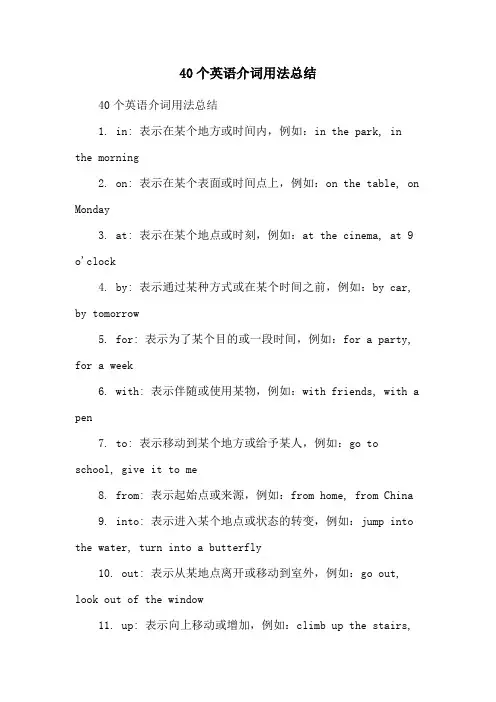
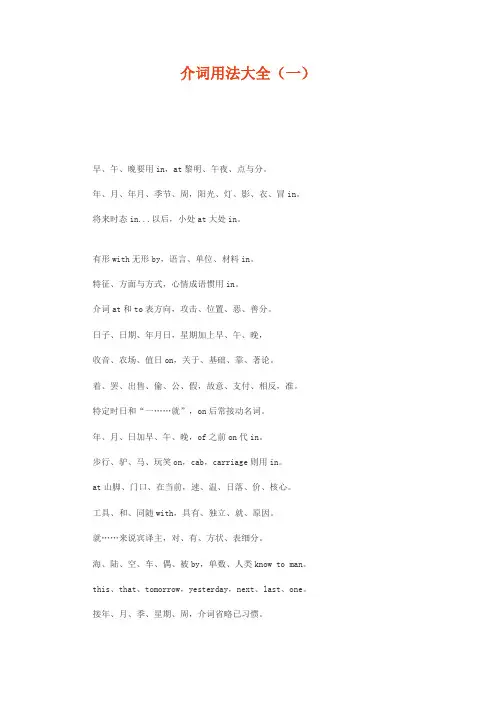
3、核心介词用法归纳与辨析(1)表示时间的介词in的用法如下。
表示在某一较长时间内,如世纪、年、月、季、周等一般用介词in,如:in the 1990s, in the year, in January, in(the) winter / summer / fall / spring, in the first week of May。
还可以用时段名词组成固定短语或词组。
如:in a while, in no time, in the daytime, in a short while, in time, in the morning (afternoon, evening)。
但要注意:①at night / at noon, in the day(在白天),in the night(大夜间)。
②in five days(weeks, months, years)中in意思是“在……以后”。
③in和during表一段时间内两词可互用。
如:in the night, during the night, in the war, during the war。
但略有区别:当接表示“活动”的抽象名词时多用during,接“活动”的动名词及短语时用in。
如:(2)在具体的某一天或某天上午、晚上、前夕,常用on。
(3)表示某一时刻或某一点时间用at,如小时、分钟等。
at breakfast(supper, lunch),at sixat noon (sunrise, sunset, midday, night, midnight, dawn)at the age of 15, at the time of war,但in time of danger/ trouble。
注意:有些时间名词前不接介词。
如:next day、last Sunday、that morning、these yearsone、each、any、every、some、all修饰时,一般不用介词,如some dayone day、yesterday / afternoon,the night before(4)till、until、to的用法。
①till(until)与持续动词连用一般用于肯定句中,与短暂动词连用一般用在否定句中。
如:He waited for me till twelve o’clock.He didn’t get up till(until) 10 a.m.(不可用to).但注意:在句首出现或强调句型中一般不用till而用until。
如:Not until 9 a.m.did Mr.Smith come back to school.②to表“终结”时常用和from连用,但要注意不与from连用时的意义。
如:from July to September, from six to(till)eight(从……到……为止),但from morning till night(从早到晚),不能用to。
from … to常构成习惯搭配,不可换用其他介词。
(A)表持久连续、传递、转移的含义。
from time to time(不时,有时),from day to day (天天),from hand to hand(不断传下去),from place to place(处处,到处),from side to side(左右摇摆),from door to door(家家户户),from house to house(挨家挨户),from shop to shop(一个商店接一个商店)。
(B)表起始终止的全过程或程度加深、状态变化。
from beginning to end(从头到尾,自始至终)(from the beginning to the end of…);from hand to mouth(仅能糊口),from bad to worse(越来越糟),from head to foot(从头到脚),from top to bottom(整个地,彻底地),from top to toe(全身),from start to finish(自始至终,从头到尾)。
(C)from one + 名词+ to another表示“依次”。
如from one car to another(顺着车厢依次地)。
(D)名词+ by + 同一单数名词,表示“一个一个地”,要与from … to短语区别开:one by one 一个一个地;little by little(bit)一点一点地;step by step 一步一步地,逐渐地(但by and by 不久以后);sentence by sentence逐句地;day by day一天一天地;side by side(with…)(和……)并肩,一起;shoulder to shoulder肩并肩地,齐心协力;hand in hand 手拉手,紧紧地;face to face面对面。