直接引语变间接引语
- 格式:doc
- 大小:34.50 KB
- 文档页数:2
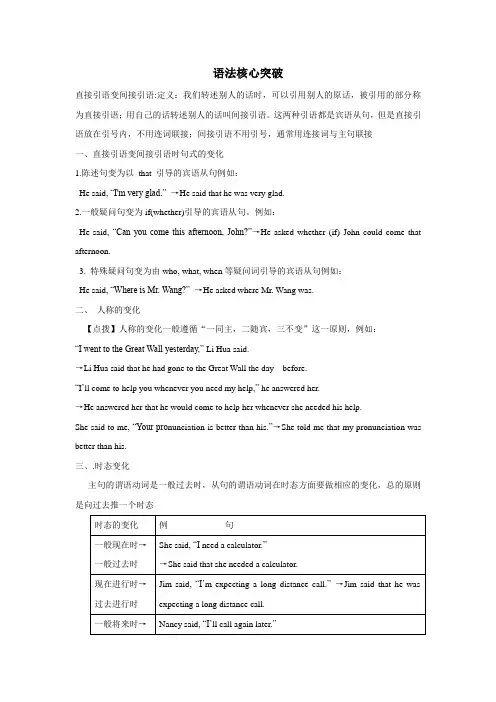
直接引语变间接引语直接引语变间接引语就是写成宾语从句或动词不定式短语,要注意以下几点:1. 直接引语为陈述句时如何变为间接引语的方法将直接引语变为由that引导的宾语从句跟在引述动词之后(that引导的宾语从句跟在引述动词之后也可省略)。
如:He said, “I want to buy a dictionary.” →He said (that) he wanted to buy a dictionary.注:(1) 若引述动词用的是say to sb这样的句型,则通常改为tell sb::“I hope you can come,” he said to me. →He told me that he hoped I could go. (2) 若直接引语是两个并列的陈述句,要注意在第二个宾语从句前加连词that:He said, “I am tired and I want to have a rest.”→He said that he was tired and that he wanted to have a rest.在此种情况下,引导第一个宾语从句的that在此种情况下,引导第一个有时可以省略,但引导第二个宾语从句的that通常不省略,以免误解。
2,直接引语是一般,选择或反问疑问句,变成间接引语,由连词whether或if 引导.将直接引语变为由if 或whether if 引导的宾语从句跟在引述动词之后:“Have you been there?” he asked. →He asked if I had been there.注:(1) 改为宾语从句的间接引语要用陈述句词序。
(2) 若直接引语的引述动词为say,改成间接引语应将其改为ask等:“Do you like it?” he said. →He asked if [whether] I liked it.(3)大多数情况下,if ,whether 可以互换,但句中出现or not,或放在介词后作连接词,只用whether.例如:She asked whether he could do it or not.. They cried out whether he was all right.3. 直接引语为特殊疑问句时如何变为间接引语的方法将直接引语变为由“疑问词” who ,whom, whose, how, when, why, where等引导的宾语从句跟在引述动词之后:He said, “Jim, when is the next train?” →He asked Jim when the next train was.注:(1) 改为宾语从句的间接引语要用陈述句词序。
(2) 若直接引语的引述动词为say,改成间接引语应将其改为ask等:He said, “Where is the station?”→He asked where the station was.”4. (1)直接引语如果是祈使句,间接引语应改为"tell(ask, order, beg等) sb (not) to do sth."句型。
如:"Don’t make any noise," she said to the children. →She told (ordered) the children not to make any noise. "Bring me a cup of tea, please," said she.→She asked him to bring her a cup of tea.(2)直接引语如果是以“Let…s”开头的祈使句,变为间接引语时,通常用“suggest +动句词(或从句)。
”如:He said, "Let’s go to the film." →He suggested going to the film.或He suggested that they should go to see the film.5. 一些注意事项(1) 变时态:直接引语在改为间接引语时、时态需要做相应的调整。
现在时它需改为过去时态;过去时态改为完成时;过去完成时则保留原来的时态。
如:1)She said. "I have lost a pen."→She said she had lost a pen2)She said. "We hope so."→She said they hoped so.3) She said. "He will go to see his friend。
"→She said he would go to see his friend。
注意: 在以下几种情况下。
在直接引语变为间接引语时,时态一般不变化。
①直接引语是客观真理。
"The earth moves around the sun and the moon moves around the earth, the teacher told me. → The teacher told me the earth moves around the sun and the moon moves around the earth。
②直接引语是过去进行时,时态不变。
如:Jack said. "John, where were you going whe n I met you in the street?"→Jack asked John where he was going when he met him in the street。
③直接引语中有具体的过去某年、某月、某日作状语,变为间接引语时,时态不变。
如:Xiao Wang said. "I was born on April 2l, 1980。
" →Xiao Wang said he was born on April 20, 1980。
④直接引语如果是一般现在时。
表示一种反复出现或习惯性的动作,变间接引语,时态不变。
如:He said, "I get up at six every morning。
" →He said he gets up at six every morning。
⑤如果直接引语中的情态动词没有过去时的形式(例:ought to,had better, used to)和已经是过去时的形式时,(例:could, should, would, might)不再变。
如:Peter said. "You had better come have today。
" →Peter said I had better go there that day。
(2)直接引语变间接引语时, 指示代词,时间,地点状语作相应的变化.例:this—that , these—those, ago—before, here---therenow 现在→ then 那时,当时/ today 今天→ that day 那天/ tonight 今晚→that night 那天晚上this week (month, year) 本周(本月,今年)→ that week (month, year) 上周(上个月,去年)yesterday 昨天→the day before 前一天/ the day before yesterday 前天→ two days before 前两天last week (month, year) 上周(上个月,去年) →the week (month, year) before 前一周(前一个月,前一年)( two days (years) ago 两天(年)前 two days (years) before 两天前tomorrow 明天→ the next day 第二天 / next week (month, year) 下周(下个月,明年) → the next week (month, year) 第二个星期(月,年)注:以上变化有时应视情况而定①若在当时转述,now不必改为then;若在当天转述,today, yesterday, tomorrow等不必改为that day, the day before, the next day等;若在当周转述,this week, last week 不必改为that week, the last week;若在当年转述,this year, last year 不必改为that year, the last year等。
②若场所和地点不发生改变,this和that、here和there、come和go、bring和take也可不变。
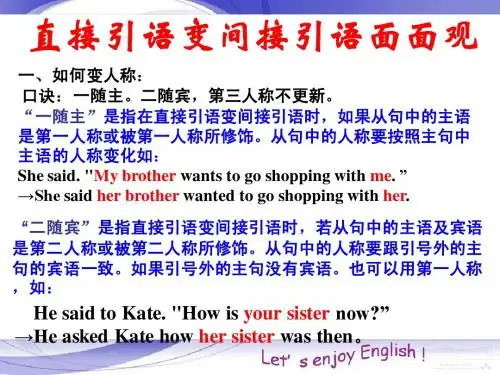
(3)直接引语是复合句,以since, when, while 引导的状语从句,变成间接引语时, 只改变主句的时态,不改变从句的时态.例如:He said : "Jim is doing his homework when his father came in."He said that Jim was doing his homework when his father came in.(4)间接引语一定要用陈述句的语序,即主,谓,宾的顺序.例如: They asked: " where are you from "→They asked where you were from.(5) 引语中人称的变化“一随主”是指在直接引语变间接引语时,如果从句中的主语是第一人称或被第一人称所修饰。
从句中的人称要按照主句中主语的人称变化如:She said. "My brother wants to go with me. "→She said her brother wanted to go with her.“二随宾”是指直接引语变间接引语时,若从句中的主语及宾语是第二人称。
或被第二人你所修饰。
从句中的人称要跟引号外的主句的宾语一致。
如果引号外的主句没有宾语。
也可以用第一人称,如:He said to Kate. "How is your sister now?"→He asked Kate how her sister was then。
“第三人称不更新”是指直接引语变间接引语时。