美国文学课件Whitman and his Poems
- 格式:doc
- 大小:78.00 KB
- 文档页数:38
Whitman and his PoemsI. Review1.First, let’s read again the following,and try to think each of them: Example 1:When we speak of nature in this manner, we have a distinct but most poetical sense in mind. We mean the integrity of impression made by manifold natural objects. It is this which distinguishes the stick of timber of the wood-cutter, from the tree of the poet. (Nature by Ralph Waldo Emerson, par. 3, p. 62)当我们这样谈论自然时,我们在心里有一种最明确但也最富诗意的意义。
我们指的是多种多样的自然物体所造成的印象的完整性,就是这一点使伐木工人的树枝和诗人的树枝区别开来。
Please read the following poem, and try to know the distinction of the willow twigs between the poet and timber of the wood-cutter.咏柳碧玉妆成一树高,万条垂下绿丝绦。
不知细叶谁裁出,二月春风似剪刀。
——唐贺知章“碧玉妆成一树高,万条垂下绿丝绦”,深深地抓着了垂柳的特征,在诗人的眼中,它似美女的化身。
高高的树干,就像她亭亭玉立的风姿,下垂的柳条,就像她裙摆上的丝带。
在这里,柳就是人,人就是柳,两者之间仿佛没有什么截然的分别。
而且“碧玉”也有双关的意义。
既在字面上与柳树的翠色相合,又指年轻貌美的少女,与下面的“二月春风”恰相呼应——这是早春的垂柳,还未到夏秋之际亭亭如盖、树荫清圆的时候。
然而,更妙的以下两句:“不知细叶谁载出,二月春风似剪刀。
”把乍暖还寒的二月春风由无形化为有形,它显示了春风的神奇灵巧,并使《咏柳》成为咏物诗的典范之作。
Example 2:To speak truly, few adult persons can see nature. Most personsdo not see the sun. At least they have a very superficial seeing. The sun illuminates only the eye of the man, but shines into the eye and the heart of the child. (Nature by Ralph Waldo Emerson, par. 4, p. 62)老实讲,您能够看见自然的成年人很少,人们大都看不见太阳。
即使看见,他们的印象也很浮浅。
太阳只会照亮成人的眼睛,却能照进孩子的眼睛和心理。
Read the following poems on the sun, trying to understand different poet’s different feelings and perspectives to the same object: Poem 1:太阳太阳,你是灯光,给宇宙照明。
没有了你,宇宙将会一片漆黑。
太阳,你是肥料,让花草树木茁壮生长。
没有了你,地球就会变成枯枝败叶的海洋。
太阳,我们不能离开你,离开了你,宇宙就一团糟。
太阳,你是光明,你是温暖。
太阳,我爱你!Poem 2:阳光灿烂灿烂的阳光,在这个严寒冬日的早晨,略微让人感到一丝的温暖。
啊!美好的阳光啊,你带给了人类温暖,你带给了人类美好。
在每一个灰暗的日子里,有了你的陪伴,世界将一片光明!Poem 3:七月的太阳七月的太阳,最好你不要出来。
你总是高高在上,盛气凌人。
即便是你,淹没在云头半隐半藏,大气层也透着你的火气和高温。
作为军人,我走在你的光焰照耀之下,更渴望晴天霹雳,让闪电把你的光芒退走,让细雨给我们送一丝清凉。
七月的太阳,你不要心痛军人的汗水而长时间离开。
天空有了太多的绵绵阴雨,洪水泛滥,人们才知道你热烈和奔放的真诚。
七月的太阳,绿色的军装在你热诚中,走向田野。
军人的忠诚和果敢,离不开你火爆的锤炼,大地的丰富和色彩,也离不开你电闪雷鸣的泪雨。
火红的七月,我们顶着太阳出发。
一路阳光,一路剪影。
满眼都是绿色,未来的收成。
满眼都是绿色,流汗的钢枪。
Example 3:Not the sun or the summer alone, but every hour and season yields its tribute of delight; for every hour andchange corresponds to and authorizes a different state of the mind, from breathless noon to grimmest midnight. Nature is a setting that fits equally well a comic or a mourning piece. In good health, the air is a cordial of incredible virtue.. Crossing a bare common, in snow puddles, at twilight, under a clouded sky, without having in my thoughts any occurrence of special good fortune, I have enjoyed a perfect exhilaration. (Nature by Ralph Waldo Emerson, line 6 to line 13 from the top, p. 63)不仅仅是太阳或夏天,而是每一时刻、每一季节都产生了自己快乐的贡物;因为从闷热的中午到最冷酷的午夜,一切时间和变化都应和着不同的心境,并且认可这种心境。
自然是喜剧或悲剧情节都配合得同样恰当的布景。
身体健康的情况下,空气是一种令人难以相信的美德的兴奋剂。
薄暮时分,在多云的天空下,走向雪泥纷乱的荒原去,心里没想到任何特别幸运的事情,我享受着完全的欣喜。
Read another poem depicting the “sun”:遥望太阳我站在地平线上,遥望刚刚醒来的太阳。
它双手揉着惺忪的眼眶,单纯又天真纯洁而可爱,像幼小的孩童一样!我站在地平线上,遥望天路中央的太阳。
它刺目耀眼的光。
照射着四面八方,每个角落都有它的影子掩藏,忽来一层浓重的云彩把它遮挡。
又怎能遮挡住它一身的能量?我站在地平线上,遥望将要睡下的太阳。
它一路奔忙,累得只剩下一点微弱的光,像是从一家农户的窗里,射出的一缕昏黄的灯光。
难道它已经找好了地方在西山的一张席梦思上,进入甜美的梦乡?Please read and appreciate some ancient Chinese poems or lines describing “snow”:梅花逊雪三分白,雪却输梅一段香。
——卢梅坡白雪纷纷何所似,撒盐空中差可似。
北风卷地百草折,胡天八月即飞雪。
忽如一夜楚风来,千树万户梨花开。
——岑参《雪--这个冬天不能承受之轻》漫天飞舞的白色精灵,亲吻着大地。
那是天使的眼泪坠落凡间,带着沉淀的凄美。
明知道凡间是你生命的终点,却飞蛾扑火般决绝,铺天盖地,无声无息,将大地的阴霾涤清,唤醒春心,片片白雪,你的生命是这个冬天不能承受。
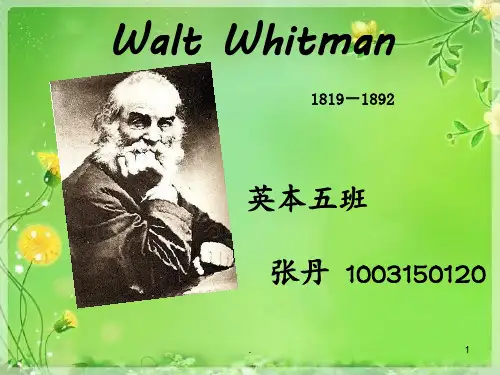
II. An Introduction to Whitman1. Whitman—Poet of the PeopleThe other major writer at mid-century, Walt Whitman, was unique. His Leaves of Grass (1855) was new in form and in content. Whitman wrote about his country in a way never done before. At first the little book of strange verse seemed a failure. Emerson, however, recognized its greatness, and now most people agree that it was the first book of truly American poetry.Here, at last, was the fresh, distinguished but destined to create an art wholly American. Through Whitman's poetry the new nation is caught in its largeness, its variety, and its great energy. One's-Self I Sing and his major poem, Song of Myself, are brilliant and complexutterances of the human spirit freed in the New World.Walt Whitman's poems are a love letter to his country. To accomplish his purpose of singing the praise of the untrammeled American spirit, Whitman forsook the confining poetic forms of his day. His poems are melodic chants, suited to the ear.Readers around the world have turned to Whitman as the spokesman for the new democratic society. No poet has celebrated that society with more enthusiasm or more poetic genius than Walt Whitman. His verses are a striking contrast to the neat meters and rhymes of conventional poetry previously written. Since Whitman's death, his writing has influenced many otherAmerican poets. (See also Whitman, Walt.)III. 自由诗(Free Verse)自由诗(free verse)比传统的素体诗或无韵诗更加自由,它没有尾韵,根本不考虑节奏的一致、诗行的整齐。