
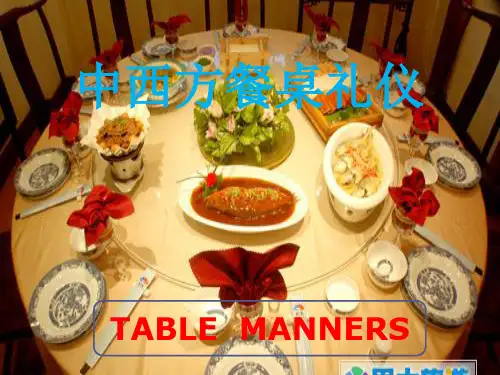
中西方餐桌礼仪 英文介绍
- 格式:ppt
- 大小:5.71 MB
- 文档页数:32

西方和中国的餐桌礼仪差异英语作文
全文共3篇示例,供读者参考
篇1
Differences in Table Manners between the West and China
Table manners are an important aspect of dining etiquette in
both Western and Chinese cultures. However, there are
significant differences between the two when it comes to dining
etiquette. In this article, we will explore the differences in table
manners between the West and China.
1. Seating arrangement:
In Western cultures, there is no strict seating arrangement at
the dining table. Guests can often choose their own seats and
may switch seats during the meal. In contrast, Chinese dining
etiquette places a significant emphasis on seating arrangement.
The host is usually seated at the head of the table, with the most
important guest seated to the right. The rest of the guests are
seated in order of importance, with the least important guest

中西方餐桌礼仪差异 九年级英语作文
全文共6篇示例,供读者参考
篇1
Differences in Table Manners Between East and West
Hello everyone! Today, I want to talk about something
interesting—differences in table manners between East and
West. Table manners are the way we behave while eating, and
they can vary a lot from one culture to another. Let's explore
some of these differences!
In Western countries, it is common to eat with a knife, fork,
and spoon. Each person has their own set of utensils, and they
use them to eat their food. It's important to hold the knife in the
right hand and the fork in the left hand. When eating, they cut
their food into small pieces and then eat it with the fork. Also, it
is polite to keep your elbows off the table while eating.
In China and many other East Asian countries, we use
chopsticks to eat. Chopsticks are thin, long sticks that are usually

中西方的餐桌礼仪英文作文
英文:
When it comes to table manners, there are some key
differences between Western and Chinese cultures. In the
West, it is considered polite to place your napkin on your
lap as soon as you sit down at the table. It is also
customary to keep your hands visible and not to rest your
elbows on the table while eating. In addition, it is
important to chew with your mouth closed and to avoid
talking with food in your mouth.
On the other hand, Chinese table manners are quite
different. In China, it is common to use chopsticks instead
of utensils, and it is considered polite to hold the rice
bowl close to your mouth while eating. It is also
acceptable to make some noise while eating, such as
slurping noodles, as it shows that you are enjoying the
meal.
In terms of seating arrangements, Western culture

中西方餐桌礼仪差异英语
-CAL-FENGHAI.-(YICAI)-Company One1 Differences between Chinese and Western table manners
With the development of global economy, cross-culture
communication has become more and more frequent, and the
differences between Chinese and western culture have become more
obvious, especially the differences of table manners.
Arrangement of seat in China
In China, people used to use the number of the tables to define the size
of banquet. In small banquets which have two tables, the table on the
left or farther to the portal is the top table. At bigger banquets that have
three or more tables, the rules are much more complicated.
Generally, seats that closer to the top table take precedence. For
example, on the wedding party, family members of the bride or the
leaderships are arranged to the table that closest to the top table. Hosts