
Unit4 wild animals
- 格式:ppt
- 大小:4.33 MB
- 文档页数:29

8A Unit4 Wild animalsReading执教者:高娟Teaching aims:1. Knowledge objectives:To read the passage about giant pandas and get the main ideas of the whole text.To get students to learn some words and phrases, get to know the growth ofgiant pandas, the problems giant pandas are facing and how to protect them. 2. Emotion objectives:To encourage the students to do as much as they can to help the wild animals.To activate the students' awareness of protecting wild animals and the nature. 3. Ability objectives:To improve students' ability of communication.To develop students' comprehensive language competence.Teaching aid: A multi-media computer, a tape recorderTeaching approach: Communicative ApproachTask-based Language ApproachCooperative Language Learning ApproachTeaching procedures:Step1. Revision1. T says: Yesterday we learned something about wild animals. Do youremember them?(Students answer: Yes.)2. T says: OK, now let's play a guessing game. Read the descriptions of theseanimals and tell us what wild animals they are.a). I come from Australia. I jump with my babies in my pocket. Who am I ?b). I am the biggest animal on land, I have a long nose and eat grass. Who amI ?c). I am small and have a big tail. I like climbing trees and eating nuts. Whoam I ?d). I am large and heavy. I have thick fur. I like eating sweet food and fish.Who am I ?e). I have yellow fur and black stripes. I look like a cat, but much bigger thana cat. Who am I ?f). I live in the sea. I am very friendly and clever. I can do lots of tricks inwater. Who am I ?g). I walk in the desert. Each eye of mine has three eyelids. Who am I ?h). I am a beautiful black and white animal. I look like a bear. I live only inChina . My greatest hope is to take a colour photo. Who am I? (When the students say out the answers, show the pictures on the screen.)Step2. Presentation1. Ask : Do you like wild animals? (Yes/ No.)Which is your favourite wild animal?Why do you like it/them?Students answer the questions.Teacher says: Do you know Miss Gao's favourite wild animal?--Giant pandas.I think they are very lovely. They are friendly to people and won't hurt people.Show a picture of a giant panda. Do you know anything about giant pandas?2.Teach new words by asking some questions about giant pandas.a). Where do giant pandas live?In the wild / In the forest/ In giant panda reserves..b). What do giant pandas eat?They eat bamboo shoots and leaves.3. Ask: But when a giant panda was born , can they eat bamboo shoots orleaves?(No.)What do they eat when they are at birth? And what are baby pandas like atbirth?Tsays: Today we have a chance to learn more about a giant panda.Step3. Fast-ReadingPlease read the passage as quickly as you can to find out the name of thegiant panda.Step4. Listening and scanningListen to the tape and then try to complete the chart.Age The growth of Xi Wang1 day weigh 100g10 days look like a white mouse4 months weigh 10kg, start to go outside her home6 months start to eat bamboo shoots and leaves8 months not a small baby any more,grow into a healthy young giantpanda,weigh 35kg20 months have to look after herselfRead the paragraphs1-3 and then let the Ss make the sentences with the words to introduce the growth of Xi Wang.Have a look at the pictures of the growth of Xi Wang and complete Part on Page61. Let the students introduce the growth of Xi Wang with their own words.Step5. Presentation1. Tsays: Do you think giant pandas are lovely? (Yes). But they are in danger. It'svery difficult for them to live in the wild. What problems are they facing?2. Listen to the tape and find out the problems they are facing. Problems ActionsIf hunters__________, they ___________. make giant panda reserves biggerIf farmers__________,giant pandas__________.build more reservesIf people___________, they ____________. encourage farmers to leave the giant panda reserves3. Let the students read the three paragraphs again and then say out the problems giant pandas are facing without looking at the books.4. Tsays: We have known the problems giant pandas are facing. Can we do something to help? OK, read the rest part of the passage and complete the chart above.5. Students say out the actions with their own words.Step6. Whole-readigRead the whole passage by themselves.Step7. An interviewLet one student stand in front of the class to act as Xi Wang. Others are all interviewers. Ask "Xi Wang"the questions they are interested in.Step8. DiscussionHold a further discussion: Why do we call it Xi Wang? Can you find another name for her?Step9. ClassworkFinish an exercise paper.。

Unit 4 Wild Animals 词组Phrases:1. look (taste) delicious 看起来(尝起来)味道很好2. learn a lot (more) about sth. 有关某事学到许多(更多)3. in danger 处在危险状态之中4. out of danger 脱离危险5. join the Wild Animals Club 加入野生动物俱乐部6. write a report on giant pandas 写一篇有关大熊猫的报道7. a dolphin show 一次海豚展8. baby pandas 小熊猫9. look like a white mouse 看上去像一只白鼠10. call her Xi Wang 把她叫作“希望”11. be born 出生12. weigh 100 grams 称得100克重13. at four months 在四个月时14. start to do sth. 开始做某事15. go outside her home for the first time 第一次走出她的家门16. eight months later 八个月以后17. grow into 长成18. at the very beginning 在一开始时19. drink her mother’s milk 吃她妈妈的奶20. up to 14 hours a day 一天多达14个小时21. eat bamboo shoots and leaves 吃竹笋和竹叶22. look after oneself 照顾某人自己23. survive in the wild 在野外生存24. cut down trees 砍树25. have nowhere to live 没有居住的地方26. leave sb. on one’s own (alone, by oneself) 把某人单独留下27. two whole days 两整天28. take ……away 把……带走29. need help with 需要某方面的帮助30. take the following actions to protect giant pandas 采取下列行动来保护大熊猫31. make giant panda reseves bigger 使大熊猫自然保护区变得更大32. encourage sb. to do sth. 鼓励某人干某事33. look sad 看上去很伤心34. look sadly at 难过地看着…35. protect …..from…保护….免受…..之害36. keep doing /keep sb. doing sth. 一直做某事(让某人一直做某事)37. keep sb. from doing sth. 阻止某人干某事38. keep … safe from danger 保持….安全远离危险rge areas of land (forests) 大面积陆地( 森林)40. stay alive 活着的41. the growth of Xi Wang “:希望”的成长过程42. many foxes 许多狐狸43. male (female) wolves 雄(雌)性的狼44. polar bears 北极熊45. walk through a rainforest 步行穿过热带雨林46. run the other way 转身跑开了47. North Africa 北非48. have time =be free 有空49. at noon 在中午50. see the feeding of animals 看见动物的喂养51. the Monkey Hill 猴子山52. have fun =enjoy oneself 玩得很开心53. watch the animals carefully 仔细观察动物54. catch fish from the water 从水中抓鱼55. step on a snake 踩到一条蛇身上56. spit poison 喷出毒57. spit at sb. 向某人吐口水58. hunt for their own food 寻找他们自己的食物59. live as a family 以家庭形式居住60. live in family groups 以家庭形式群居61. learn how to catch other animals 学会怎样抓到其他动物62. black stripes 黑色的花纹63. be good at hunting other animals 擅长于捕猎其他动物64. take (have ) medicine 服药65. make medicine from…用……制药66. good eyesight,hearing and smell 好的视力,听力和嗅觉67. be friendly towards (to) each other 互相友好68. work as a team 以团队形式工作69. do sth. for fun 为了取乐做某事70. the loss of living areas (health) 生活区(健康)的丧失71. clothes made of animal fur 用动物的毛制成的衣服72. lose one’s life (lives) 失去某人的生命73. continue to do (doing) sth. 继续做某事74. be suitable for …. (doing sth.) 适合做某事75. train sb. as a …把某人培养成为一个..76. train sb. to do sth. 培养某人做某事77. many mice 许多老鼠78. walk upright 直立行走79. forest areas 森林面积80. make new farmland 开垦新的农田81. take the land 占用土地82. make a lot of money 赚很多钱83. sell elephants’ tusks 卖象牙84. spend a lot of time doing sth. 花很多时间做某事85. at a time 在一次86. get smaller and smaller (larger) (数量)变得越来越少 (多)87. do something to 采取措施来做某事88.sharp paws 尖尖的爪子89. move around 四处移动90. in the daytime 在白天91. feel frightened 感觉害怕92. kill bears for their fur and paws 杀死熊来获取他们的毛和爪子93. get more and more beautiful 变得来越美丽Sentences:1. Can I have some bread? 我可以吃一些面包吗?2. If I don’t have food, I die. 如果我不吃食物,我会死的。
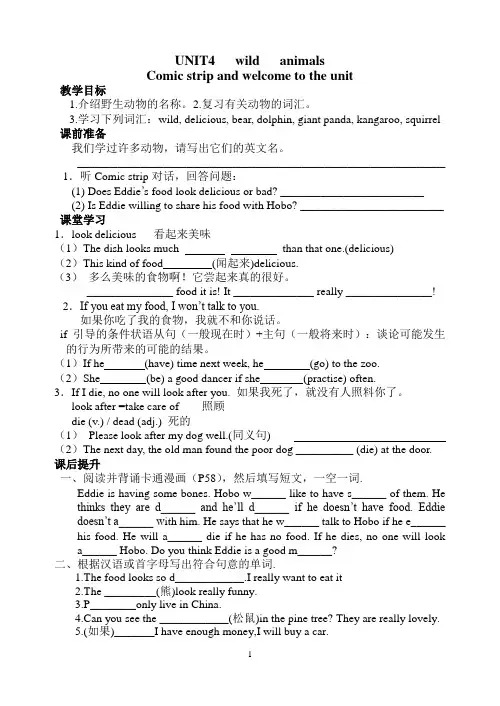
UNIT4 wild animalsComic strip and welcome to the unit教学目标1.介绍野生动物的名称。
2.复习有关动物的词汇。
3.学习下列词汇:wild, delicious, bear, dolphin, giant panda, kangaroo, squirrel 课前准备我们学过许多动物,请写出它们的英文名。
________________________________________________________________ 1.听Comic strip对话,回答问题:(1) Does Eddie’s food look delicious or bad? _________________________(2) Is Eddie willing to share his food with Hobo? _________________________ 课堂学习1.look delicious 看起来美味(1)The dish looks much than that one.(delicious)(2)This kind of food (闻起来)delicious.(3)多么美味的食物啊!它尝起来真的很好。
_______________ food it is! It ______________ really _______________! 2.If you eat my food, I won’t talk to you.如果你吃了我的食物,我就不和你说话。
if 引导的条件状语从句(一般现在时)+主句(一般将来时):谈论可能发生的行为所带来的可能的结果。
(1)If he (have) time next week, he (go) to the zoo.(2)She (be) a good dancer if she (practise) often.3.If I die, no one will look after you. 如果我死了,就没有人照料你了。