
九年级英语全册Unit4Iusedtobeafraidofthedark第4课时课件新版人教新目标版
- 格式:ppt
- 大小:14.36 MB
- 文档页数:9

人教版英语九年级Unit 4《I used to be afrd of the dark》全单元说课稿一. 教材分析人教版英语九年级Unit 4的主题是“I used to be afrd of the dark”,通过讲述一个人过去害怕黑暗,但现在不再害怕的故事,引导学生学习一般过去时态和过去习惯的表达方式。
本单元还包括两个任务,分别是讨论过去的习惯和谈论过去发生的事情。
教材内容丰富,贴近学生生活,有利于激发学生的学习兴趣和积极性。
二. 学情分析九年级的学生已经掌握了基本的英语语法和词汇,具备一定的听说读写能力。
但他们对过去时态的理解和运用还不够熟练,需要通过本节课的学习进一步巩固。
此外,部分学生可能在表达自己的过去经历时存在语言障碍,需要教师的引导和鼓励。
三. 说教学目标1.知识目标:学生能够掌握一般过去时态的构成和用法,学会表达过去的习惯和经历。
2.能力目标:学生能够运用一般过去时态进行交流,提高口语表达能力。
3.情感目标:学生能够克服恐惧,积极面对生活中的困难。
四. 说教学重难点1.重点:一般过去时态的构成和用法。
2.难点:过去习惯的表达方式和过去发生的事情的描述。
五. 说教学方法与手段1.情境教学法:通过设定情境,让学生在实际语境中学习和运用一般过去时态。
2.任务型教学法:通过完成两个任务,引导学生积极参与课堂活动,提高口语表达能力。
3.合作学习法:学生分组讨论,互相交流,共同完成任务。
4.激励评价法:教师及时给予鼓励和评价,激发学生的学习兴趣和自信心。
六. 说教学过程1.导入:教师通过提问学生是否有过害怕黑暗的经历,引出本节课的主题。
2.新课呈现:教师通过讲解和示范,教授一般过去时态的构成和用法。
3.实践环节:学生分组讨论过去的习惯和经历,用一般过去时态进行交流。
4.任务一:学生分组完成第一个任务,讨论过去的习惯,并展示给其他小组。
5.任务二:学生分组完成第二个任务,谈论过去发生的事情,并展示给其他小组。
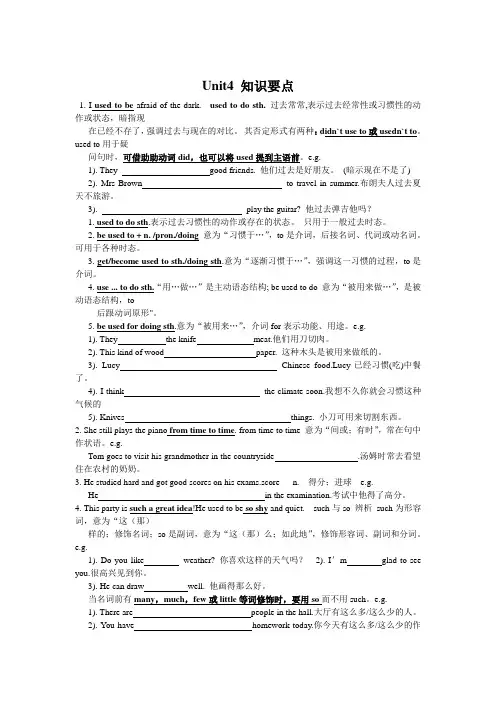
Unit4 知识要点1. I used to be afraid of the dark. used to do sth.过去常常,表示过去经常性或习惯性的动作或状态,暗指现在已经不存了,强调过去与现在的对比。
其否定形式有两种:didn`t use to或usedn`t to。
used to用于疑问句时,可借助助动词did,也可以将used提到主语前。
e.g.1). They good friends. 他们过去是好朋友。
(暗示现在不是了)2). Mrs Brown to travel in summer.布朗夫人过去夏天不旅游。
3). play the guitar? 他过去弹吉他吗?1. used to do sth.表示过去习惯性的动作或存在的状态。
只用于一般过去时态。
2. be used to + n. /pron./doing意为“习惯于…”,to是介词,后接名词、代词或动名词。
可用于各种时态。
3. get/become used to sth./doing sth.意为“逐渐习惯于…”,强调这一习惯的过程,to是介词。
4. use ... to do sth.“用…做…”是主动语态结构; be used to do 意为“被用来做…”,是被动语态结构,to后跟动词原形"。
5. be used for doing sth.意为“被用来…”,介词for表示功能、用途。
e.g.1). They the knife meat.他们用刀切肉。
2). This kind of wood paper. 这种木头是被用来做纸的。
3). Lucy Chinese food.Lucy已经习惯(吃)中餐了。
4). I think the climate soon.我想不久你就会习惯这种气候的5). Knives things. 小刀可用来切割东西。
2. She still plays the piano from time to time. from time to time 意为“间或;有时”,常在句中作状语。

初中英语·人教版·九年级全一册——Unit 4 I used to be afraid of the dark.Unit 4 第4课时(Section B 2c-Self Check)测试卷测试时间:20分钟I.阅读理解Five years ago, my mother gave birth to a brother for me when I was 8. I have learned a lot from getting along with him.After he was born, I almost became a babysitter. I had to amuse him after school. I would make faces and sing to him when he was crying. Sometimes I even carried him everywhere in our yard to refresh him while my parents were busy. What I liked to do best was to feed him when looking after him. How cute he was as he tasted his favorite food! My parents often praised me happily, “As an elder brother, you’ve made contributions to looking after your younger brother.”I have got happiness from sharing. When I was young, I was the only child in my family. I could get what I wanted from my parents and get my parents’ whole love. I was a “LittleE mperor”. But now, as long as I get something good, I will share it with him. I remembered the year when he was three, he was fond of Rubik cubes (魔方). I bought one for him with my lucky money as a birthday present. When he got the toy, he was so happy that he laughed, hugged me and said, “Brother, I love you!”Thanks for spending these years together with my family. It has taught me whatresponsibilitymeans, what unselfishness means and what friendship means. Not only should I look after myself, but also I should pay attention to my family and my friends.1. The underlined word “amuse” in the second paragraph means .A. 开他玩笑B. 令他开心C. 令他生气D. 令他讨厌2. When looking after his younger brother, the writer did the following EXCEPT .A. carrying him everywhereB. making faces and singing to himC. feeding himD. telling stories to him3. How old was the writer when he bought the birthday present for his younger brother?A. 3.B. 8.C. 11.D. 13.4. Before his younger brother was born, the writer .A. was a babysitter in his familyB. was a “Little Emperor” in his familyC. cooked for his familyD. bought a Rubik cube for himself5. If you have a brother or a sister in your family, you might learn to be from the passage.A. responsibleB. selfishC. lonelyD. puzzledII. 书面表达我们的每一次变化都见证着我们的成长,请以“The biggest personal change I’ve ever made”为题,并根据要点和要求,用英语写一篇短文。
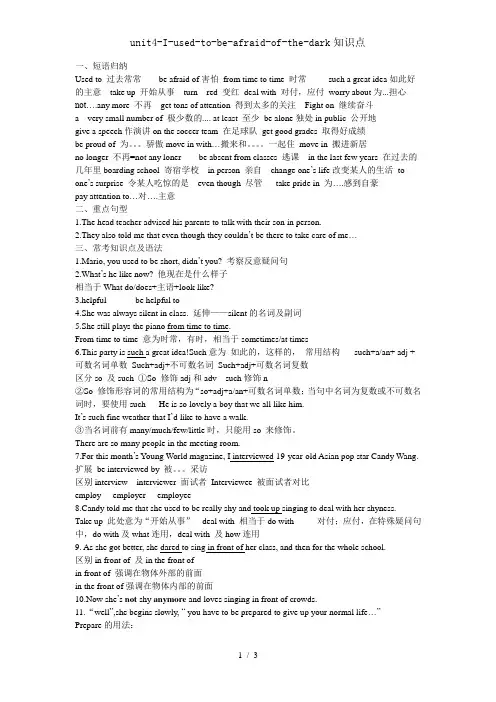
一、短语归纳Used to 过去常常be afraid of害怕from time to time 时常such a great idea如此好的主意take up 开始从事turn red 变红deal with 对付,应付worry about为...担心not….any more 不再get tons of attention 得到太多的关注Fight on 继续奋斗a very small number of 极少数的.... at least 至少be alone独处in public 公开地give a speech作演讲on the soccer team 在足球队get good grades 取得好成绩be proud of 为。
骄傲move in with…搬来和。
一起住move in 搬进新居no longer 不再=not any loner be absent from classes 逃课in the last few years 在过去的几年里boarding school 寄宿学校in person 亲自change one’s life改变某人的生活to one’s surprise 令某人吃惊的是even though 尽管take pride in 为….感到自豪pay attention to…对….主意二、重点句型1.The head teacher advised his parents to talk with their son in person.2.They also told me that even though they couldn’t be there to take care of me…三、常考知识点及语法1.Mario, you used to be short, didn’t you? 考察反意疑问句2.What’s he like now? 他现在是什么样子相当于What do/does+主语+look like?3.helpful----------be helpful to4.She was always silent in class. 延伸——silent的名词及副词5.She still plays the piano from time to time.From time to time 意为时常,有时,相当于sometimes/at times6.This party is such a great idea!Such意为如此的,这样的,常用结构-----such+a/an+ adj +可数名词单数Such+adj+不可数名词Such+adj+可数名词复数区分so 及such ①So 修饰adj和adv such修饰n②So 修饰形容词的常用结构为“so+adj+a/an+可数名词单数;当句中名词为复数或不可数名词时,要使用such He is so lovely a boy that we all like him.It’s such fine weather that I’d like to have a walk.③当名词前有many/much/few/little时,只能用so 来修饰。