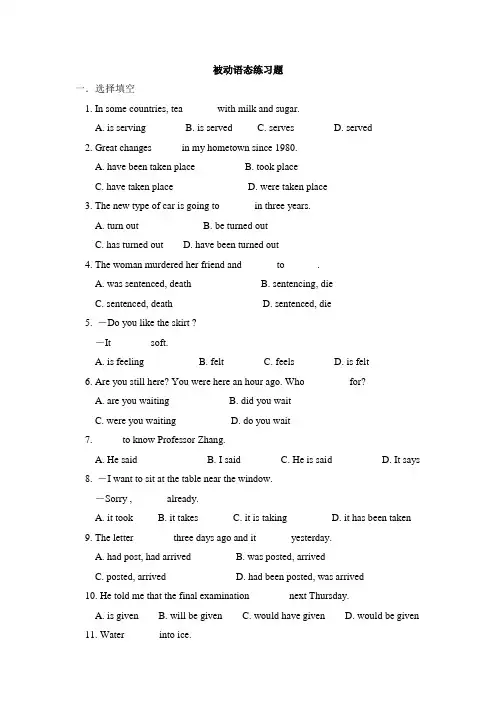
完整版)英语被动语态总结
- 格式:docx
- 大小:39.56 KB
- 文档页数:10
完整版)英语被动语态总结
Passive Voice in English: Summary and Practice
Passive voice is formed by using "be" + past participle and is
used in ten different tenses。For example。with the verb "do":
1) Present Simple: Visitors are requested not to touch the
exhibits.
2) Present Perfect: All the ns for the task have been completed。and we're ready to start.
3) Present Continuous: A new cinema is being built here.
4) Past Simple: I was given ten minutes to decide whether I
should reject the offer.
5) Past Perfect: By the end of last year。another new XXX.
6) Past Continuous: A meeting was being held when I was
there.
7) Future Simple: Hundreds of jobs will be lost if the factory
closes. 8) Future in the Past: The news would be sent to the XXX it
arrived.
9) Future Perfect: The project will have been completed
before July。(less commonly used)
10) Future Perfect in the Past: This tense is also less XXX.
It is important to note that passive voice is not always the best
choice。as it can make XXX and less clear。It is often better to
use active voice。where the subject performs the n of the verb。Practice using both active and passive XXX.
XXX his XXX.
Passive voice has us forms。including:
1) Passive voice with modal verbs。Its form is: modal verb +
be + past participle.
XXX: XXX should take good care of the baby.
2) Some verbs can have two objects。In passive voice。one
object can e the subject。while the other XXX。the indirect object
es the subject.
XXX: His mother gave him a present for his birthday can be
changed to He was given a present by his mother for his birthday.
3) When a structure of "verb + object + object complement"
es passive voice。the object es the subject in the passive structure。while the rest remains the same.
XXX: Someone caught the boy smoking a cigarette can be
changed to The boy was XXX.
4) When a bare infinitive is used as the object complement
after causative verbs like have。make。get。or sensory verbs like
see。watch。notice。hear。feel。observe。the "to" is omitted in
the active voice。However。in passive voice。"to" is added.
XXX: XXX walk into the building can be XXX to walk into
the building.
5) Some XXX。such as "XXX" or "verb + adverb," can also
be used in passive voice。However。they should be considered as
a whole and cannot be XXX.
XXX: The meeting is to be put off till Friday.
Passive voice can also be used with gerunds and infinitives
(both present and past)。For example。I don't like being laughed
at in public.
When learning passive voice。it's important to not only
understand the grammar structures。but also know when to use it
in different ns.
st night。XXX.
2.I was given a deadline of ten minutes to decide whether to
accept the offer。XXX.
3.The well-known person was XXX by people when they got
on the bus.
4.Passive meaning XXX using the active form of verbs such
as break。catch。clean。drive。lock。open。sell。read。write。and wash when used as XXX。The subject is usually an object。For example。"This kind of XXX."
Note: The active voice emphasizes the subject's
characteristics。while the passive voice emphasizes the impact
caused by external factors。For example。"The door won't lock"
(referring to a problem with the door itself) vs。"The door won't
be locked" (referring to a person not locking the door。indicating
that "the door is unlocked" due to human error).
4.有些形容词后接不定式作表语或宾语补足语,但句子的主语或宾语是动词不定式的逻辑宾语时,常用不定式的主动形式表达被动意义。这些形容词包括:nice,easy,fit,hard,difficult,important,impossible,pleasant,interesting等。例如:This problem is difficult to work out (可以看作to work out省略了for me)。
5.在too… to…结构中,不定式前面可以加逻辑主语,因此应用主动形式表示被动意义。例如:This book is too
expensive (for me) to buy。
6.在there be…句型中,当动词不定式修饰名词作定语时,不定式用主动式作定语,重点在人,用被动形式作定语,重点在物。例如:There is no time to lose(用to lose可看成for us
to lose;用to be lost,谁lost time不明确)。
7.在be to do结构中,一些不定式通常应用主动形式表示主动,被动形式表示被动。然而,由于古英语的影响,下列动词rent。blame,let等仍用不定式的主动形式表示被动意义。例如:Who is to blame for starting the fire?
介词in。on。under等+名词构成介词短语,可以表达被动意义。表示方位的介词与含有动作意义的名词合用,含有被动之义,其意义相当于该名词相应动词的被动形式。名词前一般不用冠词。例如:The building is under n (is being
constructed)。常见的还有:under control(受控制),under
treatment(在治疗中),under repair(在修理中),under n(在讨论中)。
st year。many trees and XXX。which transformed it
into a beautiful garden.
11.Some famous paintings XXX.
12.XXX will be given in the school hall next week.
13.Great changes have XXX place in this city。Many modern
tall buildings have been put up these days.