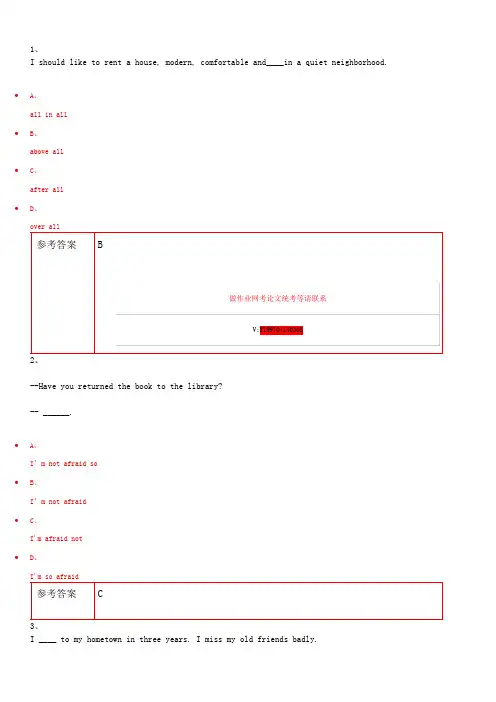
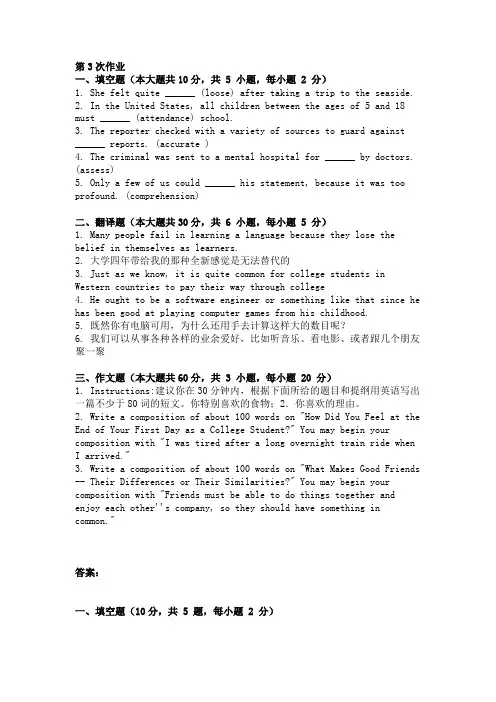
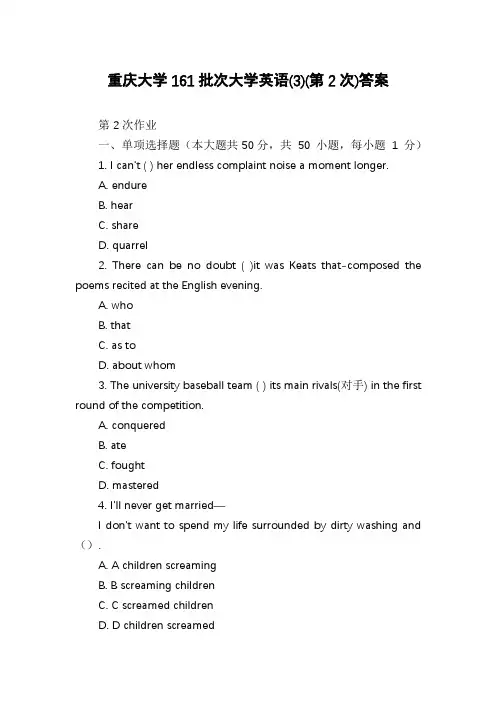
重庆大学161批次大学英语(3) ( 第1次 )答案
- 格式:doc
- 大小:55.50 KB
- 文档页数:13
第1次作业一、单项选择题(本大题共50分,共 50 小题,每小题 1 分)1.A single technical term will frequently cover an idea that would otherwise () a long phrase or clause.A. call forB. make forC. allow forD. stand for2. It is ( ) of Beijing to have such hot weather in July.A. tropicalB. typicalC. trialD. tradition3. The explorer told the boys about his ( ) in the Arctic.A. adventuresB. investigationC. applicationD. improvement4.It was not a formal occasion, so we were asked to wear ()clothes.A. regularB. informalC. simpleD. cheap5. I'll never know all that was in his mind, ().A. nor will anyone else eitherB. nor won''''t anyone else tooC. nor anyone else willD. nor will anyone else6. – What are your greatest achievements? -- ( ).A. know what you mean.B. You will know it.C. What is achievement?D. I finished college education.7. The ( ) of establishing a new amusement park seemed to be very attractive.A. outlineB. projectC. progressD. method8.A minute later John and I ran ()them and soon caught up ()them.A. A after...withB. B with...forC. C to...byD. D for...to9. He kept working, ( ) he was very tired.A. soB. howC. neverthelessD. though10.He is ()about his chances of winning a gold medal in t he Olympics next year.A. A optimisticB. B optionalC. C outstandingD. D obvious11. She's not really poor; she just ()to be poor.A. A imaginesB. B actsC. C pretendsD. D reports12. It will take him about 5 months ( ) writing this book.A. finishingB. finishC. to finishD. finished13. This took place in( ) Philadelphia.A. a 1930sB. the 1930s’C. the 1930sD. 1930’s14.By 2000, scientists surely () a cure for this kind of di sease.A. A have discoveredB. B must discoverC. C are discoveringD. D will have discovered15. We ( ) supper when a policeman came to the door.A. just haveB. were havingC. just hadD. had had just16. I can never remember ( ) drawer he keeps his shirts in.A. what.B. asC. whichD. where17.Jefferson thought that it was conflict and not unquestioning agreement ()keeps freedom alive.A. A whichB. B thatC. C whatD. D as a18. Although George has many personal problems, he ( ) present every day since the first day of class.A. has beenB. had beenC. isD. was19. The boy aimed ( ) becoming an agriculturist.A. forB. atC. ofD. in20. It is such a fine day that I ( ) going swimming in the river.A. feel likeB. feelC. likeD. love21. A. What kind of job did you do? B: ( ).A. worked at a bookstore on campus.B. Yes. I brewed coffee in the Student Union.C. But selling books was satisfying.D. I need to earn the money.22. Mary can riot work ( ) John.A. as quicker asB. as quickly asC. more quick thanD. more quickly as23.Not long ago, a person whom I know very well was ()an accident.A. A related toB. B involved inC. C included inD. D subjected to24. Can you briefly describe yourself? -- ( ).A. My college is in Chongqing.B. I am from Beijing.C. I know you.D. You are my friend.25. The professor ( ) the papers.A. passed byB. passed throughC. passed outD. passed in26. -- What you’re your career goals? -- ( ).A. 20 dollars a week.B. I want to be an engineer.C. It’s very hard.D. I will try my best.27.It's my advice that she ()right now, or she might be l ate for the plane.A. startB. startsC. would startD. will start28. -- Why do you want this job? -- ( ).A. need to earn the money.B. I don’t want.C. I like playing football.D. It’s kind of you.29. — Why don''t you travel to New York on vacation? — ( ).A. don''t want to goB. Excuse me, because I can''tC. I want to but I haven''t got enough moneyD. Because I''m going to school today30. -- I’m a history major. And you? -- ( ).A. Well, it’s nice.B. I know.C. Biology.D. You know that.C31. –What’s your favorite subject? -- ( ).A. Canada.B. Chinese.C. This one.D. Obvious.32. He grows flowers ( ) vegetables.A. as soon asB. as good asC. as wellD. as well as33. When I saw ( ) book that I bought it at once.A. such goodB. so goodC. so good aD. such good a34. They said they would not make their final ( ) until the election result came out.A. decideB. decisiveC. decisionD. depict35. If the customer is ( ) to pay a bill, the company turns their account over to a collection agency.A. unusualB. unwillingC. unworthyD.unwanted36. It was a hot day and many people were ( ) their way to the beach.A. takingB. guidingC. settingD. making37. Can you briefly describe yourself? -- ( ).A. My college is in Chongqing.B. I am from Beijing.C. I know you.D. You are my friend.38. He couldn’t remember( )A. what was the formulaB. what were the formulaC. what the formula wasD. what the formula were39. The clerk ( ) stole some money from the bankA. supposed toB. supposedlyC. supposedD. suppose40. You can send it either by air mail, ( ).A. or send it by ordinaryB. nor by ordinaryC. or by ordinaryD. or ordinary mail41. Many college students like to chat on the Internet. They think talking with friends on the Internet is ( ) casual and exciting ( ) face to face.A. not only...but alsoB. less...thanC. more...thanD. neither...nor42. Do what your mother wants, or you’ll ( ) her.A. upsetB. angryC. beatD. desperate43.We are ()interested in the age of the carbonates, becaus e it would allow us to estimate when microbial life left i ts Mark on the rock that became alh84001.A. A hardlyB. B extremelyC. C almostD. D at all44. Taking ( ) is one of Mike''s hobbies.A. photoB. photosC. photoesD. photo''s45.Professor Clark continued his research work and ()his col league''''s advice.A. ignoredB. deploredC. exploredD. implored46.I''''ll give you my telephone number in case you ()want to get in touch with me again.A. A shouldB. B willC. C shallD. D need47. Our teacher constantly ( ) to us that there is no shortcut(捷径)for learning English.A. points outB. points offC. points atD. points in48. The lecture was so ( ) that everyone went to sleep.A. boringB. boredC. interestedD. interesting49. -- How do you like your major? -- ( ).A. Don’t like it very much.B. I’d like to have one.C. It looks like a good job.D. It’s very nice of you.50. I said, “ I hope you’ll have ( ) nice birthdays.”A. many moreB. much moreC. very muchD. enough many二、阅读理解单项选择题(本大题共50分,共 5 小题,每小题 10 分)1.Moscow, Russia (Space news) ——"The computer is a better chess player, insisted Viktor Prozorov, the loser. It seemed as if it were laughing after every good move. I know I should have beaten it for the sake of mankind (人类), but I just couldn''t win", he announced and shook his head sadly.Prozorov''''s disappointment was shared by several grand masters who were present, some of whomwere so upset that they shouted at the machine. Many chess players said that this meant the end of chess championships (冠军) around the world, since the fun had been taken out of the game. The computer walked——or rather——rolled away with 5 000 dollars in prize money and limited its remarks to a set of noises and lights.(1). Which of the following best gives the main idea of this newspaper article? ( )A. 5 000 dollars goes to a computer!B. New invention : a laughing computer!C. World''s best chess player beaten!D. Computer defeats man in chess!(2). How did some of the grand masters feel about the chess game between Prozorov and the computer? ( )A.They thought that the game was not fun.B. They thought that the game wasn''t fair.C. They agreed that Prozorov didn''t play well.D. They were unhappy that the cProzoro didn''t play well.(3). What was it that Prozorov felt most bitter (痛苦) about? ( )A. That he didn''t win the $5 000.B. That he hadn''t tried his best.C. That he had lost to a machine.D. That this was the end of the chess game.(4). After wining the game, the computer( )A. laughedB. walked awayC. made some remarksD. gave out some lights and sounds(5). Many chess players felt that playing with a computer would( )A. make the game tougherB. make the game less interestingC. make man appear foolishD. make man lose lots of money2."The pen is more powerful than the sword (剑)." There have been many writers who used their pens to fight things that were wrong. Mrs. Harriet Beecher Stowe was one of them.She was born in the USA in 1811. One of her books not only made her famous but has been described as one that excited the world, and was helpful in causing a civil war and freezing the slaves. The civil war was the American Civil War of 1861, in which the Northern States fought the Southern States and finally won.This book was named "Uncle Tom''''s Cabin". There was time when every English-speaking man, woman, and child has read this novel that did so much to stop slavery. Not many people read it today, but it isstill very interesting. The book has shown us how a warm-hearted writer can arouse (唤起) people''''s sympathies (同情). The writer herself had neither been to the Southern States nor been a slave. The Southern Americans were very angry at the novel, which they said did not at all represent (代表) true state of affairs, but the Northern Americans were wildly excited over it and were so inspired (激励) by it that they-were ready to go to war to set the slaves free.(1). According to the passage ( ).A. every English-speaking person had read "Uncle Tom''s Cabin"B. "Uncle Tom''s Cabin" was not very interestingC. those who don''t speak English can not have read "Uncle Tom''s Cabin"D. the book "Uncle Tom''s Cabin" did a great deal in the American Civil War(2). How old was Mrs. Stowe when her world famous book was published? ( )A. About 60 years old.B.Over 50 years old.C.In her forties.D. Around 30 years old.(3). What do you learn about Mrs. Stowe from the passage? ( )A. AShe had been living in the north of America before the American Civil War.B. She herself encouraged the northern Americans to go to war and set the slaves free.C. She was better as writing as using a sword.D. She had once been a slave.(4). Why could Mrs. Stowe''s book cause a civil war in America? ( )A. She wrote so well that Americans loved her very much.B. She disclosed (揭露) the terrible wrongs that had been done to the slaves in the Southern States.C. The Southern Americans hated the book while the Northern Americans like it.D. The book had been read by many Americans.(5). What can we learn from the passage? ( )A. We needn''t use weapons (武器) to fight things that are wrong.B. writer is more helpful in a war than a soldier.C. We must understand the importance of literature and art.D. No war can be won without such a book as "Uncle Tom''s Cabin".3. College brings together people from all walks of life. There are so many different types of people in the world but if you go to a college campus, you are sure to find at least one of every kind. The great part about being here with so many different people is that you get to interact with some interesting characters and see how to deal with them. You will meet the people you dread the most, the smart-ass, the brain, or the unique spirit, but no matter who it is that is your worst nightmare to be around you will always be paired up with them in a group project. When you get into the real world you are not going to be able to pick your boss or coworkers. Interacting with these people in college and living with different roommates will help you learn how to cooperate with the people in life you find so unpleasant. College life is fun. The fact that I have been here for a short time just means it has not yet been a life changing experience to me. If I were to give any tips on how to survive, it would not be how to survive college, but how to survive life. I would have to say that one should be outgoing and live life to the fullest. Meet new people whenever you can because they just may be a major influence in your life. Also, get your work done before you go out and party. Lastly, I would have to say, in life if you ever feel lost or alone, talk to someone about it. Everyone gets depressed at times in their life and there is always someone who will listen to your problems.(1). What is the theme of the passage?A. Relationships in college.B. Homework in college.C. Freedom in college.D. Partying in college.(2). What does the author say about group projects?A. They are always unpleasantB. They are always difficult.C. Partners may not cooperateD. Partners may be lazy.(3). Why does the author recommend meeting many new people?A. They may become your best friends.B. They may influence your life.C. They may help you someday.D. They make your life more fun.(4). How would you describe the author''s personality?A. Shy and under confidentB. Strong but quiet.C. Extremely pessimisticD. Optimistic and outgoing.(5). What does the author say to do if you''re depressed?A. Go somewhere by yourself.B. Talk to someone about it.C. Try to forget about it.D. See a psychologist immediately4. The ordinary raindrop is a mighty earth mover with sufficient strength to cut rock. When rainwater collects on the surface of the ground, some of it evaporates and some of it sinks into the earth.The remainder begins to flow downhill, commencing its lengthy journey form brook to stream to lake, or to a river that will carry it to the sea.As water flows along the ground, it picks up sand, pebbles, even boulders. It uses them to gnaw at the sides and bottom of its channel, gradually loosening more earth.By this process enormous amounts of mud and rock are moved from the land to the sea. Each year the Mississippi River carries 730 million tons of solid matter into the Gulf of Mexico.This constant hauling of land into the sea is lowering the United States’ average height above sea level at a rate of about one foot every 9000 years. If erosion continues at the same rate, the United States will be worn completely down to sea level in about 23 million years.(1). Flowing water gradually makes its channel ______.A. narrowerB. deeperC. widerD. both B and C(2). The average height of the United States above sea level ___.A. is being raised each yearB. remains constantC. will reach sea level in 9000 yearsD. is being lowered little by little(3). Erosion by water results in _______.A. wearing down the soilB. building up landC. enriching the soilD. both B and C(4). Implied but not stated: ________A. Millions of years ago the United States was higher than it is nowB. Great amounts of land are moved to the sea by riversC. The water that sinks into the earth also reaches the oceanD. The Gulf of Mexico will be filled up in about 23 million years(5). The best title for this selection is ________.A. How Water Destroys MountainsB. How Rivers Help UsC. The Average Height of the United StatesD. The Mighty Raindrop5.Although I had left school against the advice of my teachers, I had, without telling anyone, tried to continue my studies in literature (文学) at evening classes. It was a tiresome walk from one end of the city to another and to sit among adults was uninteresting. I was the youngest in the class, so the friendship I knew at school was absent.I put up with (忍受) it for a short period. It was too long a walk on cold winter''s nights and it was hard to put my heart into Shakespeare with wet shoes and trousers. So I continued reading books and started writing poetry at home.By chance, I won some prizes and awards (奖) for literature. A young woman from a TV company came to the college one day. She told me that I had won a national poetry award. I stared at her in astonishment and disbelief. She wanted to make a short film about me, to which I said, "No, I couldn'' t do that." Not that I had any real excuse, I was just frightened. In the end she persuaded me that 1 should do it the following day.So I did. They made a short film of me reading one of my poems and I became more interested in literature than ever. I wondered what I should do after this, and decided some weeks later that 1 could not imagine myself spending the rest of my days dealing with machines. So one evening, I hesitatingly told my parents that I wanted to return to school. They were greatly surprised and, I think, a little afraid but they did not try to persuade me not to, they wanted to know if I was sure, if I knew what it meant and whether I realized that if I gave up my job training, it would be verydifficult to get a good job. But nothing could stop me, and they asked about the matter no further.(1). Which of the following has most probably been discussed in this passage? ( )A. The writer''s unhappy childhood.B. The poor teaching quality ( 质量 ) of the writer''s school.C. The writer''s leaving school against his teachers'' advice.D. Whether it was worth leaving school for job training.(2). The writer did not feel comfortable at the evening school because ( ).A. he found it difficult to make friends with his classmatesB. he had to walk a long distance to the evening schoolC. he could not put his heart into reading books afterhe was caught in the rainD. of all of the above(3). After he won some prizes and awards for literature, a young woman from a TV company ( ).A. wanted to make his success known to the publicB. came to make friends with himC. invited him to make a speechD. came to tell him that he had become a very important person(4). After his success, he( )A. decided to get a good jobB. decided to continue hisstudies in literature at the evening schoolC. decided to return to the school he once leftD. began to feel very important and proud(5). Which of the following is NOT TRUE? ( )A. His parents worried that he would have no future if he returned to school.B. His parents worried that he would leave school again.C. It was difficult for one who studied literature to get a job.D. His parents did not want him to continue his education.答案:一、单项选择题(50分,共 50 题,每小题 1 分)1. A2. B3. A4. B5. D6. D7. B8. A9. D 10. A 11. C 12. C 13. B14. D 15. B 16. C 17. B 18. A 19. B 20. A 21. A 22. C 23. B 24. B 25.C 26. B 27. A 28. A 29. C 30. C 31. B 32.D 33. C 34. C 35. B 36. D37. B 38. C 39. B 40. B 41. C 42. A 43. B 44. B 45. A 46. A 47. A 48.A 49. A 50. B二、阅读理解单项选择题(50分,共 5 题,每小题 10 分)1.(1). D (2). D (3). C (4). D (5). B2.(1). D (2). C (3). A (4). B (5). C 3.(1). A (2). B (3). B (4). D (5). B 4.(1). D (2). D (3). A (4). A (5). D 5.(1). C (2). D (3). A (4). C (5). B。