
固体电子器件SolidStateElectronicDevices
- 格式:ppt
- 大小:797.50 KB
- 文档页数:14


电子器件英语词汇表Electronic Devices English Vocabulary ListIntroduction:In the ever-evolving world of technology, electronic devices play a vital role in our daily lives. From smartphones to laptops, these devices have become an integral part of our communication, entertainment, and work. To better understand this field, it is important to familiarize ourselves with the English vocabulary related to electronic devices. In this article, we will explore a comprehensive list of commonly used terms in this domain.1. Hardware Terminology:1.1 Processor/Central Processing Unit (CPU):The CPU serves as the brain of a computer, executing instructions and carrying out calculations.1.2 Random Access Memory (RAM):RAM is a type of volatile memory that temporarily stores data for active programs.1.3 Solid State Drive (SSD):SSD is a storage device that uses integrated circuits to store data persistently.1.4 Graphics Processing Unit (GPU):The GPU is responsible for rendering images, videos, and animations, making it essential for high-quality visuals in electronic devices.1.5 Motherboard:The motherboard is the main printed circuit board (PCB) that houses vital components of a computer or electronic device.1.6 Power Supply Unit (PSU):The PSU provides electrical power to the other components of a computer or electronic device.1.7 Display:The display refers to the screen or monitor that visually presents information to the user.1.8 Keyboard:A keyboard is an input device that enables users to input text and commands into a computer or electronic device.1.9 Mouse:A mouse is another input device that allows users to control the cursor on the screen.2. Software Terminology:2.1 Operating System (OS):An OS is the software that manages computer hardware and software resources, providing a stable interface for users.2.2 Application:An application, also known as software or program, is designed to perform specific tasks on a computer or electronic device.2.3 Firmware:Firmware refers to software that is embedded in electronic devices, providing low-level control and functionality.2.4 Driver:A driver is software that enables communication between an operating system and a specific hardware device.2.5 Antivirus:Antivirus software helps protect electronic devices from malware, viruses, and other security threats.2.6 Browser:A browser is designed to access and display websites and webpages on the internet.3. Networking Terminology:3.1 Wi-Fi:Wi-Fi is a wireless networking technology that allows electronic devices to connect to the internet or other devices without using physical wired connections.3.2 Ethernet:Ethernet is a standard networking technology that uses wired connections to connect devices in a local area network (LAN).3.3 Router:A router is a device that forwards data packets between computer networks, ensuring efficient communication within a network.3.4 Bluetooth:Bluetooth is a wireless technology that enables short-range communication and data transfer between electronic devices.3.5 IP Address:An IP address is a unique numerical label assigned to each device connected to a computer network, facilitating its identification and communication.4. Mobile Devices Terminology:4.1 Smartphone:A smartphone is a mobile device that combines the functionality of a phone with other features, such as internet access, multimedia capabilities, and various applications.4.2 Tablet:A tablet is a portable computing device with a touchscreen display, similar to a smartphone but with a larger screen size.4.3 E-reader:An e-reader is a device specifically designed for reading electronic books (e-books) and other digital publications.4.4 Wearable Devices:Wearable devices, such as smartwatches and fitness trackers, are worn on the body and provide functionalities like health monitoring, notifications, and communication.Conclusion:This article has provided a comprehensive English vocabulary list related to electronic devices. By familiarizing ourselves with these terms, we can enhance our understanding of this field and effectively communicate in English when discussing electronic devices. As technology continues to advance, staying up-to-date with relevant terminology is essential for both personal and professional purposes.。

Solid State Electronic Devices : The Fundamentals and ApplicationsSolid state electronic devices are an essential part of modern technology. They are the basis for many electronic devices, such as computers, cell phones, and televisions. These devices are based on the principles of solid-state physics, which focuses on the study of materials and their properties.Solid state electronic devices, such as transistors, diodes, and integrated circuits, have revolutionized the way we live and work. They have made it possible to create smaller, faster, and more complex electronic devices. This article will explain the fundamental principles of solid-state electronic devices, their applications, and the future of solid-state electronics.The Physics ofSolid-state electronic devices are electronic components that are made from solid materials, such as semiconductor materials. A semiconductor material is one that has electrical conductivity between that of a conductor and an insulator. The most widely used semiconductor material is silicon, although other materials, such as germanium and gallium arsenide, are also used.The behavior of semiconductors is governed by their electronic properties, such as the energy band structure and the distribution of electrons and holes. These properties are determined by the arrangement of atoms in the crystal lattice structure of the material. The electronic properties of a semiconductor can be manipulated by doping it with impurities.Doping means intentionally introducing impurities or dopants into a semiconductor to modify its electrical properties. Two types of doping are used in semiconductors: n-type and p-type doping. N-type doping is the introduction of impurities with extra electrons, such as phosphorus or arsenic. P-type doping is the introduction of impurities with missing electrons, such as boron.When a semiconductor is doped with n-type impurities, it becomes an n-type semiconductor, which has a surplus of negatively charged electrons. When a semiconductor is doped with p-type impurities, it becomes a p-type semiconductor, which has a deficit of negatively charged electrons. The interaction between these two types of semiconductors is the basis of many solid-state electronic devices.The Applications ofSolid state electronic devices have many applications, from digital circuits to power electronics. They are used in the following applications:1. Digital CircuitsDigital circuits are circuits that use a binary system of 0s and 1s to represent information. Solid state electronic devices, such as diodes and transistors, are used to build digital circuits. Integrated circuits, which are made up of millions of transistors on a single chip, are used in digital circuits to perform billions of calculations in seconds.2. Power ElectronicsPower electronics involve the use of solid state electronic devices to convert electrical energy from one form to another. They are used in a wide range of applications, such as motor control, renewable energy systems, and electric vehicles. Power electronic devices, such as rectifiers, inverters, and DC-DC converters, are used in power electronics.3. OptoelectronicsOptoelectronics involves the use of solid state electronic devices to control and manipulate light. They are used in a wide range of applications, such as fiber optics, displays, and solar cells. Optoelectronic devices, such as LEDs, laser diodes, and photodetectors, are used in optoelectronics.The Future of Solid State ElectronicsSolid state electronics have come a long way since the invention of the transistor. However, there is still room for improvement. Future developments in solid state electronics will focus on the following areas:1. NanotechnologyNanotechnology involves the manipulation of matter on an atomic, molecular, and supramolecular scale. The use of nanotechnology in solid state electronics will lead to the development of smaller, faster, and more efficient devices.2. Quantum ComputingQuantum computing involves the use of quantum phenomena, such as superposition and entanglement, to perform calculations. The development of quantum computing will revolutionize the field of solid state electronics, leading to the development of new types of devices.3. Energy EfficiencyThe development of more energy-efficient solid state electronic devices is a priority, as the demand for energy continues to grow. The use of renewable energy sources, such as solar and wind power, will require the development of more efficient power electronic devices.ConclusionSolid state electronic devices have revolutionized the way we live and work. They are the basis for many electronic devices that we use every day. The principles of solid-state physics govern the behavior of these devices, and their applications are wide-ranging. The future of solid state electronics looks bright, with developments in nanotechnology, quantum computing, and energy efficiency leading the way.。

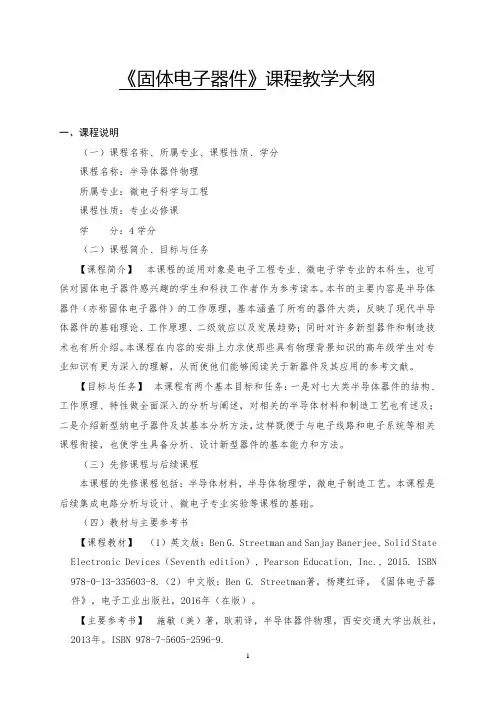
《固体电子器件》课程教学大纲一、课程说明(一)课程名称、所属专业、课程性质、学分课程名称:半导体器件物理所属专业:微电子科学与工程课程性质:专业必修课学分:4学分(二)课程简介、目标与任务【课程简介】本课程的适用对象是电子工程专业、微电子学专业的本科生,也可供对固体电子器件感兴趣的学生和科技工作者作为参考读本。
本书的主要内容是半导体器件(亦称固体电子器件)的工作原理,基本涵盖了所有的器件大类,反映了现代半导体器件的基础理论、工作原理、二级效应以及发展趋势;同时对许多新型器件和制造技术也有所介绍。
本课程在内容的安排上力求使那些具有物理背景知识的高年级学生对专业知识有更为深入的理解,从而使他们能够阅读关于新器件及其应用的参考文献。
【目标与任务】本课程有两个基本目标和任务:一是对七大类半导体器件的结构、工作原理、特性做全面深入的分析与阐述,对相关的半导体材料和制造工艺也有述及;二是介绍新型纳电子器件及其基本分析方法,这样既便于与电子线路和电子系统等相关课程衔接,也使学生具备分析、设计新型器件的基本能力和方法。
(三)先修课程与后续课程本课程的先修课程包括:半导体材料,半导体物理学,微电子制造工艺。
本课程是后续集成电路分析与设计、微电子专业实验等课程的基础。
(四)教材与主要参考书【课程教材】(1)英文版:Ben G. Streetman and Sanjay Banerjee, Solid State Electronic Devices(Seventh edition), Pearson Education, Inc., 2015. ISBN 978-0-13-335603-8.(2)中文版:Ben G. Streetman著,杨建红译,《固体电子器件》,电子工业出版社,2016年(在版)。
【主要参考书】施敏(美)著,耿莉译,半导体器件物理,西安交通大学出版社,2013年。
ISBN 978-7-5605-2596-9.二、课程内容与安排第1章晶体性质和半导体生长(略讲,无计划学时)1-1 常用半导体材料的晶体结构1-2 硅块状晶体生长电子级硅(EGS)原料的制备;单晶Si的Czochralski制备方法;Si掺杂技术。