
高中英语必修5英语教案
- 格式:ppt
- 大小:1.90 MB
- 文档页数:36


【导语】⾼⼆是承上启下的⼀年,是成绩分化的分⽔岭,成绩往往形成两极分化:⾏则扶摇直上,不⾏则每况愈下。
在这⼀年⾥学⽣必须完成学习⽅式的转变。
为了让你更好的学习⾼⼆频道为你整理了《⾼⼆英语必修五教案《Unit 3 Life in the future》》希望你喜欢! 教案【⼀】 本教学设计在新课程教学理念的指导下,⼒求在培养学⽣的语⾔知识、知识技能、情感态度、学习策略和⽂化意识等素养的基础上发展学⽣综合运⽤语⾔的能⼒,使学⽣通过观察、体验、探究等主动学习的⽅法优化英语学习⽅法,充分发挥⾃⼰的学习潜能,形成有效的学习策略。
1. 开展学⽣活动,发挥主体作⽤ 新课程强调要充分发挥学⽣在教学过程中的主体作⽤。
本课设计遵循以学⽣为主体,教师为主导这⼀教学原则,创设⾓⾊扮演情景、激烈讨论提出建议,让学⽣限度地参与教学过程,尊重学⽣的主体地位,充分发挥学⽣在学习过程中的主动性、积极性、创造性,使课堂充满活⼒。
2. 实施情景教学,统合三维⽬标 本课设计从教学需要出发,创设情景,进⾏情景设问、讨论,激起学⽣的情感体验,激活学⽣思维,帮助学⽣迅速、正确地理解和接受知识,并在学习过程中培养其积极进取的科学的⼈⽣观及价值观,较好地落实了三维⽬标。
⽽三维⽬标是相辅相成、相互渗透的,所以在情景教学的过程中,知识的落实、能⼒的培养、情感态度价值观的渗透交融在⼀起,实现了三维⽬标的和谐与统⼀。
3. 转变学习⽅式,增强教学效果 新课程要求提倡⾃主、合作、探究的学习⽅式,发挥学⽣的主体性、能动性和独⽴性,本课设计通过⾃学课本,⼩组讨论,综合分析,⾓⾊扮演等活动,为学⽣⾃主学习、合作学习、探究学习提供了空间,使学⽣体验了⾃主之乐,合作之趣,探究之悦,促进了学⽣知识的构建与运⽤,能⼒的培养和提⾼,情感体验和态度、价值观的形成,增强了教学效果。
4. 运⽤问题教学,启发学⽣思维 本课设计按照诱思探究理论要求,遵循学⽣的认知规律,引导学⽣去发现问题、分析问题和解决问题,从⽽掌握知识,形成能⼒,培养品质。

Period 5 GrammarThe General Idea of This PeriodThis period lays emphasis on grammar, that is, the past participle used as the object complement, which is also one of the difficult points in Senior English grammar.First, revise what the students have learnt in the last period by checking their homework , including some important phrases and translating some sentences from Chinese into English.In this unit the students should learn about the past particip le used as the object complement. First, the teacher presents one sentence containing a past participle used the object complement, which was taken from the reading passage.Teacher tries to analyze the function of the past participle and help the students have a general idea about it.Then the students are asked to find all the sentences that contain a past participle used as the object complement in the Reading passage.Then the students can come to a conclusion of the basic structure of the past participle1used as the object complement, that is, have/get/find/...+object +past participle.Next the teacher will explain the differences between the present participle and the past participle.The teacher compares them when are used as the attributive, predicate, object complement and adverbial.In order to do so, the teacher always shows some typical examples.After that, the students will find out the difference between them.Then they are provided with some exercises for them to consolidate what they have learned.In order to consolidate the grammar points, the students will do some oral practice.In this practice, the students will ask and answer some questions in pairs, using the past participle as the object complement.The students should not only learn about the grammar, but also learn how to use them, which is much more important.Also this part can help the students to communicate with each other using the language that they have learned, and this is the real purpose of learning the target languages.Teaching Important Point2Learn grammar: the past participle used as the object complement.Teaching DifficultiesKnow the differences between the present participle and the past participle when they are used as the attributive, predicate, object complement and adverbial.Learn to make a choice between the present participle and the past participle according to the different context.Teaching Aidsa tape recordera projectorthe blackboardThree Dimensional Teaching AimsKnowledge AimsLearn the past participle used as the object complement.3Know the differences between the present participle and the past participle when they are used as the attributive, predicate, object complement and adverbial.Ability AimsLearn to make a choice between the present participle and the past participle according to the different context.Learn to communicate with each other by using the language that they have learne d.Emotional AimsLearn to cooperate with each other.Teaching ProcedureStep 1 GreetingsTeacher greets the students as usual.Step 2 RevisionT: At the beginning of this period, let’s check your homework.First, please write down the4phrases according to the Chinese explanations.S: 1) 与……连结 be linked to2) 令某人惊讶的是 to one’s surprise3) 到处寻找, 观光 look around4) 睁大眼睛 keep one’s eyes open5) 在特殊的场合 on special occasions6) 为了纪念…… in memory of7) 拍一张照片 have a photo taken8) 展出 on show9) 为……感到骄傲 be proud of10) 遗留, 漏掉 leave outT: Good.Now, let’s check your translations of the five sentences.S1: When David Beckham arrived in Japan, the thrilled fans all went to meet him.5S2: In order to celebrate my cousin’s wedding, my aunt and uncle had an evening party arranged.S3: It is probably puzzling, but to set an example can help to clarify the puzzle.S3: Don’t be influenced by her words.You must decide for yourself.S4: Polar took the place of her father to treat the guests at the party, since her father was not available to.Step 3 Discovering Useful StructuresT: In the last unit we learnt about the past participle used as the attributive.Now let’s look at the following sentence taken from the passage.Please tell me what function is the past participle.Now when people refer to England you find Wales included as well.S: It is used as the object complement.T: You are right.So in this unit we will learn about the past participle used as the object complement.The structure is often formed with have /get /find/...+object +past participle.Please6find three more sentences from the reading passage with past participles used as the object complement.(After several minutes.)S1: To their surprise, the three countries found themselves united peacefully instead of by war.(Para.3)S 2: However, just as they were going to get Ireland connected to form the United Kingdom, the southern part of that country broke away to form its own government.(Para.3) S3: You find most of the population settled in the South, but most of the large industrial cities in the Midlands ad North of England.(Para.5)T: Yes, you are very clever.Now, look at Part 2 (Discovering useful structures) on Pages plete the sentences by using the words in brackets and the structure have /get /find something done.T: Let’s do No.1 as an example.We are having the house mended now.7(After several minutes.)S1: No.2 You look different today.Have you had your hair cut?S2: No.3 Do you want to get the dictionary delivered to your house or would you prefer to come to the shop for it?S3: No.4 Sorry, I haven’t had the film developed yet.S4: No.5 On my way to the station my car broke down.When I got to the repair shop I found it closed.S5: No.6 The computer doesn’t seem to work well.You’d better get it repaired.S6: No.7 Jill and Eric had all their money stolen while they were on holiday.S7: No.8 Chris had some flowers sent to Sarah on her birthday.Then Chris asked Sarah to marry hem and they had it announced in the newspaper.They had no time to arrange their own wedding, so they had it organized by a company.T: Ex cellent.Past participle used as the object complement can also be put after such words8as see, hear, notice, watch, keep, make, feel, etc.Please put the following sentences into English.1.她高兴地看到孩子们在托儿所受到很好的照顾。
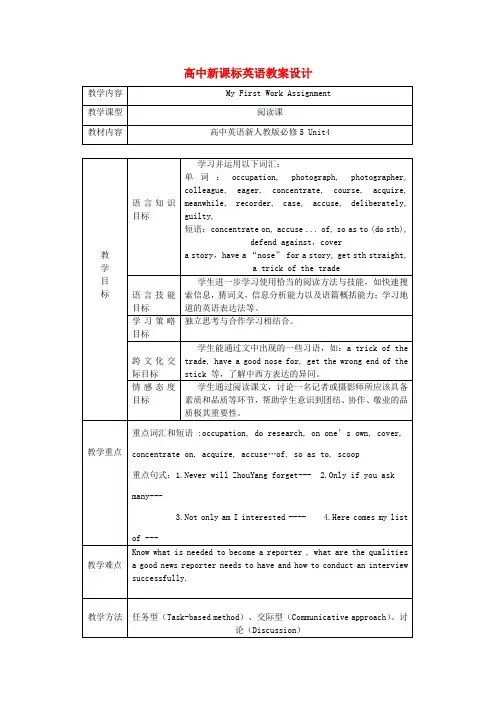

Unit 4 Making the newsPeriod 1 Warming up and reading 课时:课型Type of Lesson: Reading学习目标Learning aims:Enable the Ss to recognize the variety of jobs there are in newspapers and what is needed to work in a newspaper office.Enable the Ss to know what is needed to become a reporter and how to conduct an interview.2.. 语言目标(Language aim)重点词汇和短语occupation, update, submit, cover, concentrate on, inform, publish, polish, approve, acquire, accuse…of, so as to, scoop, deadline, depend on, ahead of, assess, demand, process三. 教学方法(Teaching method)Fast reading; Task-based method & discussion四. 教学步骤(Teaching procedure)教学重点重点句子1)Never will Zhou Yang forget his first assignment at the office of a popular English newspaper.2)You’ll find y our colleagues very eager to assist you, so you may be able to concentrate onphotography later if you’re interested .3)Not only am I interested in photography, but I took an amateur course at university to update myskills.4)Only if you ask many questions will you acquire all the information you need to know.5)We say a good journalist must have a good “nose” for a story.6)Meanwhile you have to prepare the next question depending on what the person says.7)Have you ever had a case where somebody accused your reporters of getting the wrong end of thestick?8)Perhaps I too will get a scoop!Aids: Multimedia facilities, tape-recorder, photos, diagrams教学难点Difficult Points: Know what is needed to become a reporter and how to conduct an interview Master the use of inversion.教学反思Teaching Re-thinking:家庭作业Homework:教学过程Teaching Procedures:一. 教学目标(Teaching aims)1. 能力目标(Ability aim)Period 1Step I Warming up. ( see page 25 )Can you tell some jobs in a newspaper company? What are their jobs involves?Teaching suggestions: rearrange the order of the types of jobs a newspaper has and what they involve And ask the students to do the matches. Then ask them to copy what’s on the screen to their books. At the same time deal with the new words:occupation and journalist and the expression: suppose you were…occupation =a job or professionTeaching is my occupation. 教书是我的职业.。