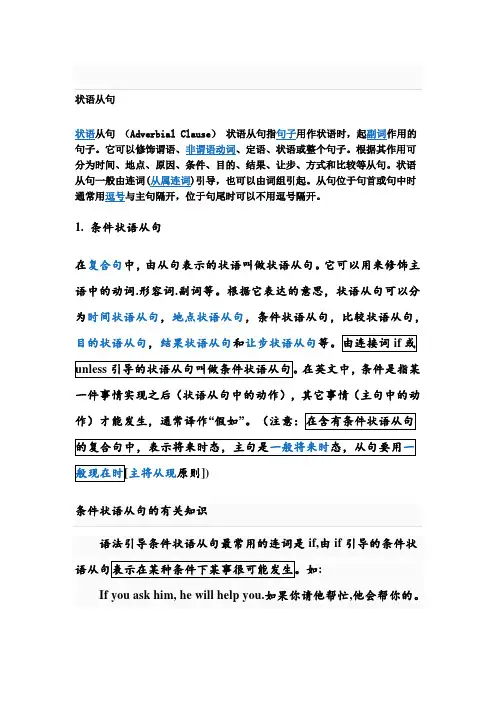
状语从句之条件状语从句
- 格式:doc
- 大小:203.50 KB
- 文档页数:19
conditional clauseDefinition:A type of adverbial clause that states a hypothesis or condition, real or imagined.A conditional clause may be introduced by the subordinating conjunction if or another conjunction, such as unless, provided that,or in case of.Like other adverbial clauses, a conditional clause can come either before or after the clause on which it states a condition.Examples and Observations:"If you want a friend in Washington, get a dog."(Harry Truman)"If we had no winter, the spring would not be so pleasant; if we did not sometimes taste of adversity, prosperity would not be so welcome."(Anne Bradstreet, "Meditations Divine and Moral")"Romans park their cars the way I would park if I had just spilled a beaker of hydrochloric acid on my lap."(Bill Bryson, Neither Here Nor There: Travels in Europe. William Morrow, 1992) ∙"If I had only known, I would have been a locksmith."(Albert Einstein)∙"Conditions deal with imagined situations: some are possible, some are unlikely, some are impossible. The speaker/writer imagines that something can or cannot happen or have happened, and then compares that situation with possible consequences or outcomes, or offers further logical conclusions about the situation."(R. Carter, Cambridge Grammar of English. Cambridge Univ. Press, 2006)∙Types of Conditional ClausesThere are six main types of conditional sentence:1.For example, the equilibrium between liquid and vapor is upset if thetemperature is increased.(General rule, or law of nature: it always happens.)2.If you start thinking about this game, it will drive you crazy.(Open future condition: it may or may not happen.)3.But if you really wanted to be on Malibu Beach, you'd be there.(Unlikely future condition: it probably won't happen.)4.If I were you, I would go to the conference center itself and ask to seesomeone in security.(Impossible future condition: it could never happen.)5."I would have resigned if they had made the decision themselves," shesaid.(Impossible past condition: it didn't happen.)6.If he had been working for three days and three nights then it was inthe suit he was wearing now.(Unknown past condition: we don't know the facts.)(John Seely, Grammar for Teachers. Oxpecker, 2007)These type of clauses are often called "if clauses" in English grammar books and follow conditional sentence patterns. Take a look at the chart below to study the various usage of different time expressions.PunctuationWhen an adverb clause begins the sentence use a comma to separate the two clauses.Example:If he comes, we will have some lunch.. When the adverb clause finishes the sentence there is no need for a comma. Example:He would have invited me if he had known.More information on the correct tense usage for the conditionalsIf∙If we win, we'll go to Kelly's to celebrate!∙She would buy a house, if she had enough money.'If' clauses express the conditions necessary for the result. If clauses are followed by expected results based on the condition. More information on the correct tense usage for the conditionalsEven if∙Even if she saves a lot, she won't be able to afford that house.In contrast to sentences with 'if' sentences with 'even if' show a result that is unexpected based on the condition in the 'even if' clause. Example:COMPARE: If she studies hard, she will pass the exam AND Even if she studies hard, she won't pass the exam.Whether or not∙They won't be able to come whether or not they have enough money.∙Whether they have money or not, they won't be able to come.'Whether or not' expresses the idea that neither one condition or another matters; the result will be the same. Notice the possibility of inversion (Whether they have money or not) with 'whether or not'.Unless∙Unless she hurries up, we won't arrive in time.∙We won't go unless he arrives soon.'Unless' expresses the idea of 'if not' Example:Unless she hurries up, we won't arrive in time. MEANS THE SAME AS: If she doesn't hurry up, we won't arrive in time. 'Unless' is only used in the first conditional.In case (that), in the event (that)∙In the case you need me, I'll be at Tom's.∙I'll be studying upstairs in the event he calls.'In case' and 'in the event' usually mean that you don't expect something to happen, but if it does... Both are used primarily for future events.Only if∙We'll give you your bicycle only if you do well on your exams.∙Only if you do well on your exams will we give you your bicycle.'Only if' means 'only in the case that something happens - and only if'. This form basically means the same as 'if'. However, it does stress the condition for the result. Note that when 'only if' begins the sentence you need to invert the main clause.Second ConditionalIntroductionThe second conditional (also called conditional type 2) is a structure used for talking about unreal situations in the present or in the future. This page will explain how the second conditional is formed, and when to use it.The structure of a second conditional sentenceLike a first conditional, a second conditional sentence consists of two clauses, an “if” clause and a main clause:If the “if” clause comes first, a comma is usually used. If the “if” clause comes second, there is no need for a comma:We use different verb forms in each part of a second conditional:*Note that this "simple past" form is slightly different from usual in the case of the verb BE. Whatever the subject, the verb form is "were", not "was": If I were rich, I'd buy a big house.Using the second conditionalThe second conditional is used to talk about things which are unreal (not true or not possible) in the present or the future -- things which don't or won't happen:When you are sure that you understand the lesson, you can continue with the exercises.Second Conditional 1All of these sentences are second conditionals. Choose the correct form of the verb in each question.1.If there ________ no mosquitos, there would be no malaria.A. ? wereB. ? areC. ? isD. ? wasE. ? would be2.If I ________ a penny for every can of soda I've drunk in my life, I wouldbe rich!A. ? will haveB. ? haveC. ? hadD. ? would have3.If he were a young man, he ________ able to walk faster.A. ? isB. ? wasC. ? will beD. ? would be4.If her hair were black, she ________ completely different.A. ? looksB. ? would lookC. ? lookD. ? will look5.We'd be on the beach if we ________ in Mexico!A. ? would beB. ? will beC. ? wereD. ? are6.If the weather ________ better, we ________ to the park.A. ? is... would goB. ? were... will goC. ? was... goD. ? were... would go7.We would learn a lot from dolphins if they ________.A. ? can talkB. ? will talkC. ? talkD. ? could talk8.He's so stupid! If he ________ an animal, he would be asheep.A. ? wasB. ? wereC. ? isD. ? would beE. ? are9.If smoking were allowed, I ________ a cigarette.A. ? would haveB. ? haveC. ? hadD. ? will have10.We don't mind camping, but if we ________ enough money, we ________in a hotel.A. ? had... would stayB. ? have... stayedC. ? had... stayedD. ? would have...stayedNext exerciseSecond Conditional 2Type the correct form of each verb.Each of these sentences is a second conditional. Complete the sentences by typing the correct form of each verb in brackets.Third ConditionalIntroductionThe third conditional (also called conditional type 3) is a structure used for talking about unreal situations in the past. This page will explain how the third conditional is formed, and when to use it.The structure of a third conditional sentenceLike the other conditionals, a third conditional sentence consists of two clauses, an “if” clause and a main clause:Explanation: I failed the exam, because I didn't study hard enough.If the “if” clause comes first, a comma is usually used. If the “if” clause c omes second, there is no need for a comma:We use different verb forms in each part of a third conditional:*The past perfect is formed with the auxiliary verb “had”, and the past participle (or third form) of the verb.Note also that third conditional forms can be contracted:Using the third conditionalThe third conditional is used to talk about things which did not happen in the past. If your native language does not have a similar construction, you may find this a little strange, but it can be very useful. It is often used to express criticism or regret:Third ConditionalIntroductionWe use Third Conditional (also known as the past hypothetical conditional) to talk about or write about past unreal situations, past situations that didn't actually happen. Since neither action took place, the condition is unreal.Consider the following examples.Meaning: I spent all my money earlier, so I wasn't able to lend you any.Meaning: We were very hungry, so we ate a large meal.Forming the Third ConditionalFormationLike the other conditionals, a third or hypothetical conditional sentence consists of two clauses, an "if" clause and a main clause: Consider these examples.If I had had time, I would have helped you.Meaning: I wanted to help you, but I couldn't because I didn't have enough time.If the street had not been so icy, the accident could have been avoided. Meaning: The street was icy, so the drivers weren't able to avoid hitting each other. We use different verb forms in each part of a third conditional:*The past perfect is formed with the auxiliary verb "had", and the past participle (or third form) of the verb.Note also that third conditional forms can be contracted:Conditional AuxiliariesThere are four conditional auxiliaries: would, could, might, and should.WouldThe conditional auxiliary would is used to indicate probability or intention. See the following example.CouldThe conditional auxiliary could is used to indicate hypothetical ability or possibility, as in these two examples.MightThe conditional auxiliary might is used to indicate less certain possibility, as in this example.* NoteSometimes there is a connection between past hypothetical conditionals and the present. Consider these examples.If nobody had invented rock music, what would music be like today?If the Wright brothers had not invented the airplane, how would people travel great distances quickly today?Third ConditionalIn this exercise, you will practise forming the third conditional. Based on the example sentence, complete the third conditional sentence by filling in the spaces.For example:I didn't pass the test, because I hadn't studied hard enough. --> "If I had studied harder, I would have passed the test."Third Conditional 1Choose the correct answer to complete each sentence.1.If the paramedics had not arrived so quickly, ____________________A. ? the accident victim didn't survive.B. ? the accident victim might not have survived.C. ? the accident victim might have survived.2.If you had edited your essay before handing it in, ____________________A. ? you made so many mistakes.B. ? you wouldn't have made so many mistakes.C. ? you wouldn't make so many mistakes.3.If innovative musicians like Buddy Holly and Jimi Hendrix had not died soyoung, ____________________A. ? I wonder what the music scene would be like today.B. ? I wonder what will the music scene be like today.C. ? I wonder what the music scene is like today.4.If the government had eliminated the deficit, ____________________A. ? our taxes would have been reduced.B. ? our taxes could be reduced.C. ? our taxes will have been reduced.5.There probably would have been more casualties ____________________A. ? if people at the scene were calm.B. ? if people at the scene had stayed calm.C. ? if people at the scene had not stayed calm.6.If I had gone to university, ____________________A. ? I would have studied medicine.B. ? I have studied medicine.C. ? I would study medicine.7.If you had not found that missing file, ____________________A. ? the company might not have lost a lot of money.B. ? the company might have lost a lot of money.C. ? the company lost a lot of money.8.Had she not topped the list of hopeful job candidates,____________________A. ? we didn't offer her the position.B. ? we would not offer her the position.C. ? we would not have offered her the position.9.If I had known more details about the position, ____________________A. ? I would do better at the interview.B. ? I did better at the interview.C. ? I could have done better at the interview.10.If we had not shopped for so long, ____________________A. ? we could have been home by now.B. ? we have been home by now.C. ? we had been home by now.Third Conditional 2Choose the correct answer to complete each sentence.1.I wonder how things would have been different ____________________A. ? if Edison had not invented the electric light.B. ? if Edison would not have invented the electric light.C. ? if Edison didn't invent the electric light.2.If I had not had the support of my friends, ____________________A. ? I don't know what to do.B. ? I don't know what I would do.C. ? I don't know what I would have done.3.If the driver had not been going too fast, ____________________A. ? he might have avoided hitting the other car.B. ? he should have avoided hitting the other car.C. ? he might avoid hitting the other car.4.If the table had not been so heavy, ____________________A. ? I will move it by myself.B. ? I would move it by myself.C. ? I could have moved it by myself.5.If the fire department had not responded so quickly,____________________A. ? The house will have burned down.B. ? the house could have burned down.C. ? the house would burn down.6.He might not have lost his money ____________________A. ? if he would not have invested it unwisely.B. ? if he were to invest it wisely.C. ? if he had not invested it unwisely.7.If last week's winner had not purchased a lottery ticket,____________________A. ? he wouldn't be a millionaire now.B. ? he might not be a millionaire now.C. ? he would have been a millionaire.8.If I had practiced more, ____________________A. ? I will play better.B. ? I could have played better.C. ? I should have played better.9.If there had not been a witness to the robbery, ____________________A. ? the police would have caught the robber.B. ? the police might not have caught the robber.C. ? the police might not catch the robber.10.If we had arrived at the station a few minutes later, ____________________A. ? we have missed our train.B. ? we would have missed our train.C. ? we will miss our train.1.I want to buy a Porsche, but I don't have enough money.A. ? If I have enough money, I buy a Porsche.B. ? If I have enough money, I will buy a Porsche.C. ? If I had had enough money, I would have bought a Porsche.D. ? If I had enough money, I would buy a Porsche.2.You ignored my advice, so you got into trouble!A. ? If you don't ignore my advice, you won't get into trouble.B. ? If you don't ignore my advice, you don't get into trouble.C. ? If you hadn't ignored my advice, you wouldn't have got intotrouble.D. ? If you didn't ignore my advice, you wouldn't get into trouble.3.He stepped on the mine, and it exploded.A. ? If he doesn't step on the mine, it won't explode.B. ? If he hadn't stepped on the mine, it wouldn't have exploded.C. ? If he didn't step on the mine, it wouldn't explode.D. ? If he doesn't step on the mine, it doesn't explode.4.It may rain this afternoon. I hope it doesn't because I don't want the matchto be cancelled.A. ? If it rained, the match would be cancelled.B. ? If it rains, the match is cancelled.C. ? If it rains, the match will be cancelled.D. ? If it had rained, the match would have been cancelled.5.In my experiments, the liquid is cooled to 32 degrees. It always freezes.A. ? If you cool the liquid to 32 degrees, it freezes.B. ? If you cool the liquid to 32 degrees, it will freeze.C. ? If you cooled the liquid to 32 degrees, it would freeze.D. ? If you had cooled the liquid to 32 degrees, it would have frozen.6.Unfortunately, I don't know Philosophy, so I can't answer your question.A. ? If I know Philosophy, I will be able to answer your question.B. ? If I had known Philosophy, I would have been able to answeryour question.C. ? If I know Philosophy, I can answer your question.D. ? If I knew Philosophy, I would be able to answer your question.。