
H2DCFDA-DataSheet-MedChemExpress
- 格式:pdf
- 大小:94.92 KB
- 文档页数:2

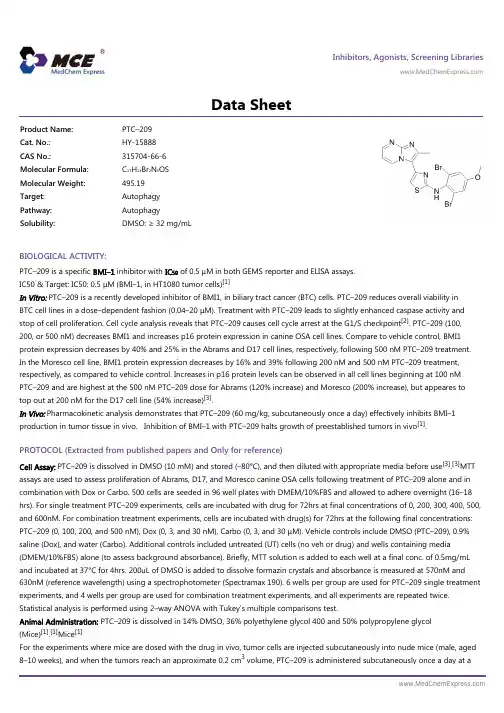
Inhibitors, Agonists, Screening Libraries Data SheetBIOLOGICAL ACTIVITY:PTC–209 is a specific BMI–1 inhibitor with IC 50 of 0.5 μM in both GEMS reporter and ELISA assays.IC50 & Target: IC50: 0.5 μM (BMI–1, in HT1080 tumor cells)[1]In Vitro: PTC–209 is a recently developed inhibitor of BMI1, in biliary tract cancer (BTC) cells. PTC–209 reduces overall viability in BTC cell lines in a dose–dependent fashion (0.04–20 μM). Treatment with PTC–209 leads to slightly enhanced caspase activity and stop of cell proliferation. Cell cycle analysis reveals that PTC–209 causes cell cycle arrest at the G1/S checkpoint [2]. PTC–209 (100,200, or 500 nM) decreases BMI1 and increases p16 protein expression in canine OSA cell lines. Compare to vehicle control, BMI1protein expression decreases by 40% and 25% in the Abrams and D17 cell lines, respectively, following 500 nM PTC–209 treatment.In the Moresco cell line, BMI1 protein expression decreases by 16% and 39% following 200 nM and 500 nM PTC–209 treatment,respectively, as compared to vehicle control. Increases in p16 protein levels can be observed in all cell lines beginning at 100 nM PTC–209 and are highest at the 500 nM PTC–209 dose for Abrams (120% increase) and Moresco (200% increase), but appeares to top out at 200 nM for the D17 cell line (54% increase)[3].In Vivo: Pharmacokinetic analysis demonstrates that PTC–209 (60 mg/kg, subcutaneously once a day) effectively inhibits BMI–1production in tumor tissue in vivo. Inhibition of BMI–1 with PTC–209 halts growth of preestablished tumors in vivo [1].PROTOCOL (Extracted from published papers and Only for reference)Cell Assay: PTC–209 is dissolved in DMSO (10 mM) and stored (–80°C), and then diluted with appropriate media before use [3].[3]MTT assays are used to assess proliferation of Abrams, D17, and Moresco canine OSA cells following treatment of PTC–209 alone and in combination with Dox or Carbo. 500 cells are seeded in 96 well plates with DMEM/10%FBS and allowed to adhere overnight (16–18hrs). For single treatment PTC–209 experiments, cells are incubated with drug for 72hrs at final concentrations of 0, 200, 300, 400, 500,and 600nM. For combination treatment experiments, cells are incubated with drug(s) for 72hrs at the following final concentrations:PTC–209 (0, 100, 200, and 500 nM), Dox (0, 3, and 30 nM), Carbo (0, 3, and 30 μM). Vehicle controls include DMSO (PTC–209), 0.9%saline (Dox), and water (Carbo). Additional controls included untreated (UT) cells (no veh or drug) and wells containing media(DMEM/10%FBS) alone (to assess background absorbance). Briefly, MTT solution is added to each well at a final conc. of 0.5mg/mL and incubated at 37°C for 4hrs. 200uL of DMSO is added to dissolve formazin crystals and absorbance is measured at 570nM and 630nM (reference wavelength) using a spectrophotometer (Spectramax 190). 6 wells per group are used for PTC–209 single treatment experiments, and 4 wells per group are used for combination treatment experiments, and all experiments are repeated twice.Statistical analysis is performed using 2–way ANOVA with Tukey’s multiple comparisons test.Animal Administration: PTC–209 is dissolved in 14% DMSO, 36% polyethylene glycol 400 and 50% polypropylene glycol(Mice)[1].[1]Mice [1]For the experiments where mice are dosed with the drug in vivo, tumor cells are injected subcutaneously into nude mice (male, aged 8–10 weeks), and when the tumors reach an approximate 0.2 cm 3 volume, PTC–209 is administered subcutaneously once a day at aProduct Name:PTC–209Cat. No.:HY-15888CAS No.:315704-66-6Molecular Formula:C 17H 13Br 2N 5OS Molecular Weight:495.19Target:Autophagy Pathway:Autophagy Solubility:DMSO: ≥ 32 mg/mLdose of 60 mg per kg body weight (control animals received equal volumes of vehicle, 14% DMSO, 36% polyethylene glycol 400 and 50% polypropylene glycol). Tumor volume measurements are recorded every 3–7 d until the endpoint is reached.References:[1]. Kreso A, et al. Self–renewal as a therapeutic target in human colorectal cancer. Nat Med. 2014 Jan;20(1):29–36.[2]. Christian Mayr, et al. The BMI1 inhibitor PTC–209 is a potential compound to halt cellular growth in biliary tract cancer cells. Oncotarget. 2016 Jan 5; 7(1): 745–758.[3]. Shahi MH, et al. BMI1 is expressed in canine osteosarcoma and contributes to cell growth and chemotherapy resistance. PLoS One. 2015 Jun 25;10(6):e0131006.Caution: Product has not been fully validated for medical applications. For research use only.Tel: 609-228-6898 Fax: 609-228-5909 E-mail: tech@Address: 1 Deer Park Dr, Suite Q, Monmouth Junction, NJ 08852, USA。

第46卷第3期2021年6月广州化学Guangzhou ChemistryV ol. 46 No. 3Jun. 2021文章编号:1009-220X(2021)03-0078-05 DOI:10.16560/ki.gzhx.20210309气相-顶空色谱法测定艾拉莫德中潜在基因毒杂质氯甲烷、氯乙烷和2-氯丙烷含量徐甲,尤昆,尹春燕(江苏正大清江制药有限公司,江苏南京210033)摘要:建立了气相色谱法(GC法)对艾拉莫德中的潜在基因毒杂质氯甲烷、氯乙烷、2-氯丙烷进行定量检测。
结果表明,氯甲烷、氯乙烷、2-氯丙烷浓度均在5~40 μg/mL范围内,与峰面积线性良好,定量限浓度均为0.2 μg/mL,回收率范围均在90%~108%。
本研究建立的GC法能用于艾拉莫德中潜在基因毒杂质氯甲烷、氯乙烷、2-氯丙烷的检测。
关键词:艾拉莫德;氯甲烷、氯乙烷、2-氯丙烷;基因毒杂质;气相色谱法中图分类号:R979.5 文献标识码:A艾拉莫德在合成过程中使用了甲醇、乙醇、异丙醇和盐酸,有可能产生氯甲烷、氯乙烷和2-氯丙烷这类潜在基因毒杂质。
根据已有临床前研究发现这类杂质的DNA烷基化作用会导致诱变效应、致癌效应和致畸效应,参考ICH M7,按照TTC法计算。
按照ICH规定连续服用10年,则该类杂质的人体摄入量每人每天不能超过10 μg/天,艾拉莫德最大日服用量为50 mg,计算可知,艾拉莫德原料药中的氯甲烷、氯乙烷和2-氯丙烷限度不得超过200 ppm。
目前关于艾拉莫德含量和有关物质已有报道,但未见艾拉莫德中氯甲烷、氯乙烷、2-氯丙烷的相关研究。
在现有文献报道中,氯甲烷和氯乙烷的研究文献较多,2-氯丙烷研究的文献较少,未见氯甲烷、氯乙烷、2-氯丙烷同时检出的研究报道。
本文建立了气相色谱检测本品中潜在基因毒杂质的方法,并进行了相应的方法学验证,该方法简便快速,可为艾拉莫德的质量优化提供参考依据。
1 实验1.1仪器与试药Agilent 7890B气相色谱仪(带7697A顶空进样器);梅特勒电子天平XS205R。

分子量487.29溶解性(25°C)DMSO ≥ 90 mg/mL分子式C24H16Cl2O7WaterCAS号4091-99-0Ethanol储存条件3年 -20°C 粉末状生物活性H2DCFDA是可渗透细胞,用于检测细胞内活性氧 (ROS) 的探针。
ROS测量将H2DCFDA溶解在DMSO中以获得10mM储备溶液,并在使用前进一步稀释。
为了检测细胞内ROS水平,使用ROS敏感性探针H2DCFDA。
将贴壁细胞(ESC,difESC,eMSC,HeLa,U118)与PBS中的5μM染色溶液在37℃下在黑暗中孵育30分钟,然后用0.05%胰蛋白酶-EDTA溶液收获,悬浮在新鲜培养基中,并且用流式细胞仪立即分析。
将对照和PHA活化的淋巴细胞重悬浮于PBS中,与5μMH2DCFDA在黑暗中于37℃温育30分钟,并立即分析。
不同实验动物依据体表面积的等效剂量转换表(数据来源于FDA指南)小鼠大鼠兔豚鼠仓鼠狗重量 (kg)0.020.15 1.80.40.0810体表面积 (m)0.0070.0250.150.050.020.5K系数36128520动物 A (mg/kg) = 动物 B (mg/kg) ×动物 B的K系数动物 A的K系数例如,依据体表面积折算法,将白藜芦醇用于小鼠的剂量22.4 mg/kg 换算成大鼠的剂量,需要将22.4 mg/kg 乘以小鼠的K系数(3),再除以大鼠的K系数(6),得到白藜芦醇用于大鼠的等效剂量为11.2 mg/kg。
H2DCFDA 目录号M9096化学数据2mmmm m。

氢溴酸伏硫西汀质量标准英文回答:Hydrobromic acid, also known as hydrogen bromide, is a chemical compound with the formula HBr. It is a strong acid that is commonly used in various industries and laboratories. In this article, I will discuss the quality standards for hydrobromic acid, its uses, and some examples to illustrate its importance.Firstly, let's talk about the quality standards for hydrobromic acid. The purity of hydrobromic acid is an essential factor in determining its quality. The concentration of HBr in the acid is usually expressed as a percentage. For example, a high-quality hydrobromic acid may have a concentration of 48% or higher. Impurities in the acid, such as water, bromine, or other acids, should be kept at minimal levels to ensure its effectiveness and safety.In addition to purity, the quality of hydrobromic acid can also be assessed based on its physical properties. These properties include color, odor, and density. High-quality hydrobromic acid should be a clear, colorlessliquid with a pungent odor. Its density should be around 1.49 g/cm³. Any deviation from these physical properties may indicate impurities or degradation of the acid.Now, let's move on to the uses of hydrobromic acid. One of the most common applications of hydrobromic acid is in the synthesis of organic compounds. It is often used as a catalyst or reagent in chemical reactions. For example, it can be used to convert alkenes into alkyl bromides, which are important building blocks in the pharmaceutical and agrochemical industries.Hydrobromic acid is also used in the production of inorganic bromides, such as sodium bromide and potassium bromide. These compounds have various applications, including as flame retardants, disinfectants, and pharmaceuticals. Hydrobromic acid is also used in the synthesis of dyes and pigments, as well as in thepurification of metals.To illustrate the importance of hydrobromic acid, let's consider an example. Imagine a pharmaceutical company that is developing a new drug. They need to synthesize aspecific organic compound as an intermediate step in the production process. Hydrobromic acid can be used as a catalyst in this reaction, allowing the company to efficiently and selectively convert the starting material into the desired compound. Without hydrobromic acid, the synthesis process may be slower, less efficient, or even impossible.中文回答:氢溴酸,也称为氢溴化物,化学式为HBr。