
be动词,助动词、情态动词用法
- 格式:ppt
- 大小:293.00 KB
- 文档页数:35


be动词与助动词的用法
1.陈述句:be动词第一人称用am,第二人称用are,第三人称单数用is复数用are.
助动词do一般省略,直接用动词,注意动词时态和人称变化.有时在动词前加do,表示强调,加强语气.如:Do be quiet!
2.疑问句:be动词直接提前,其他部分不变(由陈述句转变).助动词do同样,由省略直接提前放置,后面动词不变,注意do的时态和人称变化.
3.否定句:be动词和助动词do后面加not.
be作助动词用的形式如下:
①am, is, are, was, were
②助动词+be:shall be, will be, can be, etc.
③have/has/had + been(完成时)
④am, is, …being(进行时)
(1)表达进行时态
句型 be + V-ing…(进行时态)
例:What are you reading?
(你正在阅读什么?)
I am reading a magazine.
(我正在阅读杂志。)
例:He will be taking a walk in the park at this time tomorrow morning.
(明天早晨此时他将会正在公园散步。)
例:She has been teaching English in our school for years.
(她已在我们学校教英语许多年了。)
解说 第一例句是表达现在进行时,第二例句是将来进行时,第三例句是现在完成进行时。
(2)表达被动语态
句型 be +p.p. …(被动语态)
例:English is spoken in both Canada and the United States.
(加拿大和美国都讲英语。) 例:Those keys were found in your drawer.
(那些钥匙是在你的抽屉里找到的。)
例:It can be done much faster in this way.

千里之行,始于足下。
第 1 页/共 2 页
be动词、助动词、情态动词用法总结及练习
动词是英语中最重要的词类之一。在动词中,有一些特殊的类型,包括be动词、助动词和情态动词。它们有着特定的用法和功能。下面是对这些特殊动词的用法总结,以及一些练习来挂念巩固学问。
1. Be动词的用法:
- 表示存在或状态:I am a student.(我是一名同学。)
- 表示身份、职业或特征:She is a doctor.(她是一名医生。)
- 表示时态和语态:He was playing basketball.(他正在打篮球。)
The book is being read by her.(这本书正在被她读。)
- 表示位置:The pen is on the table.(钢笔在桌子上。)
2. 助动词的用法:
- be, do, have:用于构成时态、语态和否定句等:She is studying for
the exam.(她正在为考试复习。) I don't like coffee.(我不宠爱咖啡。)
- Modal verbs(情态动词):can, could, may, might, must, shall,
should, will, would等。它们用于表示力量、可能性、义务、建议、恳求等:You should go to bed early.(你应当早睡。) He can speak three
languages.(他会说三种语言。)
3. 情态动词的用法:
- can:表示力量、许可或可能性。I can swim.(我会游泳。) Can I
use your pen?(我可以用你的笔吗?)
- could:过去式,表示过去的力量或可能性。When I was young, I
could run very fast.(我年轻时跑得很快。)
- may: 表示许可或可能性。You may use my computer.(你可以用我的电脑。)It may rain tomorrow.(明天可能会下雨。) 锲而不舍,金石可镂。
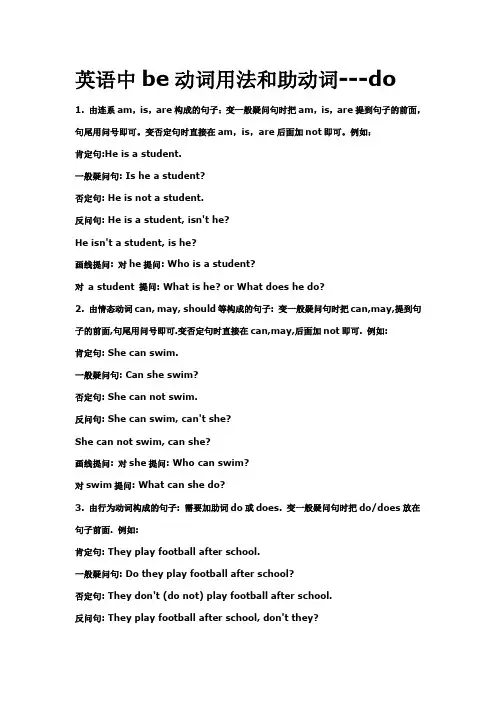
英语中be动词用法和助动词---do
1. 由连系am,is,are构成的句子:变一般疑问句时把am,is,are提到句子的前面,句尾用问号即可。变否定句时直接在am,is,are后面加not即可。例如:
肯定句:He is a student.
一般疑问句: Is he a student?
否定句: He is not a student.
反问句: He is a student, isn't he?
He isn't a student, is he?
画线提问: 对he提问: Who is a student?
对 a student 提问: What is he? or What does he do?
2. 由情态动词can, may, should等构成的句子: 变一般疑问句时把can,may,提到句子的前面,句尾用问号即可.变否定句时直接在can,may,后面加not即可. 例如:
肯定句: She can swim.
一般疑问句: Can she swim?
否定句: She can not swim.
反问句: She can swim, can't she?
She can not swim, can she?
画线提问: 对she提问: Who can swim?
对swim提问: What can she do?
3. 由行为动词构成的句子: 需要加助词do或does. 变一般疑问句时把do/does放在句子前面. 例如:
肯定句: They play football after school.
一般疑问句: Do they play football after school?
否定句: They don't (do not) play football after school.
反问句: They play football after school, don't they?

Be动词和情态动词专项练习
一、填空。
1.Be动词有___________ _____________ _____________。它们的意思是:_____________。
E.g. I am Andy. I am here.
2.There be句型表示:在…有…。
There_____________+单数名词或是不可数名词。There _____________+可数名词复数。
3.情态动词有_____________(必须) _____________(能) _____________(可以)。
二、用there be的适当形式填空。
1. __________________ some milk in the bottle.
2. __________________ seven days in a week.
3. __________________ any books on the bag? Yes, __________________.
4. __________________ a pen on the desk? No, __________________ not.
5. __________________ some trees in front of our classroom.
6. __________________ a swimming pool in our school.
7. __________________ a ruler and two pencils in the pencil-box.
8. __________________ any eggs on the plate? Yes, __________________.
9. __________________ two dogs and a cat in the room.