
初中英语介词知识点:介词的主要用法
- 格式:doc
- 大小:22.50 KB
- 文档页数:1


初中英语介词用法总结与归纳摘要介词是英语中一种重要的词类,它用来表示名词或代词与其他句子成分的关系,通常位于名词或代词之前。
介词可以分为简单介词和复合介词两种,常见的简单介词有at, in, on, for, to, from, by, with等,常见的复合介词有in front of, because of, instead of, by means of等。
介词的用法很多,本文将根据不同的场合和意义,归纳总结初中英语中常用的介词用法,并给出相应的例句和表格,帮助读者掌握和运用介词。
一、表示时间的介词表示时间的介词有at, in, on, before, after, by, until, till, for, during, since等,它们的用法如下:介词用法例句at表示时刻、时间点、节日、夜晚等at six o'clock at noonat Christmas at nightin表示年、月、季节、上午、下午、晚上等in 2023in Julyin winterin the morningon表示具体的某一天、某一天的上午、下午、晚上等on Mondayon July 1ston Monday morningbefore表示在……之前before noon before the examafter表示在……之后after school after lunchby表示在……之前(截止时间)by tomorrowby the end of this monthuntil/till表示直到……为止(持续时间)until/till next week until/till he comes backfor表示持续时间(多久)for two hours for a long timeduring表示在……期间(什么时候)during the summer vacation during the meetingsince表示从……开始(起点时间)since last year since he was born二、表示地点的介词表示地点的介词有in, on, at, to, from, across, along, around, behind, beside等,它们的用法如下:介词用法例句in表示在某个范围内,或在某个国家、城市、街道等较大的地方in Chinain Beijing介词用法例句in ZhongshanRoadon表示在某个表面上,或在某个楼层、台阶等较小的地方,或在某个方位上on the wall on the secondflooron the left/rightat 表示在某个具体的位置或地点,或在某个机构、场所等较小的地方,或表示靠近、附近等at the cornerat schoolat the bus stopto表示朝向某个方向或地点,或表示到达某个地点(范围之外)to the east to Japan to schoolfrom表示从某个地点出发或离开(范围之外)from home from Shanghai from Chinaacross表示横穿或穿过(从一边到另一边)across the street across the riveralong表示沿着或顺着(在一边)along the road along the riveraround表示围绕或环绕(在四周)around the lake around the worldbehind表示在……后面behind the door behind himbeside表示在……旁边beside the window beside her三、表示方向的介词表示方向的介词有to, from, into, out of, onto, off, up, down, through等,它们的用法如下:介词用法例句to表示朝向某个方向或地点,或表示目的地He is going to Beijing. She gave the book to me.from表示从某个方向或地点出发或离开,或表示来源He came from the south. This is a gift from my friend.into表示进入某个范围或空间(由外到内)He jumped into the water. She put the flowers into the vase.out of表示离开某个范围或空间(由内到外)He ran out of the room. She took the book out of the bag.onto表示移动到某个表面上(由低到高)He climbed onto the roof. She threw the ball onto the ground.off表示从某个表面上移开(由高到低)He fell off the bike. She took off her hat.up表示向上移动(由低到高)He went up the hill.介词用法例句She climbed up the ladder.down表示向下移动(由高到低)He came down the stairs. She slid down the slide.through表示穿过某个空间或物体(从一端到另一端)He walked through the forest. She looked through the window.四、表示方式、手段、工具的介词表示方式、手段、工具的介词有by, with, in, on等,它们的用法如下:介词用法例句by 表示交通工具、方式、方法等,或表示被动语态的动作执行者,或表示时间的截止点,或表示计量单位等by busby mistakeby himby tomorrowby weightwith 表示使用某种工具、器具、材料等,或表示伴随的人或物,或表示具有某种特征、状态等,或表示原因、理由等with a knifewith hisparentswith long hairwith joyin 表示使用某种语言、文字、颜色等,或表示穿着某种衣服,或表示处于某种状态、情况等,或表示在某种范围内等in Englishin black andwhitein a red dressin a hurryin generalon 表示使用某种电子设备、媒体等,或表示依靠某种力量、条件等,或表示以某种方式等,或表示参与某种活动等on TVon footon fireon dutyon holiday五、表示原因、目的、结果的介词表示原因、目的、结果的介词有for, at, from, of, with, by, because of, owing to, thanks to, out of, through等,它们的用法如下:介词用法例句for 表示原因、理由,常与sorry, famous, punish, praise, thank, blame等连用,也表示目的、意图,常与hope, wish, wait, look, come, go等连用,也可以表示用途、功能等for peacefor helpfor a walkfor funfor cutting paperat表示目的、意图,常与surprised, shocked, amazed, good, bad等连用,也可以表示针对、针对性等at his words at the news at math介词用法例句at solvingproblemsfrom 表示结果、效果,常与different, far, free, safe等连用,也可以表示来源、出发点等from the picturefrom now onfrom dangerfrom birthof 表示原因、理由,常与afraid, proud, sure, tired等连用,也可以表示所属、属性、特征等of the darkof himof the resultof his workwith 表示原因、理由,常与pleased, satisfied, angry, happy等连用,也可以表示伴随、方式、工具等with the answerwith himwith a smilewith a knifeby 表示方式、方法、手段等,也可以表示被动语态的动作执行者,或表示时间的截止点,或表示计量单位等by doing thisby himby tomorrowby weightbecauseof 表示原因、理由,相当于一个从句,后面接名词或代词等because of therainbecause of thatowing to表示原因、理由,相当于一个从句,后面接名词或代词等owing to the trafficjamowing to hisillnessthanks to表示原因、理由,含有感激或讽刺的意味,后面接名词或代词等thanks to yourhelp thanks to his carelessnessout of表示原因、理由,含有出于某种动机或感情的意味,后面接名词或代词等out of curiosity out of pitythrough表示原因、理由,含有经过某种过程或方式的意味,后面接名词或代词等through hard work through a window六、表示对象、范围的介词表示对象、范围的介词有of, for, about, with, to, from, among, between等,它们的用法如下:介词用法例句of表示所属、属性、特征等,也可以表示分离、脱离等the color of the skya cup of teaa friend of mineget rid of itfor表示目标、对象、受益者等,也可以表示目的、原因等 a gift for youa seat for twoa doctor for the poora room for rentabout表示主题、内容、话题等,也可以表示大约、左右等a book about history tell me about yourself about ten minuteswith表示伴随、陪同等,也可以表示方式、工具等stay with mea man with glasses speak with a loud voice cut it with a knifeto表示方向、目的地等,也可以表示对象、接受者等go to school fly to London say hello to him give it to herfrom表示来源、出发点等,也可以表示对象、对比者等come from Chinaa letter from my father different from youlearn from himamong表示在三个或三个以上的人或物之间(内部)share it among yourselves a flower among the grassbetween表示在两个人或物之间(内部或外部)sit between thema river between two mountains七、其他常用的介词除了上述介词外,还有一些其他常用的介词,如as, like, except, without, beyond, above, below, over, under等,它们的用法如下:介词用法例句as表示身份、职业、角色等,也可以表示方式、方法、程度等as a teacher as usual as you know as well aslike表示相似、类似等,也可以表示喜欢、喜爱等like a birdlike father, like sonI like music.except表示除……之外(不包括)everyone except me every day except Sundaywithout表示没有、缺少等without money without water without a wordbeyond表示超出、超过等beyond the wall beyond my expectation beyond controlabove表示在……之上(不接触)above the ground above sea levelabove allbelow表示在……之下(不接触)below the surface below zero below averageover表示在……之上(覆盖或接触)over the bridge over his head over the phoneunder表示在……之下(覆盖或接触)under the tree under his arm under the weather。
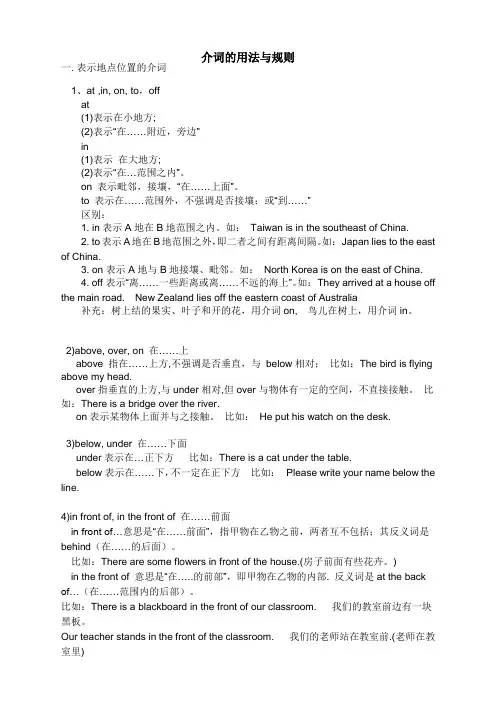
介词的用法与规则一. 表示地点位置的介词1、at ,in, on, to,offat(1)表示在小地方;(2)表示“在……附近,旁边”in(1)表示在大地方;(2)表示“在…范围之内”。
on 表示毗邻,接壤,“在……上面”。
to 表示在……范围外,不强调是否接壤;或“到……”区别:1. in表示A地在B地范围之内。
如:Taiwan is in the southeast of China.2. to表示A地在B地范围之外,即二者之间有距离间隔。
如:Japan lies to the east of China.3. on表示A地与B地接壤、毗邻。
如:North Korea is on the east of China.4. off表示“离……一些距离或离……不远的海上”。
如:They arrived at a house off the main road. New Zealand lies off the eastern coast of Australia补充:树上结的果实、叶子和开的花,用介词on, 鸟儿在树上,用介词in。
2)above, over, on 在……上above 指在……上方,不强调是否垂直,与below相对;比如:The bird is flying above my head.over指垂直的上方,与under相对,但over与物体有一定的空间,不直接接触。
比如:There is a bridge over the river.on表示某物体上面并与之接触。
比如:He put his watch on the desk.3)below, under 在……下面under表示在…正下方比如:There is a cat under the table.below表示在……下,不一定在正下方比如:Please write your name below the line.4)in front of, in the front of 在……前面in front of…意思是“在……前面”,指甲物在乙物之前,两者互不包括;其反义词是behind(在……的后面)。

初中英语介词的用法一、介词按其构成可分为:1. 简单介词 at, in, on, to, since, until 等。
如:He's worked there since 1998.2. 复合介词 into, onto, out of 等。
如:She is out of school. 她毕业了。
3. 二重介词 from under, from behind, from out of, until after, except in 等。
如:I'm from out of town. 我是从城外来的。
4. 短语介词 because of, instead of, in spite of 等。
如:I went back not because of the rain, but because I was tired.我回去不是因为下雨,而是因为我累了。
二、介词的作用:1. 表示地点:after, along, at, below, by, of, near, over, through, under 等。
如:Near the village the boys are skating on the ice. 男孩子们正在村子附近的冰上滑冰。
They lay down under the shade of a tree. 他们躺在一棵树的树阴下。
2. 表示时间:about, after, across, at, during, for, in, of, till, until 等。
如:After class he will tell us about the accident. 课后他将告诉我们有关事故的情况。
A heavy rain has been falling across three days. 一场大雨下了整整三天。
The accident happened during the night. 事故发生在夜间。

初中英语介词用法总结一、表示时间的介词:1. at: 通常用来表示具体的时刻,例如 at 6 o'clock(6点), at noon(中午)。
2. in: 用来表示较长的时间段,如 in the morning(早上),in summer(夏天)。
3. on: 用于特定的日期或天,例如 on Monday(星期一),on Christmas Day(圣诞节)。
二、表示地点的介词:1. in: 用于表示大的区域或内部位置,如 in the kitchen(在厨房),in London(在伦敦)。
2. on: 用于表示较小的平面面积,如on the table(在桌子上),on the street(在街上)。
3. at: 用于表示具体位置或地点,如 at school(在学校),atthe park(在公园)。
三、表示方式、方式、原因的介词:1. by: 表示通过某种方式或手段,如 by bus(乘公交车),by email(通过电子邮件)。
2. with: 表示伴随或使用某物,如with friends(和朋友一起),with a pen(用一支笔)。
3. for: 表示目的或原因,如 for fun(为了好玩),for the reason (因为...)。
四、表示动作方向的介词:1. to: 表示运动或行动的方向,如 go to school(去学校),send a letter to(寄一封信给)。
2. into: 表示进入某个内部空间,如 jump into the pool(跳进游泳池)。
五、表示关系和连接的介词:1. of: 表示所有关系,如 a photo of my family(我家的照片)。
2. with: 表示随同或具有某种关系,如 a girl with long hair(一位长发的女孩)。
3. to: 表示某种连接或关联,如 the key to the door(开门的钥匙)。