
Differences in the Metacognitive Awareness of Reading Strategies among Advanced, High- Intermed
- 格式:pdf
- 大小:244.92 KB
- 文档页数:6


New English Curriculum for Chinese Primary Schools andJunior/Senior Middle SchoolsExperimental Version drafted by the Education Ministry of the PRCPart 1: IntroductionWith the advent of the information age and the global economy, English has become increasingly important. English is the dominant carrier of information and the most widely spoken language in the world. Many countries have made English a cornerstone of quality education when developing strategies for basic education.Since China’s reform and opening, the scale of its English education has continually grown, attended by significant achievements in teaching and learning. However, English education in its current form is failing to meet the needs of contemporary social and economic development.The current round of reforms to the English curriculum aim to end the following practices:●Over-emphasizing the transmission and explanation of knowledge about grammar and vocabulary●Neglecting to develop students’ ability to use language for realIn their place, the reforms aim to establish a curriculum that:●Develops students’ comprehensive language competence●Motivates students, is relevant to their life experiences and cognitive level●Promotes task-based teaching methods●Involves students in experiential, practical, participatory and cooperative learning●Develops students’positive attitudes, thinking skills, practical abilities, cultural awareness andautonomy through the language learning process1.The Nature of the New CurriculumThe new English curriculum strives to accomplish far more than just help students learn English. At one level learning English should involve helping students to:●Develop a certain level of comprehensive language competence and the ability to use language forreal communication●Master certain basic language knowledge●Master listening, speaking, reading and writing skillsHowever, at another level the curriculum should also serve students’ all-round development, providing them with opportunities to:●Strengthen their interest in studying English●Grow in self-discipline, perseverance and self-confidence●Improve their cooperative, investigative and thinking abilities●Develop their memory, imagination and creativity●Adopt good study habits and effective learning strategies●Develop as autonomous and lifelong learners●Build moral integrity and a healthy outlook on life●Establish both national spirit and an awareness of and respect for cultural differences●Broaden their horizons and enrich their life experience●Take part in cultural life●Develop as individuals2.Basic Principles of the New CurriculumThe curriculum promotes quality education (as opposed to exam-orientated education) and the all-round development of the studentsTo promote quality education particular attention must be paid to:●Valuing each stude nt’s feelings●Stimulating students’ interest in studying English●Helping students gain a sense of achievement and self-confidenceThe curriculum must go beyond developing students’comprehensive language competence to include areas such as:●Improving students’ ability to contribute to cultural and social life●Developing students’ practical abilities●Fostering students’ creativityThe curriculum objectives are holistic and flexible.The fundamental aim of the new English curriculum is to develop students’comprehensive language competence. This aim is broken down into five general objectives. These objectives are then divided into nine ability levels with descriptors provided for each level. The five general objectives are:nguage Skillsnguage Knowledge3.Attitudes to Learning4.Learning Strategies5.Cultural AwarenessThis design allows students to progress systematically through each level whilst meeting the full range of the curriculum’s demands.Students are put at the centre of the curriculum and individual differences are respected Students’ must be at the heart of the new curriculum. For example, their developmental needs must be the central consideration when developing:●Curriculum objectives●The teaching and learning process●The assessment process●Teaching and learning resourcesWhen implementing the curriculum each student must be allowed to develop individually under the guidance of the teacher:The curriculum promotes activity-based methods, experiential and participatory learningThe curriculum promotes task-based learning whereby, under the guidance of the teacher, the students gain a sense of achievement by reaching the goals of the task. Task completion will involve the following types of learning:●Sensory●Experiential●‘Hands on’/practical●Participatory●CooperativeIn order to improve their ability to use language for real communication, students should also be able to: ●Adjust their learning strategies and control their emotions●Form positive attitudes towards learningThe curriculum recognizes the important role of formative assessment in promoting student’developmentThe assessment system should combine formative with summative assessment. The purposes of assessment should be to:●Promote students’ comprehensive language competence●Encourage and motivate students●Help students become more autonomous learners●Benefit students’ healthy personal development●Give teachers useful feedback from which to develop teaching and learning●Inform the ongoing development and perfection of the English curriculumFormative assessment should be an important part of the English teaching and learning process with a particular emphasis on:●Encouraging students’ active participation in learning●Improving students’ self-confidenceSummative assessment should focus on:●Testing students’ integrated language skills●Testing students’ ability to use languageThe curriculum expands the range of learning resources and opportunities availableThe curriculum should strive to use and develop resources whose content is:●Realistic●Close to the students’ lives●Contemporary●Healthy●Rich and variedActive use should be made of:●Audio visual material●Print media●The InternetStudents should be encouraged to take responsibility for finding, using and developing learning resources themselves.3.The Curriculum DesignThe curriculum follows the international practice of dividing the general objectives into different ability levels. When designing these nine levels consideration was given to the following:●The nature of language development●The different needs of different age groups●The needs of different ethnic groups and areas●The economic imbalances that exist in ChinaThe aim is to have designed a system that is holistic and flexible.The correspondence between the level system and the grade system is shown in the following diagram:Part 2: Introduction to The General ObjectivesThe fundamental aim of the new curriculum is to develop students’ comprehensive language competence.This comprehensive language competence is achieved through the five general objectives as shown in the following diagram:Diagram 2: The General ObjectivesA further diagram illustrates the more comprehensive nature of the new curriculum compared to the old●Language skills and knowledge form the basis of comprehensive language competence●The students’attitudes to learning strongly influence their learning and development●Successful learning strategies improve the effectiveness of students’ learning●Cultural awareness ensures students use language appropriatelyThe overall descriptors for comprehensive language competence (i.e. a combination of all five general objectives) for Levels 1 to 9 are presented below:Part 3: The General Objectives in DetailDetailed descriptors for Levels 2 and 5 of each of the five general objectives are presented in thefollowing tables. Please refer to the translation of the senior English curriculum (available from the VSO Programme Office) for Level 6 – 9 descriptors.Part 4: Guidelines for Implementation1.Suggestions for Teaching and Learning1.1Lay the groundwork for students’ all-round and lifelong developmentTeaching and learning should meet the diverse needs of all students, ensuring the healthy development of their mind and body. In particular the teacher should pay attention to the following:●Encourage students to use English bravely, taking a lenient attitude towards mistakes they makeduring the learning process.●Provide students with ample opportunities to collaborate with others and to become autonomouslearners.●Give students plenty of space for self-development.●Encourage students to develop their language skills in an integrated way through experiential,practical, cooperative and inquiry-based learning.●Create conditions that allow students to explore questions they are personally interested in and solveproblems by themselves.1.2Create a relaxed, democratic and harmonious learning environmentPositive attitudes are an essential condition for effective learning. Negative attitudes can not only reduce the effectiveness of study but also adversely affect students’long-term development. In particular, teachers should heed the following:●Respect each individual student, actively encouraging everyone to try and safeguarding theirself-esteem and enthusiasm.●Integrate students’English education with their emotional education. Develop cooperative spirit byorganizing learning activities that let students work together, help each other and experience group recognition and achievement.●Pay particular attention to introverted students or weak learners, trying to give them as many languagepractice opportunities as possible.●Establish a friendly and democratic channel of communication between students and teacher,frequently reflecting on the learning process and results together, and offering mutual help and support.1.3Use task-based learning methods to promote students comprehensive language competence Teachers should try to adopt task-based learning methods as much as possible. Teachers should creatively design learning activities that are relevant to the students’ real lives, according to the overall curriculum objectives and content. Teachers should engage students’interest in the activity and organize them effectively so that they participate actively and complete the tasks, learning and using English through thinking, carrying out surveys, discussing, communicating and cooperating. Attention should be paid to the following points when designing tasks:●Activities must have clear and achievable aims and objectives.●Activities must be relevant to students’ life experiences and interests; the content and style should beas true to life as possible.●Activities should be of a cross-curricular nature, promoting the integrated development of students’thinking and imagination, aesthetic and artistic sense, cooperative and creative spirit.●Activities should make students gather, process and use information, using English to communicatewith others in order to develop their ability to use English to solve real problems.●Activities should not purely be limited to the classroom but also extend to out of school learning.1.4. Provide increased guidance about learning strategiesHelping students to adopt good study habits and effective learning strategies is one of the important tasks of the new curriculum. Teachers should consciously give students guidance about learning strategies so that, through learning and using English, they are learning how to learn. To this end the teacher should observe the following:●Give students chances to establish their own study targets and the means of fulfilling these.●Help students to use inference, research and inquiry style methods to carry out their learning.●Develop students’ practical abilities and creative thinking by designing inquiry based activities.●Encourage students to use observation, discovery and induction to acquire language knowledge andgrasp language functions.●Help students to carry out self-assessment during the learning process and adjust their own learningobjectives and strategies appropriately according to the results.1.4Develop students’ awareness of and ability in cross-cultural communicationLanguage and culture are closely related, language being the main transmitter and carrier of culture. Teachers should work hard to help students achieve the following during the English learning process:●Understand foreign cultures, especially those of English speaking countries●Use English appropriately●Constantly broaden their cultural horizons●Deepen their understanding of their own culture●Develop an awareness of and ability in cross-cultural communication1.5Use modern teaching technology and expand learning opportunitiesIn order to increase the effectiveness of teaching and learning, teachers should make good use of modern technology, expand the range resources and opportunities through which students can learn, thereby modernizing learning ways. Conditions permitting, teachers should try to:●Use audiovisual material and the Internet to enrich the learning content and form and improveoutcomes.●Use computer and multi-media software to explore new teaching and learning methods and promotemore individualized study.●Create conditions for students to study more independently through sensible use of a variety oflearning resources, such as broadcasts, print media, libraries and the Internet.1.6Organize lively and active extracurricular activities to promote students’ English learning Teachers should arrange a variety of extracurricular activities according to the students’ age and interests to help them expand their knowledge, broaden their horizons, strengthen their intellect and individuality and use their talents. The content and form of these carefully planned activities should be rich and varied. Suggestions include:●Recitals●Songs●Story telling●Speeches●Performances●English corner●English wall displays●Cclass discussions●ExhibitionsThe teacher should be good at leading these activities to maintain students’interest and foster their creativity and initiative.1.7Continue to develop professionallyTeachers should aim to:●Familiarize themselves with the principles, objectives, content, teaching and learning methods,psychological theories and language learning research findings of this curriculum●Select and adjust English teaching and learning strategies according to their students’ psychologicalcharacteristics●Develop their ability to organize and monitor activities●Use a variety of teaching skills and methods flexibly●Master the use of modern educational technology, using it increasingly in their own continuing studyand real classroom practice●Consciously deepen their knowledge of Chinese and foreign cultures●Actively and creatively explore which teaching and learning methods best suit their students’ needs,local conditions and the objectives●Continuously reflect on their own practice, endeavouring to become a creative and research driventeacher1.8Follow high frequency principles to ensure effective teaching and learningIn Grades 3-6 there should be a minimum of four teaching and learning periods per week, with shorter periods for the younger years. For Grades 5 and 6 classes should not exceed two periods in length. In order to ensure the effectiveness of teaching and learning, class sizes should not exceed 40 at primary level. Grades 7 –9 and senior school students should have a minimum of four lessons a week.2.Suggestions for Assessment and EvaluationAssessment and evaluation is an important component of the new curriculum. Assessment should be carried out according to the requirements of the curriculum standards, focusing not only on the results but also the process of learning. The primary purposes of assessment are to:●Let students continuously experience progress and success during the learning process●Let students know their own progress and build confidence●Promote all aspects of students’ comprehensive language competence●Provide the teacher with feedback on the teaching and learning process●Help the teacher reflect on their own teaching practice and adjust it accordingly●Help the teacher continuously improve the quality of their teaching●Provide the school with prompt feedback on the implementation of the curriculum●Help improve educational management●Inform the ongoing development and perfection of the new English curriculumThe assessment system should diversify both the subjects and forms of assessment. Assessment should focus on students’comprehensive language competence, combining both formative assessment (concentrating on the study process) and summative assessment (concentrating on the learning outcomes).Ensure that students are the subjects (not objects) of assessmentStudents are at the centre of learning. The development of their comprehensive language competence should be the starting point for both teaching and learning and assessment.●Assessment should help students know their own progress, develop self-confidence, reflect on andadjust their own study process, thereby ensuring the continuous development of their language ability.●Teachers should help students carry out self-assessment.●Students should be active participants and collaborators in a variety of assessment activities.●Assessment should be an organic part of teaching and learning activities.●Assessment should help students to analyse their own successes and shortcomings, clarifying thedirection in which they need to work.Make sure formative assessment plays a role in student developmentFormative assessment is an important component and driving element of teaching and learning. Formative assessment should check the students’learning outcomes, attitudes and strategies during the everyday learning process. The purpose of formative assessment is to encourage students, help students adjust the learning process effectively, help students gain a sense of achievement, strengthen their self-confidence, and improve their cooperative spirit. Formative assessment helps students develop from passive objects of assessment to active participants in the assessment process. In order to let formative assessment become an organic part of the study process its important to:●Establish an open and relaxed atmosphere for assessment●Use both tests and other methods●Use a combination of individual and small group assessment●Encourage students, classmates, teachers and parents to collectively participate in assessment, therebydiversifying the subjects of assessmentFormative assessment can take many forms, such as:● A learning portfolio●Questionnaires●Interviews●Feedback from parents●Everyday quizzes and testsFormative assessment can be recorded in the form of descriptions, levels or marks. No matter what method is used, the role of assessment in encouraging learners must not be forgotten. According to the assessment results, teachers should give students individual feedback, ensuring their steady progress and encouraging them to reflect on and better themselves.Make sure assessment methods are varied and flexibleTeachers must select assessment methods suitable for the age of the students and the learning conditions. During formal assessment teachers should permit students to select assessment methods that suit their characteristics or strengths. If students get unsatisfactory results during a certain test they should be allowed to negotiate with the teacher to retake the test after sufficient preparation.Make sure assessment feedback is used to increase the effectiveness of teaching and learning The teacher should ask themselves the following questions:●Does the assessment help promote autonomous learning and self-confidence?●Does the assessment reflect the students’ achievements?●Does the assessment reflect the teachers’ strengths and weaknesses?●Does the assessment reflect problems in the students’ learning process?Teachers should promptly adjust their teaching methods and plans according to assessment feedback.Summative assessment should focus on checking students’ comprehensive language competence Summative assessment (such as end of term exams and graduation exams) is the main means of measuring the level of students’ comprehensive language competence. It also reflects the effectiveness of the teaching and learning process and is a major indicator of the schools’ quality in managing teaching and learning. Summative assessment must have the target of assessing students’ comprehensive language competence, striving to scientifically and comprehensively check students’ language level at the end of a particular stage of learning. The following should be observed:●Exams should include oral, listening and writing amongst other components in assessing students’comprehensive language competence.●Listening tests must account for a minimum of twenty percent of termly, yearly and graduation exams.●Listening tests should check students’ understanding and ability to gain information rather than askingthem to distinguish between different pronunciations.●Writing exams should avoid testing knowledge of phonetics or grammar in isolation.●There should be an increase in questions that require students to use English in a specific languagecontext.●Objective questions with a single correct answer should be reduced in favour of more subjectivequestions with several correct answers.●Exam results should not be publicly displayed nor students ranked in order of their results.Recognize the special characteristics of assessment for Grades 3 – 6The main purpose of assessment at primary level should be to encourage students’interest and active participation in learning English. Assessment methods should be varied and choice should be offered. Formative assessment should be the main type, focusing mainly on students’ performance and ability to cooperate during a variety of everyday teaching and learning activities.●In Grades 3 and 4 end of term or end of year assessment should use assessment activities similar tonormal teaching and learning activities. Through observing students’behaviour and discussing with them teachers should assess their ability to use English to do things.●For end of term or year assessment in Grades 5 and 6 a combination of oral and written tests can beused. Oral tests should check students’ ability to use language to communicate about content close to their real lives. Written tests should focus on checking their listening and reading skills, using methods that are as active and lively as possible.Pay attention to the relationship between assessment and teaching and learningPay attention to the proportion of teaching and learning time spent on assessment. Only carry out assessment that has useful results. Avoid over-elaborate and time-consuming assessment processes. Don’t let assessment become the sole end of teaching and learning.The assessment of each level should be founded on the general objectivesThe general objectives should be the basis for all assessment. Since the assessment of Level 2 will be organized by individual places and schools, formative assessment should be the main means. The same applies to all other levels apart from Levels 5 and 8, whose assessment is organized by national and provincial education bodies. Selection exams should unite the requirements of this curriculum with those of local conditions to establish suitable levels and test demands.Example 1: Self assessment questionnaire for Grade 7-9 students about learning strategies Includes statements such as:●I can concentrate during study.●During communication I use gestures and facial expressions to help express myself.●I often use associations to help study and remember new wordsStudents choose between ‘never’, ‘rarely’, ‘sometimes’, ‘often’ and ‘always’.Example 2: Assessment reference sheet for Grade 3-6 for English ‘playing, performing, watching, speaking and listening’Example 3: Formative assessment scheme for Grade 3-6 listening at Level 2Example 4: Guidelines for using student portfoliosPortfolios might include:●Some kind of baseline assessment!- ●Examples of the students’ best written homework, as selected by themselves●Teachers’ and parents’ observations on the students’ study situation●Results of tests and quizzes marked by the teacher, student or students’ classmates, either as grades orwritten comments●Students’ self-assessments and reflections on their own attitude, methods and outcomesExample 5: Guidelines for oral testsEnd of term or end of year oral tests should test students’real ability to express themselves orally. Students can be tested in groups of two, three or four. According to a situation or topic (that might be presented through words or pictures), students discuss and communicate. Teachers should assess their oral expression, communicative ability and effectiveness. The following questions may be useful:●Is information coherent and easily expressed? (Students may make grammar and vocabulary mistakesthat affect the accuracy but the basic information is still transmitted effectively.)●Are the pronunciation, intonation and rhythm natural? Can the speaker be understood?●Does the speaker use appropriate communication strategies, such as repetition, clarification, usingexpressions and gestures, to complete the activity successfully?Example 6: Reference sheet for the assessment of writing for Levels 3 – 8.3.Exploitation and Use of Curricular Resources4.The compilation of teaching materials and guidelines for their useSource of this translation:英语课程标准教师读本(修订本),华中师范大学出版社,2003,武汉,ISBN 7-5622-2557-5/G.1317。
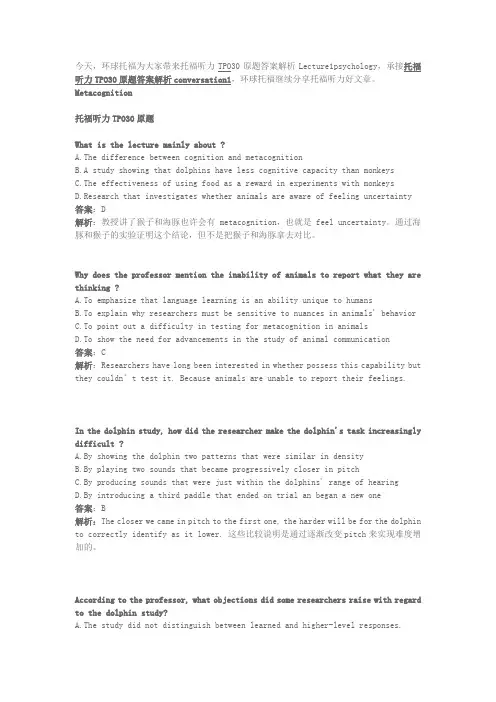
今天,环球托福为大家带来托福听力TPO30原题答案解析Lecture1psychology,承接托福听力TPO30原题答案解析conversation1,环球托福继续分享托福听力好文章。
Metacognition托福听力TPO30原题What is the lecture mainly about ?A.The difference between cognition and metacognitionB.A study showing that dolphins have less cognitive capacity than monkeysC.The effectiveness of using food as a reward in experiments with monkeysD.Research that investigates whether animals are aware of feeling uncertainty答案:D解析:教授讲了猴子和海豚也许会有metacognition,也就是 feel uncertainty。
通过海豚和猴子的实验证明这个结论,但不是把猴子和海豚拿去对比。
Why does the professor mention the inability of animals to report what they are thinking ?A.To emphasize that language learning is an ability unique to humansB.To explain why researchers must be sensitive to nuances in animals' behaviorC.To point out a difficulty in testing for metacognition in animalsD.To show the need for advancements in the study of animal communication答案:C解析:Researchers have long been interested in whether possess this capability but they couldn’t test it. Because animals are unable to report their feelings.In the dolphin study, how did the researcher make the dolphin's task increasingly difficult ?A.By showing the dolphin two patterns that were similar in densityB.By playing two sounds that became progressively closer in pitchC.By producing sounds that were just within the dolphins' range of hearingD.By introducing a third paddle that ended on trial an began a new one答案:B解析:The closer we came in pitch to the first one, the harder will be for the dolphin to correctly identify as it lower. 这些比较说明是通过逐渐改变pitch来实现难度增加的。

英语议论文三段式范文第一篇:Title: The Importance of Learning English as a Second Language Introduction:English is an essential language that connects people from different countries and cultures. It is no wonder that it has become the world's leading lingua franca. In this essay, we will look at the importance of learning English as a second language.Body Paragraph 1:Firstly, English is a widely spoken language. It is the official language of 53 countries and is spoken by over 1.5 billion people worldwide. Learning English would open up opportunities for us to travel, study, work and communicate with people from different cultures. It would benefit us both personally and professionally. Body Paragraph 2:English is also the language of business and international relations. Many companies require their employees to be proficient in English because it is a language that is used in global markets. In addition, English is the official language of international organizations such as the United Nations and the International Olympic Committee. Having a good command of English would enable us to participate in international conferences, negotiations, and events.Body Paragraph 3:Finally, English is the language of technology and the internet.Today, the internet is an indispensable part of our lives, and English is the primary language used online. From social media to e-commerce platforms to online education, everything is conducted in English. Learning English would allow us to access a vast array of information and take advantage of the latest technological advances.Conclusion:In conclusion, learning English as a second language is crucial in the modern world. It enables us to communicate with people from different cultures, work in global companies, and access the latest technological advances. Therefore, it is always a good idea to invest in learning English as a second language.Word count: 268第二篇:Title: The Negative Effects of Social MediaIntroduction:In today's world, social media has taken over our lives. We use it to communicate with friends, share pictures, exchange opinions and ideas, and find information. However, it also has some negative effects that we should be aware of. This essay aims to explore the negative effects of social media.Body Paragraph 1:One of the negative effects of social media is that it can lead to addiction. It is easy to get carried away by scrolling throughendless feeds and notifications, checking likes and comments. When we get addicted to social media, we lose track of time and end up neglecting our work, studies, hobbies, and relationships. In the worst-case scenario, it can cause anxiety, depression, and other mental health problems.Body Paragraph 2:Another negative effect of social media is that it can lead to cyberbullying. Cyberbullying is the use of technology to harass, humiliate or threaten others. People can post hurtful comments, spread rumors, or share embarrassing photos and videos. It can be especially damaging to children and teenagers who are more vulnerable to peer pressure and social exclusion.Body Paragraph 3:Furthermore, social media can also affect our self-esteem and body image negatively. We are bombarded with images of perfect bodies, lifestyles, and achievements that we may not be able to attain. We compare ourselves to others and feel inadequate, which can lead to low self-esteem, anxiety, and even eating disorders. Conclusion:In conclusion, social media has its negative effects that we should be aware of. It can lead to addiction, cyberbullying, and negative self-esteem and body image. Therefore, it is important to use social media responsibly and not let it control our lives.Word count: 261第三篇:Title: The Role of Education in the 21st CenturyIntroduction:Education plays a vital role in shaping the future of individuals and society as a whole. It is essential for personal growth, social development, and economic progress. In this essay, we will explore the role of education in the 21st century.Body Paragraph 1:Education is essential for personal growth and development. Through education, people acquire knowledge, skills, and values that enable them to lead fulfilling and meaningful lives. It helps them to understand the world and their place in it. Education also fosters critical thinking, creativity, and problem-solving skills that are essential in the modern workforce.Body Paragraph 2:Education is also crucial for social development. It helps to promote ethical and moral values that are necessary for a just and equitable society. Education promotes social cohesion, tolerance, and respect for diversity. It provides opportunities for individuals from different backgrounds to interact and learn from each other. Body Paragraph 3:Moreover, education is essential for economic progress. It helps to create a skilled workforce that is capable of meeting the demands of the global market. Education fosters innovation, entrepreneurship, and creativity that drive economic growth. It also helps to reduce poverty and inequality by providing people withthe skills and knowledge needed to secure better-paying jobs.Conclusion:In conclusion, education plays a crucial role in the 21st century. It is essential for personal growth, social development, and economic progress. Therefore, it is vital to invest in education and ensure that everyone has access to quality education that meets their needs.Word count: 255.第一篇:The Importance of Learning English as a Second LanguageEnglish has become the world's leading lingua franca for a reason - it connects people from different countries and cultures, facilitating communication in business, education, entertainment, and more. Therefore, it is essential, if not imperative, for people to learn English as a second language. In this essay, we will delve deeper into the importance of learning English and the benefits it brings to individuals and society.One of the most significant advantages of learning English is that it is a widely spoken language. English is the official language of 53 countries and is spoken by over 1.5 billion people worldwide. Therefore, being proficient in English opens up opportunities to travel, study, work, and communicate with people from different cultures. Whether you plan to visit a foreign country, pursue higher education abroad, or work in a global company, English is crucial in facilitating cross-cultural interactions and enabling international mobility.Moreover, English is the language of business and internationalrelations. Many companies require their employees to be proficient in English because it is a language that is used in global markets. In addition, English is the official language of international organizations such as the United Nations and the International Olympic Committee. Having a good command of English would enable us to participate in international conferences, negotiations, and events. It would also allow us to communicate effectively with clients, partners, and colleagues from around the world.Furthermore, English is the language of technology and the internet - a significant part of our daily lives. From social media to e-commerce platforms to online education, everything is conducted in English. Being proficient in English allows us to access a vast array of information and take advantage of the latest technological advances. Moreover, being able to communicate in English enables us to participate in online forums, discussions, and communities, sharing ideas and learning from others worldwide.Another benefit of learning English is the cognitive and psychological advantages it imparts. Studies have shown that bilingualism improves cognitive functions such as attention, memory, and problem-solving skills. Moreover, learning a new language enhances metacognitive awareness and empathy for different cultures, which, in turn, leads to a more complex and nuanced understanding of the world. This, in turn, builds overall cognitive and psychological resilience and enhances personal development.Finally, learning English as a second language is not only beneficial to individuals but also to society as a whole.Multilingual individuals contribute to a more diverse and inclusive society, fostering deeper cross-cultural understandings and reducing social prejudices. Multilingualism also has economic benefits - it can increase trade opportunities and attract foreign investments, leading to a stronger economy and job creation.In conclusion, learning English as a second language has become critical in the modern world. It enables us to communicate with people from different cultures, work in global companies, and access the latest technological advances. It also provides cognitive and psychological benefits and can contribute to a more diverse and inclusive society. Therefore, investing in learning English as a second language is a wise decision that can lead to personal and societal success.Word count: 499第二篇:The Negative Effects of Social MediaWhile social media has brought many benefits to our lives, it has also brought some apparent negative effects that we should be aware of. In this essay, we will examine the most significant negative effects of social media and the implications they have on our personal and social well-being.One of the most critical negative effects of social media is that it can lead to addiction. The dopamine hit that comes from checking notifications and receiving likes can lead to a habitual use of social media, causing people to lose track of time and become neglectful of other essential tasks. This addiction can cause anxiety, stress,sleep disorders, and depression, and its severity may eventually require professional help.Another negative effect of social media is that it can lead to cyberbullying. Cyberbullying is the use of technology to harass, humiliate or threaten others. People can post hurtful comments, spread rumors, or share embarrassing photos and videos. Cyberbullying can have an amplified impact on individuals' psychological well-being because it can be conducted anonymously and can reach a massive audience quickly. Moreover, cyberbullying can lead to social exclusion, anxiety, and depression, especially among young children and teenagers who are more vulnerable to this form of aggression.Additionally, social media can influence personal self-esteem and body image negatively. Images of "ideal" physical features, so often portrayed in movies, TV shows, Instagram, and other platforms, can create unrealistic expectations of physical appearance in people. Unrealistic expectations of beauty can leadto feelings of self-doubt, inadequacy, anxiety, and depression. Social media's impact on body image can have alarming consequences, leading to eating disorders, substance abuse, and suicidal ideation.Moreover, social media's role in enabling the spread of disinformation has become a growing concern in today's fast-moving society. Fake news, false information, and propaganda can spread over social media at breakneck speed, impacting people's belief systems and influencing their actions. The lack of gatekeepers and quality control means that everyone can publishmisleading and inaccurate information, leading to a lack of trust in media sources and diminished accountability.In conclusion, while social media has many benefits, it is crucial to recognize the negative effects it can have on our individual and societal well-being. The addiction it can create, the cyberbullying it can enable, the negative self-image it can promote, and the spread of misinformation it can facilitate are all issues that need to be addressed. As we continue to expand our use of social media, it is essential to use these platforms responsibly and address the negative impacts they can have on our society.Word count: 498第三篇:The Role of Education in the 21st CenturyEducation has always played a vital role in shaping individuals and society as a whole, but its role has become even more critical in the 21st century. In this essay, we will explore the significance of education in the modern age and how it contributes to personal development, social progress, and economic growth.The primary function of education is personal growth and development. Education imparts knowledge, skills, and values that enable individuals to lead fulfilling and meaningful lives. A good education enhances one's ability to understand the complexities of the world and their place in it. Moreover, education fosters critical thinking, creativity, and problem-solving skills, essential traits needed to navigate the challenges of the modern workforce.Education also plays an essential function in social development. Education helps foster ethical and moral values, vital for a just and equitable society. Education promotes social cohesion, tolerance, and respect for diversity, reducing prejudices and social biases. Education brings people of different backgrounds together and creates opportunities for cross-cultural interactions, leading to deeper understandings and a more inclusive society.Moreover, education is essential for economic progress. A skilled workforce with advanced competencies is increasingly required to meet the demands of the global market. Education fosters innovation, entrepreneurship, and creativity, driving economic growth and societal progress. Education is also instrumental in reducing poverty and inequality by providing people with the skills and knowledge needed to secure better-paying jobs.Furthermore, the role of education is not limited to personal and societal development, but also extends to environmental and cultural preservation. Education can lead to sustainable lifestyles and behaviors, ensuring the long-term protection of the planet. Education promotes cultural preservation by enabling people to learn and appreciate their cultural heritage, reducing the likelihood of their extinction.In conclusion, education is essential in the 21st century, contributing to personal growth, social development, economic progress, environmental protection, and cultural preservation. Therefore, it is paramount to invest in education and ensure that everyone has access to quality education. Education is the foundation of our future, and it is the cornerstone of anyprogressive and prosperous society.Word count: 498The task is to provide a 300-word summary of the three essays with the given titles. The first essay discusses the importance of learning English as a second language. The second essay highlights the negative effects of social media, while the third essay talks about the role of education in the 21st century.Learning English as a second language has many benefits in the modern world according to the first essay. English is widely spoken worldwide and is the language of business, international relations, technology, and the internet. Bilingualism also enhances cognitive and psychological functions, leading to a more complex and nuanced understanding of the world. Finally, multilingualism contributes to a more diverse and inclusive society, reducing social prejudices, and increasing trade opportunities.The second essay discusses the negative effects of social media. Addiction to social media can lead to anxiety, stress, sleep disorders, and depression. Cyberbullying can lead to social exclusion, anxiety, and depression, especially among young people. Social media can negatively impact personal self-esteem and body image, leading to eating disorders, substance abuse, and suicidal ideation. Moreover, the spread of disinformation has become a growing problem, leading to a lack of trust in media sources and diminished accountability.Finally, the third essay highlights the importance of education in the 21st century. Education contributes to personal growth and development, social progress, and economic growth. Educationimparts knowledge, skills, and values that enable individuals to lead fulfilling and meaningful lives. Education fosters ethical and moral values, promotes social cohesion, tolerance, and respect for diversity. Education is also essential for economic progress, innovation, and entrepreneurship.In conclusion, learning English as a second language, social media's negative effects, and education's crucial role are discussed in the three essays. Learning English as a second language provides opportunities for international mobility, while social media can lead to addiction, cyberbullying, and the spread of disinformation. Education is essential for personal growth, social progress, economic growth, environmental protection, and cultural preservation. The essays provide valuable insights into the importance of language learning, the negative consequences of social media, and the significance of education in the modern age.。

活学活用是掌握知识的标志英语作文英文回答:Proficient use of knowledge is a hallmark of mastery in any field of study. To truly comprehend and retain information, it is not enough to simply memorize facts and concepts. Instead, individuals must engage in active and meaningful application of their understanding.One key aspect of proficient knowledge use is theability to apply concepts and theories to real-world situations. This involves being able to identify relevant knowledge, analyze complex issues, and develop innovative solutions. By engaging in this type of critical thinking, individuals demonstrate a deep comprehension of the subject matter and the ability to transfer their knowledge to various contexts.Another crucial aspect is the capacity for knowledge integration. Proficient knowledge users can connect ideasfrom multiple sources and perspectives, thereby expanding their understanding and broadening their perspectives. This involves recognizing relationships, identifying patterns, and synthesizing information to create a more comprehensive and nuanced view of the subject at hand.Furthermore, effective knowledge use requires a strong foundation in communication skills. Individuals must be able to articulate their ideas clearly and persuasively, both in written and oral form. This involves being able to present complex information in a logical and accessible manner, persuading others of their views, and engaging in meaningful discussions.In addition to these cognitive skills, proficient knowledge use also entails a range of metacognitive abilities. These include the ability to reflect on one's own learning, identify areas for improvement, and develop strategies for continuous growth. By engaging in metacognitive processes, individuals become more self-aware and better equipped to enhance their knowledge and skills.Overall, proficient use of knowledge is the culmination of a multifaceted set of cognitive, metacognitive, and communication skills. It reflects a deep understanding of the subject matter, the ability to apply knowledge to real-world situations, the capacity for knowledge integration, and the proficiency in communication and metacognition. Individuals who possess these qualities are well-equipped to succeed in their chosen fields and make meaningful contributions to society.中文回答:熟练运用知识是掌握知识的标志。