
reliability
- 格式:ppt
- 大小:5.05 MB
- 文档页数:62

信度與效度1、信度(reliability)與效度(validity)是所有測量的重要議題。
兩者都是關心我們所設計的具體指標與這些指標所預測之構念(construct)間的關係。
構念是指將一些觀念,事實或印象有系統的組織起來後,所形成的概念。
2、信度是指可靠性或一致性。
信度好的指標在同樣或類似的條件下重複操作,可以得到一致或穩定的結果。
信度有三種:⏹穩定信度(stability reliability):這是一種長期的信度。
也就是指標在不同時間做測量時,可以得到同樣的結果。
通常我們是用測試與再測試方法(test-retest method)來檢視一個指標的穩定信度,也就是將同樣的指標對同一群體重新施測,如果每次都得到同樣的結果,則此指標即有穩定信度。
⏹代表性信度(representative reliability):代表性信度是橫跨各個次母體或群組的信度。
也就是指標用於不同次母體或群組(如年齡、性別)時,可以得到同樣的結果。
例如,對年齡的測量,應該是詢問不同年齡層時,都可得到一致性的資訊,不論此指標是正確的問到年齡,還是有同樣方向的偏誤,如以多報少。
做次母群體分析(subpopulation analysis)時,除了比較指標使用在不同的次母群體或群組的結果外,還涉及利用其他獨立的資訊,以判斷指標使用在不同群組時所得到的結果是否有同樣的誤差。
⏹同等信度(equivalence reliability):同等信度是應用在利用多重指標測量同一構念的情況。
我們感興趣的是:是否不同指標能得到一致的測量結果?研究者常用折半法(the split-half method)來做此種信度的分析。
其作法是將測量同一構念的多重指標隨機分成兩組後進行測量,然後判定是否兩組指標得到相同的結果。
我們可以用如Cronbach’s α這種統計方法來做此種信度分析。
如果多重指標有相當的信度,我們就可利用這些指標來建構量表。
另一種同等信度的特殊分析方法是做編碼者間信度(intercoderreliability)的分析。
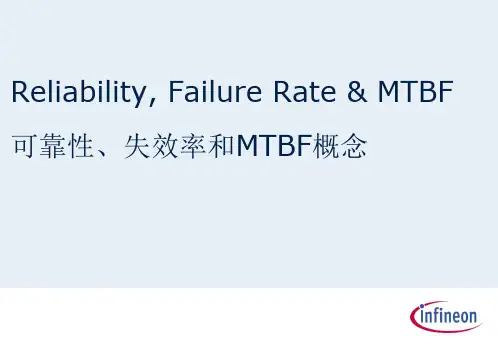
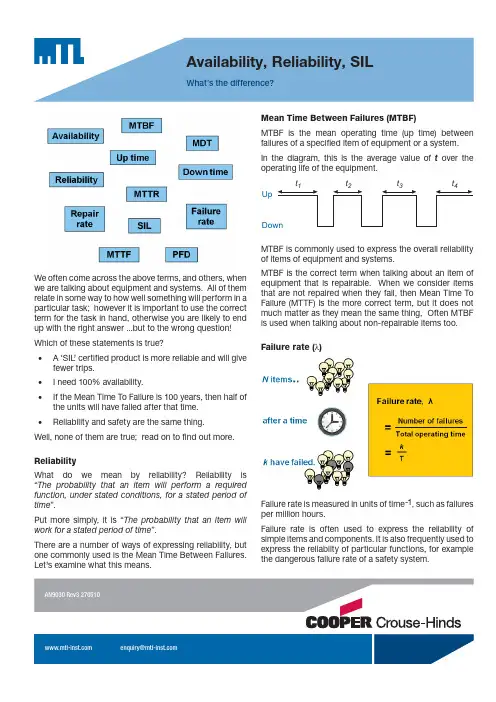
We often come across the above terms, and others, when we are talking about equipment and systems. All of them relate in some way to how well something will perform in a particular task; however it is important to use the correct term for the task in hand, otherwise you are likely to end up with the right answer ...but to the wrong question!Which of these statements is true?• A ‘SIL ’ certified product is more reliable and will give fewer trips.• I need 100% availability.• If the Mean Time To Failure is 100 years, then half of the units will have failed after that time.•Reliability and safety are the same thing.Well, none of them are true; read on to find out more.ReliabilityWhat do we mean by reliability? Reliability is “The probability that an item will perform a required function, under stated conditions, for a stated period oftime ”.Put more simply, it is “The probability that an item willwork for a stated period of time ”.There are a number of ways of expressing reliability, but one commonly used is the Mean Time Between Failures. Let’s examine what this means.Mean Time Between Failures (MTBF)MTBF is the mean operating time (up time) between failures of a specified item of equipment or a system.In the diagram, this is the average value of t over the operating life of the equipment.UpMTBF is commonly used to express the overall reliability of items of equipment and systems.MTBF is the correct term when talking about an item of equipment that is repairable. When weconsider items that are not repaired when they fail, then Mean Time To Failure (MTTF) is the more correct term, but it does not much matter as they mean the same thing, Often MTBF is used when talking about non-repairable items too.Failure rate (λ)Failure rate is measured in units of time -1, such as failures per million hours.Failure rate is often used to express the reliability of simple items and components. It is also frequently used toexpress the reliablity of particular functions, for example the dangerous failure rate of a safety system.Availability, Reliability, SILWhat’s the difference?AN9030 Rev3 270510Relationship between MTBF and λSinceMTBF=Total operating time Number of failuresandλ=Number of failures Total operating timeIt is implied thatMTBF=1λThis is true, but only if the failure rate does not change over time. Usually this is so for simple equipment but not so for redundant1 systems.As MTBF and λ are measuring the same thing, why have different terms?• MTBF (years, hours) – is most often used to express the overall reliability of equipment.• MTTF (Mean time to failure, years, hours) – more correct for items that are not repaired• λ (hr-1, pmh, FITs) – is con ven ien t to use for components, and it is easy to calculate the MTBF ofan item of equipment from the sum of the componentλs. It is also commonly used to express the reliabilityof a particular function, such as a safety function. The meaning of MTBFIt is all too easy to assume that MTBF means average life or expected life, or something like that. It does not.The table shows the percentage of units that will be still working, on average, after a time that is some multiple of the MTBF. For example, after a time equal to the MTBF only 37% of the units will still be working.If only one unit is being considered, then the table shows the probability that the unit will still be working after a given time. After a time equal to the MTBF, the probability that a unit will still be working is just 0.37.After a time equal to Percentage of units still working, or the probability thata single unit will still be working0.01 x MTBF99% 0.1 x MTBF90%0.5 x MTBF61%1 x MTBF37%2 x MTBF13%AvailabilityAvailability can be defined as“The proportion of time for which the equipment is able to perform its function”Availability is different from reliability in that it takes repair time into account. An item of equipment may not be very reliable, but if it can be repaired quickly when it fails, its availability could be high.Look again at the diagram we saw earlier:UpFrom this we can see what is meant by Up Time – the time when the equipment is available - and Down Time – the time when the equipment has failed and so is unavailable.The averages of each of these are:• Mean Up Time, which we have already seen is known as the MTBF• Mean Down Time, or MDTBy definition:Availability=Up timeTotal time=Mean up timeMean up time + Mean down time=MTBFMTBF + MDTSometimes Mean Time To Repair (MTTR) is used in this formula instead of MDT. But MTTR may not be the same as MDT because:• The failure may not be noticed for some time after it has occurred• It may be decided not to repair the equipment immediately• The equipment may not be put back in service immediately it is repairedWhether MDT or MTTR is used, it is important that it reflects the total time for which the equipment is unavailable for service, otherwise the calculated availability will be incorrect.In the process industries, MTTR is often taken to be 8 hours, the length of an ordinary work shift but in reality the repair time in a particular installation might be different.1 - A redun dan t system has two or more parallel paths so that the system continues to operate after the failure of one path.UnavailabilitySometimes unavailability can be a useful term: Unavailability= 1 – availability= 1 –MTBF MTBF + MDT=λ MDT 1 + λ MDT=λ MDTWhat is PFD?PFD means probability of failure on deman d. Safety systems are often designed to be working in the background, monitoring a process, but not doing anything until a safety limit is exceeded when they must take some action to keep the process safe. These safety systems are often known as emergency shut down (ESD) systems. PFD is the unavailability of a safety function. If a demand to act occurs after a time, what is the probability that the safety function has already failed? As you might expect, the formula for PFD looks very similar to the formula above for general unavailability:PFDavg ≈λDU MDTPFD avg means the average probability of failure on demand, which is really the correct term to use, since the probability does change over time – the probability of your system having failed will depend on how long ago you tested it.Note that we talk about λDU here, the failure rate of dangerous undetected failures. We are not counting any failures that are deemed to be ‘safe’, perhaps because they cause the process to shut down, only those failures which remain hidden but will defeat the operation of the safety function when it is called upon.This is important, as it warns us not to assume that a safety-related product is generally more reliable than a general purpose product. A safety-related product is designed to have a particularly low rate of failure of the safety function, but its total failure rate (or, equivalently, its MTBF) may not be very impressive.So, what is the MDT for a safety function? By definition, a dangerous undetected failure will not be apparent until either a demand comes along or it is revealed by a proof test.Suppose we proof test our safety function every year or two, say every T1 hours. The safety function is equally likely to fail at any time between one proof test and the next, so, on average it is down for T1 / 2 hours. From this we get the simplest form of PFD calculation for safety functions:PFDavg ≈½λDU T1What is SIL?SIL is one of the most misused terms in the field of reliability. ‘SIL’ is often used to imply that a product has better quality, higher reliability, or some other desirable feature. It does not.SIL means safety in tegrity level, a number between 1 and 4. It is used to describe the degree of safety protection needed by a process and consequently the safety reliability of the safety system necessary to achieve that protection. SIL1 is the lowest level of safety protection and SIL4 the highest.Many products are described as ‘SIL’ rated, implying that they are suitable for use in safety systems. Whether this is really true depends on a lot of detail, which is beyond the scope of this article. But remember that even when a product genuinely complies with ‘SIL’ requirements, that is only telling you that it will do a certain job in a safety system. Its safety reliability may be high, but its general reliability may not be, as we noted in the previous section. Useful to remember• An item is highly reliable if it works for a long time without failing.• An item is highly available if it does not fail very often and, when it does, it can be quickly returnedto service.• A system is considered to be safe, if it is reliable in performing its safety function. The system may fail much more frequently in modes that are notconsidered to be dangerous.• Consequently, a safety system may be less reliable in total (lower MTBF) than a n on-safety system performing a similar function.• ‘SIL’ is not a guarantee of quality or reliability, except in a defined safety context.• MTBF is a measure of reliability, but it does not mean the expected life, the useful life, or the average life.• Calculations of reliability and failure rate of redundant systems are complex and often counter-intuitive.© MTL Instruments 2010。
