
纸质书与电子书英语的比较
- 格式:pptx
- 大小:1.31 MB
- 文档页数:11


In the modern era,the debate between the merits of traditional paper books and the convenience of ebooks has been a topic of much discussion.Here,we will explore the advantages and disadvantages of both formats to provide a comprehensive comparison.Advantages of Paper Books:1.Tactile Experience:Paper books offer a physical experience that many readers find comforting.The feel of the pages,the smell of the paper,and the act of turning pages are all part of the reading experience.2.Less Distractions:Unlike ebooks,which can be used on devices that also access the internet and social media,paper books provide a distractionfree environment,allowing for a more focused reading experience.3.Eyesight:Reading from a paper book is generally considered easier on the eyes,as it does not involve the same level of screen glare that can be associated with digital reading devices.4.Aesthetic Appeal:Many book lovers appreciate the aesthetic value of a welldesigned book cover and the satisfaction of adding to their physical book collection.5.No Power Source Needed:Paper books do not require a power source,which means they can be read anywhere,anytime,without the worry of a dead battery. Disadvantages of Paper Books:1.Space Consumption:Accumulating a large collection of paper books can take up considerable space in a home or office.2.Weight and Portability:Carrying multiple paper books can be cumbersome,especially for those who like to read on the go.3.Environmental Impact:The production of paper books involves the use of natural resources and can have a significant environmental impact.Advantages of Ebooks:1.Convenience:Ebooks can be easily downloaded and stored on a single device, allowing readers to carry thousands of books with them wherever they go.2.Searchability:Ebooks often come with search functions that make it easy to find specific passages or words within the text.3.Adjustable Font Size:Readers can adjust the font size and style to suit their reading preferences,which can be particularly beneficial for those with visual impairments.4.Instant Access:With ebooks,there is no need to wait for a physical copy to be delivered they can be purchased and read almost immediately.5.CostEffectiveness:Ebooks are often less expensive than their paper counterparts,and some are even available for free.Disadvantages of Ebooks:1.Device Dependency:To read an ebook,one needs a compatible device,which can be a limitation for those without access to such technology.2.Battery Life:Ebooks require a power source,which can be inconvenient if the device runs out of battery during reading.3.Potential for Distractions:The same device used for reading ebooks can also access the internet,social media,and other distractions,which can interrupt the reading experience.4.Eyesight Concerns:Prolonged exposure to screens can cause eye strain and discomfort, although this can be mitigated with proper screen settings and regular breaks.5.Ownership and Accessibility:Ebooks are often subject to digital rights management DRM,which can limit how and where they can be read,and in some cases,may prevent permanent ownership of the content.In conclusion,the choice between paper books and ebooks often comes down to personal preference and the specific needs of the reader.While paper books offer a traditional and tactile reading experience,ebooks provide the convenience and portability of digital technology.Both formats have their place in the world of reading,and many readers choose to use a combination of both to suit their lifestyle and reading habits.。

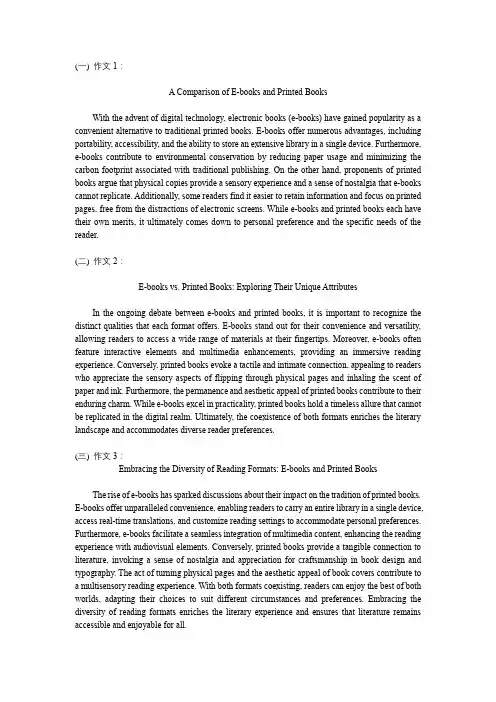
(一)作文1:A Comparison of E-books and Printed BooksWith the advent of digital technology, electronic books (e-books) have gained popularity as a convenient alternative to traditional printed books. E-books offer numerous advantages, including portability, accessibility, and the ability to store an extensive library in a single device. Furthermore, e-books contribute to environmental conservation by reducing paper usage and minimizing the carbon footprint associated with traditional publishing. On the other hand, proponents of printed books argue that physical copies provide a sensory experience and a sense of nostalgia that e-books cannot replicate. Additionally, some readers find it easier to retain information and focus on printed pages, free from the distractions of electronic screens. While e-books and printed books each have their own merits, it ultimately comes down to personal preference and the specific needs of the reader.(二)作文2:E-books vs. Printed Books: Exploring Their Unique AttributesIn the ongoing debate between e-books and printed books, it is important to recognize the distinct qualities that each format offers. E-books stand out for their convenience and versatility, allowing readers to access a wide range of materials at their fingertips. Moreover, e-books often feature interactive elements and multimedia enhancements, providing an immersive reading experience. Conversely, printed books evoke a tactile and intimate connection, appealing to readers who appreciate the sensory aspects of flipping through physical pages and inhaling the scent of paper and ink. Furthermore, the permanence and aesthetic appeal of printed books contribute to their enduring charm. While e-books excel in practicality, printed books hold a timeless allure that cannot be replicated in the digital realm. Ultimately, the coexistence of both formats enriches the literary landscape and accommodates diverse reader preferences.(三)作文3:Embracing the Diversity of Reading Formats: E-books and Printed BooksThe rise of e-books has sparked discussions about their impact on the tradition of printed books. E-books offer unparalleled convenience, enabling readers to carry an entire library in a single device, access real-time translations, and customize reading settings to accommodate personal preferences. Furthermore, e-books facilitate a seamless integration of multimedia content, enhancing the reading experience with audiovisual elements. Conversely, printed books provide a tangible connection to literature, invoking a sense of nostalgia and appreciation for craftsmanship in book design and typography. The act of turning physical pages and the aesthetic appeal of book covers contribute to a multisensory reading experience. With both formats coexisting, readers can enjoy the best of both worlds, adapting their choices to suit different circumstances and preferences. Embracing the diversity of reading formats enriches the literary experience and ensures that literature remains accessible and enjoyable for all.。

电子书籍与传统纸质书的比较英语作文范文In today's digital age, the debate between electronic books (e-books) and traditional printed books has become increasingly relevant. Both formats offer unique advantages and cater to different preferences among readers. This essay examines the merits and drawbacks of each format and explores how they contribute to the reading experience in contemporary society.Firstly, e-books provide unparalleled convenience and accessibility. With a digital device such as a tablet, smartphone, or e-reader, readers can carry an entire library with them wherever they go. This portability eliminates the need for physical storage space and allows for instant access to a vast range of titles. Moreover, e-books often feature adjustable text sizes and built-in dictionaries, enhancing readability and comprehension for users.However, traditional printed books offer their own distinct pleasures. Many readers appreciate the tactile experience of holding a physical book, turning its pages, and feeling the weight of the volume in their hands. Printed books also appeal to those who value the sensory aspects of reading, such as the smell of ink on paper or the aesthetic quality of a well-designed book cover. Furthermore, printed books do not require batteries or electronic devices, making them reliable in situations where access to electricity or technology may be limited.Another consideration is the environmental impact of each format. E-books generally consume fewer natural resources in their production and distribution compared to printed books, which require paper, ink, and transportation. Digital books contribute to reducing deforestation and carbon emissions associated with traditional publishing processes. However, the manufacturing and disposal of electronic devices used forreading e-books can generate electronic waste, posing environmental challenges of its own.In terms of cost, e-books often provide a more economical option for readers, especially considering the lower production and distribution costs involved in digital publishing. Additionally, e-books can be instantly downloaded or purchased online, eliminating shipping fees and delivery times associated with printed books. On the other hand, while printed books may be more expensive to produce and purchase, they can be resold, shared, or borrowed from libraries, offering cost-saving opportunities and fostering community engagement among readers.Beyond practical considerations, both e-books and printed books play crucial roles in preserving and disseminating knowledge and culture. Printed books have a rich history of being cherished as artifacts and repositories of human thought and creativity. They hold sentimental value for manyindividuals and contribute to the cultural heritage of societies worldwide. In contrast, e-books facilitate the democratization of knowledge by providing access toliterature and educational resources to a global audience, including populations with limited access to physical books.In conclusion, the choice between e-books and traditional printed books ultimately depends on individual preferences, circumstances, and values. While e-books offer convenience, accessibility, and environmental benefits, printed books provide sensory satisfaction, cultural significance, and potential cost advantages. Both formats contribute uniquely to the reading experience and continue to coexist in arapidly evolving digital landscape. As technology advances and reader preferences evolve, the future of books may involve a harmonious integration of digital and traditional formats, ensuring diverse options for readers worldwide.。