
Language-Variation
- 格式:ppt
- 大小:329.00 KB
- 文档页数:23


1. Language
1.1 Defining Language
1.2 Design features
1.3 Origin
1.4 Functions
1.1 Defining Language
. Language is a system of arbitrary vocal symbols used for human communication.
Language is a system, i.e., elements of language are combined according to rules.
“iblk” “Been he wounded has”
Language is arbitrary: there is no logical/intrinsic connection between a linguistic
symbol and what the symbol stands for.
-- Different languages have different words for the same object;
-- The symbolic nature of language: words are just symbols: they are associated with
objects, actions, ideas, etc. by convention.
“A rose by any other name would smell as sweet.” (Romeo and Juliet -- William
Shakespeare)
Language is vocal because the primary medium for all languages is sound.
The term “human” is meant to specify that language is human-specific. (Why?)

1. What are the categories of lexical meaning?
Lexical meaning includes: a) referential meaning (also denotative meaning). b) Associative
meanings. Referential meaning is the central meaning and it is more stable and universal.
Associative meanings are meanings are meanings that hinge on referential meaning, which are less
stable and more culture-specific.
Types of associative meanings: connotative meaning, social meaning, affective meaning, reflected
meaning, collective meaning
2. What are the components of metaphor?
There are two positions on the function of metaphors: a) the classical view sees metaphor a
rhetorical device; b) another view holds metaphor a cognitive device. Metaphors 一s possible
precisely because there are metaphors in a person’s conceptual systems.
All metaphors are composed of two domains: target domain (also tenor) and source domain
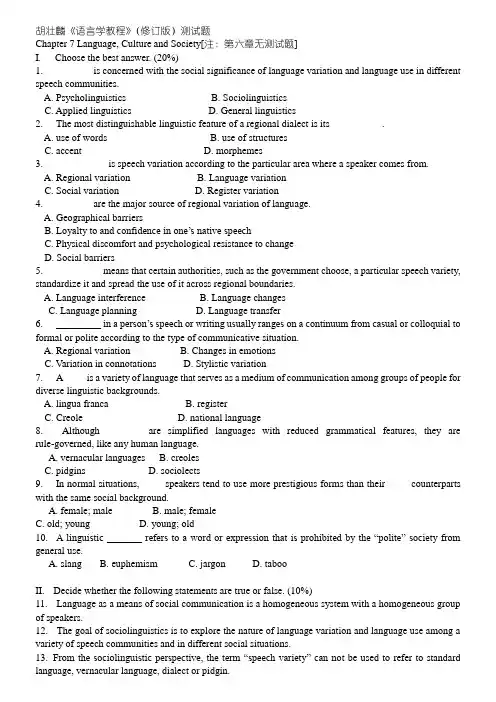
胡壮麟《语言学教程》(修订版)测试题
Chapter 7 Language, Culture and Society[注:第六章无测试题]
I. Choose the best answer. (20%)
1. _______ is concerned with the social significance of language variation and language use in different
speech communities.
A. Psycholinguistics B. Sociolinguistics
C. Applied linguistics D. General linguistics
2. The most distinguishable linguistic feature of a regional dialect is its __________.
A. use of words B. use of structures
C. accent D. morphemes
3. __________ is speech variation according to the particular area where a speaker comes from.
A. Regional variation B. Language variation
C. Social variation D. Register variation
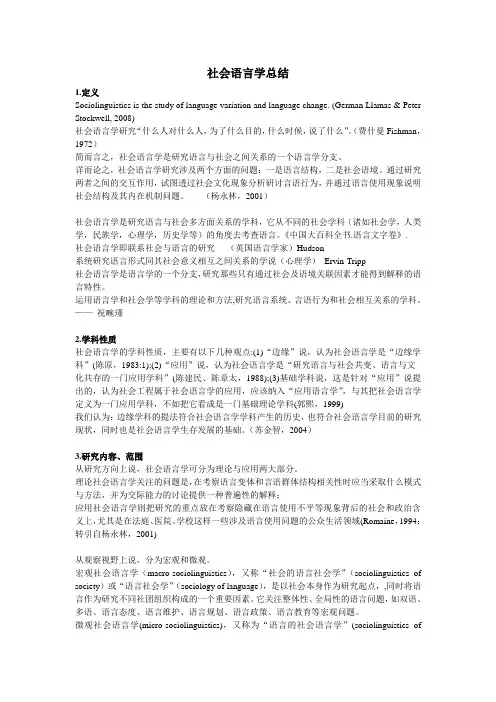
社会语言学总结
1.定义
Sociolinguistics is the study of language variation and language change. (German Llamas & Peter
Stockwell, 2008)
社会语言学研究“什么人对什么人,为了什么目的,什么时候,说了什么”。(费什曼Fishman,1972)
简而言之,社会语言学是研究语言与社会之间关系的一个语言学分支。
详而论之,社会语言学研究涉及两个方面的问题:一是语言结构,二是社会语境。通过研究两者之间的交互作用,试图透过社会文化现象分析研讨言语行为,并通过语言使用现象说明社会结构及其内在机制问题。 (杨永林,2001)
社会语言学是研究语言与社会多方面关系的学科,它从不同的社会学科(诸如社会学,人类学,民族学,心理学,历史学等)的角度去考查语言。《中国大百科全书.语言文字卷》.
社会语言学即联系社会与语言的研究----(英国语言学家)Hudson
系统研究语言形式同其社会意义相互之间关系的学说(心理学) Ervin-Tripp
社会语言学是语言学的一个分支,研究那些只有通过社会及语境关联因素才能得到解释的语言特性。
运用语言学和社会学等学科的理论和方法,研究语言系统、言语行为和社会相互关系的学科。
—— 祝畹瑾
2.学科性质
社会语言学的学科性质,主要有以下几种观点:(1)“边缘”说,认为社会语言学是“边缘学科”(陈原,1983:1);(2)“应用”说,认为社会语言学是“研究语言与社会共变、语言与文
化共存的一门应用学科”(陈建民、陈章太,1988);(3)基础学科说,这是针对“应用”说提出的,认为社会工程属于社会语言学的应用,应该纳入“应用语言学”,与其把社会语言学定义为一门应用学科,不如把它看成是一门基础理论学科(郭熙,1999)
我们认为:边缘学科的提法符合社会语言学学科产生的历史,也符合社会语言学目前的研究现状,同时也是社会语言学生存发展的基础。(苏金智,2004)