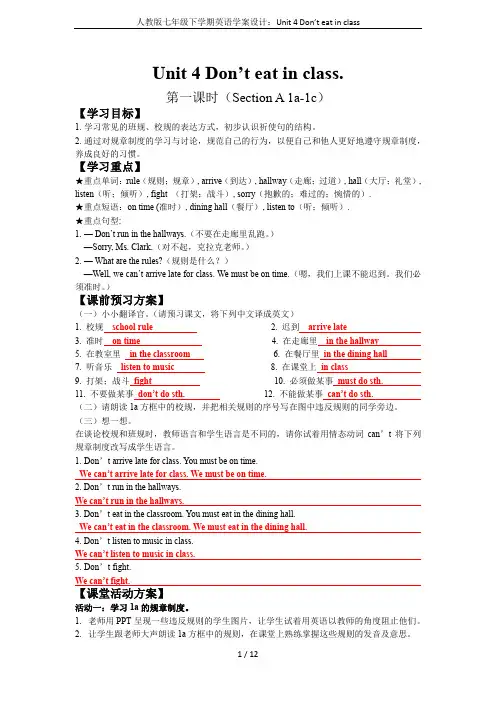
Unit 4 Don’t eat in class辅导教案
- 格式:doc
- 大小:38.50 KB
- 文档页数:12
Don’t eat in class、
适用学科 英语 适用年级 初一
适用区域 使用人教版教材地区 课时时长(分钟) 2课时
知识点 1。课本重点语言点学习。
2、学习祈使句的基本用法、
3、学习情态动词have to ,must的基本用法。
教学目标 知识:1。掌握课本重点语言点。
2、掌握祈使句的基本用法。
3。 掌握情态动词have to ,must的基本用法。
方法:讲、练、测结合,突出重点与核心,掌握所学内容。
能力:1。能够正确运用祈使句。
2、掌握情态动词have to ,must的考查点与易错点。
教学重点 1、学习课本重点语言点、
2。学习祈使句的基本用法。
3、学习情态动词have to ,must的基本用法
教学难点 have to 的句式变化以及must与have to 之区别
教学过程
一、课堂导入
引导学生复习祈使句的用法,并说说以下句子有什么不同及用于什么场合: 1、 Keep quiet!
2。 Be quiet!
3、 No parking!
4、 No smoking!
二、复习预习
教师引导学生说说学校里面都有哪些情况能做,哪些情况不能做?并制定一些规定,用We can
do 、、、与We can’t do、、。结构、
如:We can listen to music during the break between classes。
We can’t play mobile phone in class、
三、知识讲解
知识点1:单元知识梳理
1。 有关规定的表达:
1) 祈使句:
Do sth。 Don’t do sth、
2) Can we eat in class?
2. 短语荟萃:
eat in the dining hall be quiet in the library listen to music
make the bed leave sth、 +地点 after school make rules follow sb、
知识点2:重点知识精讲
1、 school rule/ school rules校规
如:We must obey school rules、 我们必须遵守校规。
【考查点】 obey/follow the school rules 遵守校规 break rules 违反校规 a school rule 学校规定
2、 arrive vi、
【考查点】一 arrive是不及物动词,表示“到达、抵达某地(尤指行程的终点),后常接介词at 或in,一般in接大地方,at 接小地方,若是地点副词, 则不需用介词。
如:Do you know what time the plane arrive in Moscow? 您明白飞机什么时候抵达莫斯科?
They arrived at the station at 8 this morning。 他们今天早晨八点到达车站的。
【考查点】二 一般来讲reach = arrive in/at=get to
如 :Mr Green arrived in /got to/reached Wuhan last night。 格林先生昨晚抵达武汉、
3、 fight vi。 打架;与…打仗
【考查点】一fight against /with打架/ 与…作战 如:Don’t fight with him、
【考查点】二fight for 为…而战 如:They are fighting for freedom、
4。 辨析on time; in time
【考查点】on time 定时 in time 及时
如:He always goes to school on time、
Firemen reached the house on fire in time、
5。 hear、listen与sound
【考查点】hear强调听的结果,意为“听见"或“听说", listen强调听的动作, sound+ 形容词 如: I’m sorry to hear that you are ill、
Listen to me carefully。
That sounds great、
6。 辨析take, bring
【考查点】take 强调“由近及远",为“带走”, bring强调“由远及近”,意为“带来”
如: Can you help me to take the books to the classroom?
Bring your homework here tomorrow, please。
7、 strict adj。 是形容词,意为 “严格的” “严厉的”
【考查点】通常与be动词连用。be strict in 对某事要求严格,be strict with 对某人要求严格
如:Students should be strict in their subjects、 学生们应该严格对待自己的课程。
One should be strict with oneself一个人应该对自己严格要求。
8、 too many ,too much, much too 之区别
【易错点】”too many, too much”两者的意思都是“太多的……”too many = many+可数名词复数;too much意思是“太多的……"。too是用来加强much的,后加不可数名词;
much too意思是“特别,太”。much是用来加强too的、后接形容词或副词。
如: There are too many people in the park。 公园里有太多的人
There is too much water on the floor、 地板上有特别多水、
It’s much too hot、 天太热。
知识点3:语法讲解与练习: 祈使句 1、【考查点】祈使句的定义及句式特征:
祈使句是用来表示请求、命令、叮嘱、邀请、劝告或祝愿等的句子。它的特点是通常省略主语you,
以动词原形开头,末尾可用句号或感叹号。祈使句没有疑问句的形式,一般只有肯定与否定两种形式。
例如:
Go and wash your hands、 (表命令)
Be quite, please、 (Please be quiet、)(表请求)
Be kind to your sister。(表劝告)
Watch your steps、(表警告)
No parking、 (表禁止)
2、 【考查点】祈使句的肯定形式(动词原形开头)
1)以系动词be开头的祈使句,这种祈使句的常用结构:be+形容词 / 名词
例如:Be quiet / quick!
Be a good student!
Be careful when crossing the street。
2)以实义动词开头的祈使句,这种祈使句的常用结构为:动词原形+宾语(+其他)。
例如:e in, please!
Please open your books!
Put them away!
3)let型(Let+宾语+动词原形+其他)
例如:Let him do it by himself、
Let me help you、
Let’s go to the park、 3。【考查点】祈使句的否定形式(一般在动词上否定,也能够用否定副词(never)来表示)
1)be型(Don’t be +其他成分(形容词、名词或介词短语))
例如:Don't be careless!
Never be late again next time!
【易错点】① 在这种句型中,be不能省略;
②否定副词not不可置于be之后。
2)do型(Don’t +动词原形+其他)
例如:Don't believe him!
Don’t worry!
Never do it again!
3)Let引起的祈使句有两种否定形式
a。 Let+宾语+not+动词原形+其他
例如:Let her not do that、
Let’s not think about it。 It’s only a waste of time、
b、 Don't+ let+宾语+动词原形+其他
例如:Don't let Jim do that。
Don't let us go, please、
4) 在公共场合的提示语中,否定祈使句常用“No+名词 / V-ing形式”结构,表示“禁止做某事"、
例如:No photos! 禁止拍照!
No parking! 禁止停车!
4。【考查点】祈使句的反意问句
祈使句的反意疑问句须按其句子结构及讲话人的语气来决定其疑问部分,通常有以下三种形式: 1)、 祈使句为肯定句式,其反意疑问句表示请求时,通常用will you;表示邀请、劝说时,用won’t you、
例如:Be sure to write to us, will you? 您一定要给我们写信,好不?
e to have dinner with us this evening, won't you? 今晚来与我们一起吃饭,好不?
2)、 祈使句为否定句式,其反意疑问句通常只用will you、
例如:Don't smoke in the meeting room, will you? 不要在会议室抽烟,好不?
3)、 Let开头的祈使句构成反意疑问句时,除Let's用shall we外,其它均用will you。
例如:Let the boy go first, will you? 让个那男孩先走,好不?
Let's take a walk after supper, shall we? 晚饭后我们去散步,好不?
5、【考查点】祈使句的回答
祈使句的动作通常是表示以后发生的动作,因此回答祈使句时,一般用will或won’t。
在回答具有否定意义的祈使句时,要注意两点:
1、 形式一致 (即Yes与will保持一致;No与won’t保持一致)
2、 意思相反 (即Yes是 “不”的意思;No是 “是”的意思)。
在回答时,要注意分析上下文语境中所提供的条件。
例如:--— Don’t go out, please、 It’s raining heavily outside、
请不要出去。外面雨下得特别大。
-——— Yes, I will、 I have to meet my brother at the airport。