
Unit-5-The-Real-Truth-about-LiesPPT优秀课件
- 格式:ppt
- 大小:339.00 KB
- 文档页数:33


Unit 5 The real truth about lies.
Vocabulary.
1. Explain the underlined part in each sentence in your own words.
(1)very important/shocking/traumatic;
(2) avoid hurting the others’ feelings;
(3)modifying the truth;
(4) a course of action which can easily lead to something unacceptable,
wrong or disastrous;
(5)under any circumstances/whatever might happen;
2. Fill in the blank in each sentence with a word taken from the box
in the proper form.
(1) supportive; (2) perceived; (3) prevarication; (4) astounded;
(5)undermine; (6) faltered; (7) fibs; (8) volunteered
3. Fill in the blanks with the appropriate forms of the given words.
(1) unethical; (2) feigned; (3) unsparing; (4) cynical;
(5) confoundedly; (6) lubricated; (7) entangled; (8) Willful
4.Fill in the blank in each sentence with an appropriate phrasal verb

英专综合教程3 (第2版)电子教案 Unit 5
1
Unit 5 The Real Truth about Lies
I
1 When we start to tell a lie, we have entered a very intricate situation, as a lie often requires
other lies until the whole structure of lies becomes so complex that it ensnares the liar.
2 One is less inhibited from lying; his ability to make moral right and wrong judgments is
dulled, and he may become less cautious against being caught.
3 The most understandable and acceptable lies are those which are told for the sake to love
and care at the expense of trust, according to the ethicists.
I
1 very important/shocking/traumatic
2 avoid hurting the other’s feelings/avoid doing something that would upset the other person
3 telling the truth with a favorable emphasis or slant/modifying the truth
4 a course of action which can easily lead to something unacceptable, wrong, or disastrous
1 Unit 5
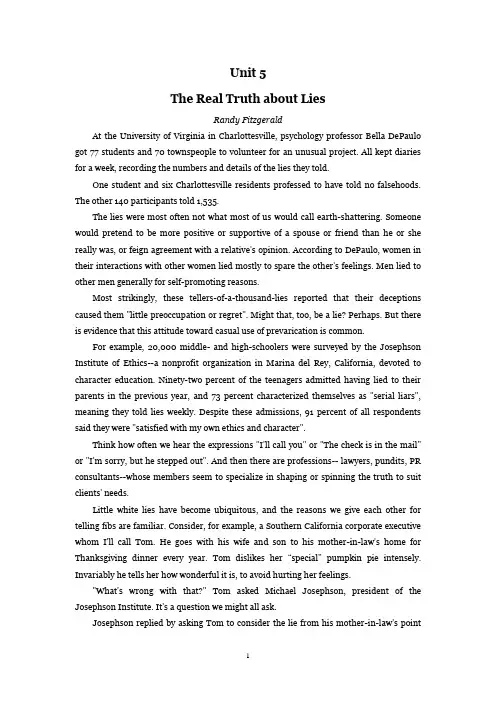
The Real Truth about Lies
Randy Fitzgerald
At the University of Virginia in Charlottesville, psychology professor Bella DePaulo
got 77 students and 70 townspeople to volunteer for an unusual project. All kept diaries
for a week, recording the numbers and details of the lies they told.
One student and six Charlottesville residents professed to have told no falsehoods.
The other 140 participants told 1,535.
The lies were most often not what most of us would call earth-shattering. Someone
would pretend to be more positive or supportive of a spouse or friend than he or she
really was, or feign agreement with a relative's opinion. According to DePaulo, women in
their interactions with other women lied mostly to spare the other's feelings. Men lied to
other men generally for self-promoting reasons.

Unit 5 The Real Truth about Lies
Key to the Exercises
Text comprehension
I. Decide which of the following best sums up the argument of the passage.
C
II. Judge, according to the text, whether the following statements are true or false.
1. T (Refer to Paragraph 3. It is true that women tell lies because they care about others'
feelings, and men are more selfish; they tell lies generally for self-promoting purposes.)
2. T (Refer to Paragraph 5.)
3. T (Refer to Paragraph 6.)
4. F (Refer to Paragraph 12. Even seemingly harmless falsehoods, or white lies, can
have unforeseen consequences.)
5. F (Refer to Paragraph 16. There are still occasions where lies are acceptable.)
III. Answer the following questions.
1. Refer to Paragraphs 2-5. Professor DePaulo's study suggests that lying is a common
phenomenon and most of the lies we tell are small and insignificant. Meanwhile, as she