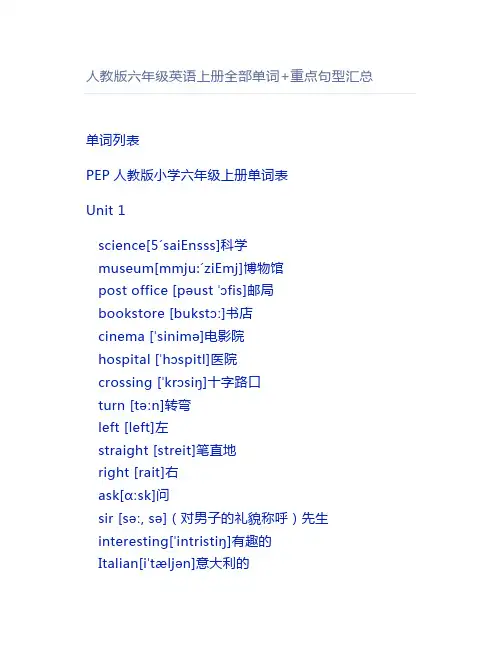
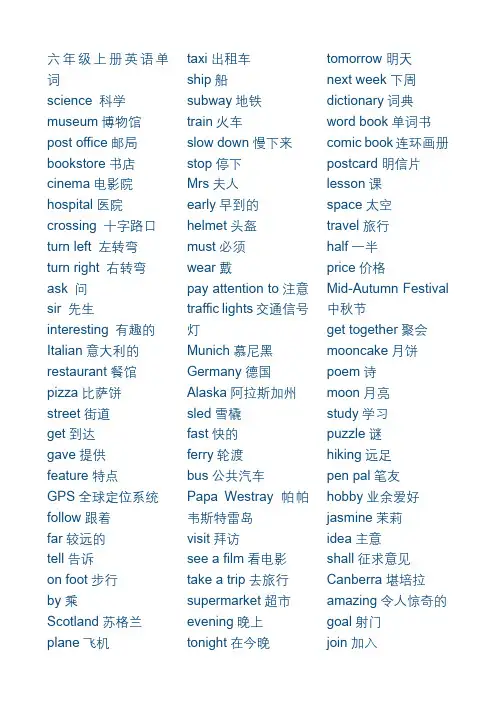
人教版六年级上册英语单词分类
- 格式:doc
- 大小:25.53 KB
- 文档页数:5
人教版六年级上册英语单词分类
As students enter the sixth grade, the complexity and
diversity of English vocabulary they encounter increases
significantly. The textbooks published by the People's
Education Press (PEP) are widely used in China, and the
sixth-grade upper volume is no exception. In this article,
we delve into the English vocabulary found in the PEP
sixth-grade upper textbook, examining the various
categories and how they contribute to the overall language
learning experience.
The PEP sixth-grade upper textbook is rich in
vocabulary, covering a wide range of topics from daily life
to school subjects. One of the most prominent categories is
that of school life, including words like "classroom,"
"teacher," "blackboard," and "homework." These words
provide a solid foundation for students to discuss their
school experiences and routines.
Another significant category is that of daily routines
and activities. Vocabulary such as "breakfast," "lunch,"
"dinner," "exercise," and "sleep" helps students express
their daily habits and schedules. This not only enhances their language skills but also encourages healthy living
habits.
The textbook also introduces vocabulary related to
emotions and feelings, allowing students to express their
thoughts and feelings more effectively. Words like "happy,"
"sad," "angry," "excited," and "surprised" encourage
emotional literacy and foster empathy among students.
Moreover, the PEP sixth-grade upper textbook covers
vocabulary related to nature and the environment. Terms
like "sun," "moon," "star," "tree," "flower," and "river"
introduce students to the wonders of the natural world,
fostering a sense of wonder and respect for nature.
In addition, the book introduces vocabulary related to
holidays and festivals, such as "Christmas," "New Year,"
"birthday," and "festival." This not only helps students
learn about different cultures but also encourages them to
celebrate and appreciate the diversity of festivals and
traditions.
The variety of vocabulary in the PEP sixth-grade upper
textbook is not only diverse but also contextualized,
making it easier for students to understand and remember. The use of illustrations and real-life scenarios further
enhances the learning experience, making vocabulary
learning more engaging and fun.
The分类of vocabulary in the PEP sixth-grade upper
textbook is comprehensive, covering various aspects of
students' lives and interests. This structured approach to
vocabulary learning not only improves students' language
skills but also fosters a love for learning and a curiosity
about the world. As students progress through the grades,
they will build upon this foundation, developing a rich and
diverse vocabulary that will serve them well in their
academic and personal lives.
**人教版六年级上册英语单词分类探索**
随着学生进入六年级,他们所接触的英语词汇的复杂性和多样性显著增加。由人民教育出版社(PEP)出版的教科书在中国广泛使用,六年级上册也不例外。在本文中,我们将深入探讨PEP六年级上册教科书中的英语词汇,研究各种类别以及它们如何为整体语言学习体验做出贡献。
PEP六年级上册教科书词汇丰富,涵盖了从日常生活到学校科目的广泛主题。其中最为突出的类别之一是学校生活,包括“classroom”(教室)、“teacher”(老师)、“blackboard”(黑板)和“homework”(作业)等词汇。这些词汇为学生讨论他们的学校经历和日常例程提供了坚实的基础。
另一个重要的类别是日常例程和活动。诸如“breakfast”(早餐)、“lunch”(午餐)、“dinner”(晚餐)、“exercise”(锻炼)和“sleep”(睡眠)等词汇帮助学生表达他们的日常习惯和时间表。这不仅提高了他们的语言技能,还鼓励他们养成健康的生活习惯。
教科书还介绍了与情感和感觉相关的词汇,使学生能够更有效地表达自己的思想和感受。诸如“happy”(高兴)、“sad”(伤心)、“angry”(生气)、“excited”(兴奋)和“surprised”(惊讶)等词汇培养了学生的情感素养,并促进了他们之间的同理心。
此外,PEP六年级上册教科书还涵盖了与自然和环境相关的词汇。诸如“sun”(太阳)、“moon”(月亮)、“star”(星星)、“tree”(树)、“flower”(花)和“river”(河流)等词汇向学生介绍了自然界的奇迹,培养了他们对自然的敬畏和好奇心。
此外,该书还介绍了与节日和庆典相关的词汇,如“Christmas”(圣诞节)、“New Year”(新年)、“birthday”(生日)和“festival”(节日)等。这不仅帮助学生了解不同的文化,还鼓励他们庆祝和欣赏各种节日和传统的多样性。 PEP六年级上册教科书中的词汇种类繁多,不仅多样化而且具有上下文性,这使学生更容易理解和记忆。插图和真实场景的使用进一步增强了学习体验,使词汇学习更加引人入胜和有趣。
PEP六年级上册教科书中的词汇分类全面,涵盖了学生生活和兴趣的各个方面。这种有结构的词汇学习方法不仅提高了学生的语言技能,还培养了他们对学习的热爱和对世界的好奇心。随着学生年级的升高,他们将在这一基础上不断积累,形成丰富多样的词汇库,为他们的学术和个人生活奠定坚实的基础。