
初中英语:If引导的条件状语从句ppt课件
- 格式:ppt
- 大小:6.10 MB
- 文档页数:21


if 引导条件状语从句
摘要:
1.条件状语从句的定义
2.if 引导条件状语从句的语法结构
3.if 引导条件状语从句的用法和实例
正文:
条件状语从句是用来表示一个条件,即如果某个条件成立,那么就会发生某个结果。在英语中,条件状语从句通常由 if 引导。
语法结构:
if + 条件从句(主语 + 谓语 + 其他成分)
主句(主语 + 谓语 + 其他成分)
if 引导条件状语从句的用法和实例:
1.肯定句中的条件状语从句
If it is hot, we will go to the beach.(如果天气热,我们将去海滩。)
2.否定句中的条件状语从句
If it is not hot, we will go to the park.(如果天气不热,我们将去公园。)
3.一般疑问句中的条件状语从句
Will you help me if I need your help?(如果我需要你的帮助,你会帮助我吗?)
4.特殊疑问句中的条件状语从句 What will you do if you win the lottery?(如果你中彩票,你会做什么?)
通过以上实例,我们可以看到 if 引导条件状语从句在各种句子类型中的用法。

人教版八年级英语上册笔记1--10单元
精心整理超详细!人教版八年级英语上册笔记1--10单元Unit 1
Where did you go on vacation ?
Section A 知识提纲
一、词形变化
1.wonder v. 想知道→adj. wonderful 精彩的,绝妙的
二、短语
1.go on vacation去度假
2.stay at home待在家里
3.go to the mountains去爬山
4.go to the beach去海滩
5.visit museums 参观博物馆
6.go to summer camp去参加夏令营
7.quite a few相当多 8.study for tests为测验而学习
9.go out出去 10.go out with anyone 跟别人出去
11.most of the time大部分时间 12.of course=sure =certainly当然
13.have a good time doing=have fun doing =enjoy oneself玩得高兴
14.go shopping去购物 15. keep a diary 写日记
三、词法
1. buy sb. sth.=buy sth. for sb.为某人买某物
Buy me some books = Buy some books for me .
2.taste / look/sound/smell good. 尝起来/看起来/听起来/闻起来不错
3.nothing…but+动词原形除了……之外什么都没有
I have nothing to do but watch TV all day .
我整天除了看电视什么也没干。
4.seem link v.(系动词) 似乎,好像,看来 ① seem + adj.
② seem to do sth.
③ It seems that + 陈述句
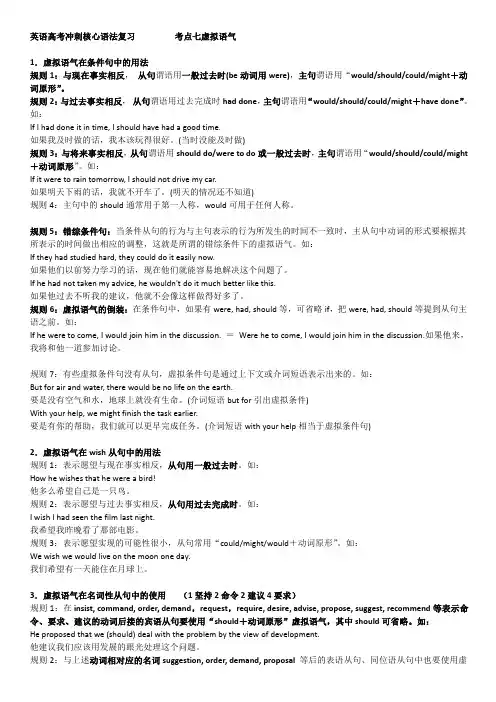
英语高考冲刺核心语法复习考点七虚拟语气
1.虚拟语气在条件句中的用法
规则1:与现在事实相反,从句谓语用一般过去时(be动词用were),主句谓语用“would/should/could/might+动
词原形”。
规则2:与过去事实相反,从句谓语用过去完成时haddone,主句谓语用“would/should/could/might+havedone”。
如:IfIhaddoneitintime,Ishouldhavehadagoodtime.
如果我及时做的话,我本该玩得很好。(当时没能及时做)
规则3:与将来事实相反,从句谓语用shoulddo/weretodo或一般过去时,主句谓语用“would/should/could/might
+动词原形”。如:Ifitweretoraintomorrow,Ishouldnotdrivemycar.
如果明天下雨的话,我就不开车了。(明天的情况还不知道)
规则4:主句中的should通常用于第一人称,would可用于任何人称。
规则5:错综条件句:当条件从句的行为与主句表示的行为所发生的时间不一致时,主从句中动词的形式要根据其
所表示的时间做出相应的调整,这就是所谓的错综条件下的虚拟语气。如:Iftheyhadstudiedhard,theycoulddoiteasilynow.
如果他们以前努力学习的话,现在他们就能容易地解决这个问题了。Ifhehadnottakenmyadvice,hewouldn'tdoitmuchbetterlikethis.
如果他过去不听我的建议,他就不会像这样做得好多了。
规则6:虚拟语气的倒装:在条件句中,如果有were,had,should等,可省略if,把were,had,should等提到从句主
语之前。如:Ifheweretocome,Iwouldjoinhiminthediscussion.=Werehetocome,Iwouldjoinhiminthediscussion.如果他来,

英语常用连接词的用法:with,some与any
with的用法
with 是介词,但其意义颇多,一时难掌握。为帮助大家理清头绪,这里以教材中的句子为例,进行分类,并配以简单的解释
1. 带着,牵着…… (表动作特征)。如:Run with the kite like this.
2. 附加、附带着……(表事物特征)。如:
A glass of apple juice, twoglasses of coke, two hamburgers
with potato chips, rice and fish.
3. 和…… (某人)一起。
a. 跟某人一起(居住、吃、喝、玩、交谈……) 。如:
Now I am in China with myparents. Sometimes we go out to
eat withour friends.
b. 跟go, come 连用,有 '加入'到某方的意思。如:Do you want
to come with me?
4. 和play一起构成短语动词play
with 意为'玩耍……,玩弄……' 如: Two boys are playing with their yo-yos.
5. 与help 一起构成 help...with...句式,意为'帮助 (某人) 做 (某事)'。如:
On Monday and Wednesday, he helpshis friends with their
English.
6. 表示面部神情,有'含着……,带着……' 如:
'I'm late for school,'said Sun Yang, with tears in his eyes.
7. 表示 '用……' 如:You play it with your feet. What do the
farmers do with your machines?
8. 表示 '对……, 关于……'。如:What'swrong with it? There's