电气工程及其自动化专业外文文献英文文献外文翻译方面
- 格式:pdf
- 大小:857.47 KB
- 文档页数:11
1、 外文原文(复印件)
A: Fundamentals of Single-chip Microcomputer
The single-chip microcomputer is the culmination of both the development of the digital computer and the integrated circuit arguably
the tow most significant inventions of the 20th century [1]. These tow types of architecture are found in single-chip microcomputer. Some employ the split program/data memory of the
Harvard architecture, shown in -5A, others follow the philosophy, widely
adapted for general-purpose computers and microprocessors, of making no
logical distinction between program and data memory as in the Princeton architecture, shown in -5A.
In general terms a single-chip microcomputer is characterized by the incorporation of all the units of a computer into a single device, as
shown in Fig3-5A-3.
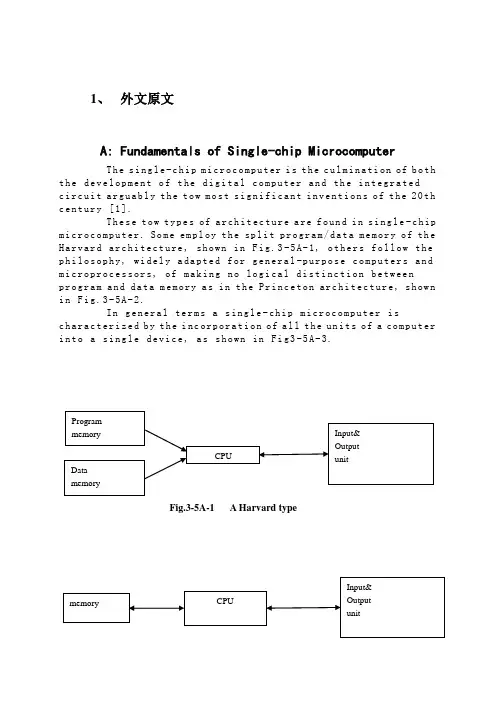
-5A-1 A Harvard type
-5A. A conventional Princeton computer
Program
memory
Data
memory CPU Input& Output
unit
memory CPU Input&
Output
unit
Reset
Interrupts
Power
Fig3-5A-3. Principal features of a microcomputer
Read only memory (ROM).ROM is usually for the permanent,
non-volatile storage of an applications program .Many microcomputers and
microcontrollers are intended for high-volume applications and hence the economical manufacture of the devices requires that the contents of the
program memory be commied permanently during the manufacture of
chips . Clearly, this implies a rigorous approach to ROM code development
since changes cannot be made after manufacture .This development process
may involve emulation using a sophisticated development system with a
hardware emulation capability as well as the use of powerful software tools.
Some manufacturers provide additional ROM options by including in their range devices with (or intended for use with) user programmable
memory. The simplest of these is usually device which can operate in a
microprocessor mode by using some of the input/output lines as an address and data bus for accessing external memory. This type of device can behave
functionally as the single chip microcomputer from which it is derived
albeit with restricted I/O and a modified external circuit. The use of these
ROMless devices is common even in production circuits where the volume
does not justify the development costs of custom on-chip ROM[2];there can
still be a significant saving in I/O and other chips compared to a External
Timing components System
clock Timer/
Counter
Serial I/O
Prarallel
I/O
RAM ROM
CPU
conventional microprocessor based circuit. More exact replacement for
ROM devices can be obtained in the form of variants with 'piggy-back' EPROM(Erasable programmable ROM )sockets or devices with EPROM
instead of ROM 。These devices are naturally more expensive than
equivalent ROM device, but do provide complete circuit equivalents.
EPROM based devices are also extremely aractive for low-volume
applications where they provide the advantages of a single-chip device, in
terms of on-chip I/O, etc. ,with the convenience of flexible user programmability.
Random access memory (RAM).RAM is for the storage of working
variables and data used during program execution. The size of this memory
varies with device type but it has the same characteristic width (4,8,16 bits
etc.) as the processor ,Special function registers, such as stack pointer or
timer register are often logically incorporated into the RAM area. It is also
common in Harard type microcomputers to treat the RAM area as a
collection of register; it is unnecessary to make distinction between RAM
and processor register as is done in the case of a microprocessor system
since RAM and registers are not usually physically separated in a
microcomputer .
Central processing unit (CPU).The CPU is much like that of any
microprocessor. Many applications of microcomputers and microcontrollers
involve the handling of binary-coded decimal (BCD) data (for numerical
displays, for example) ,hence it is common to find that the CPU is well
adapted to handling this type of data .It is also common to find good
facilities for testing, seing and reseing individual bits of memory or I/O since many controller applications involve the turning on and off of single
output lines or the reading the single line. These lines are readily
interfaced to two-state devices such as switches, thermostats, solid-state
relays, valves, motor, etc.
Parallel input/output. Parallel input and output schemes vary
somewhat in different microcomputer; in most a mechanism is provided to
at least allow some flexibility of choosing which pins are outputs and which
are inputs. This may apply to all or some of the ports. Some I/O lines are
suitable for direct interfacing to, for example, fluorescent displays, or can
provide sufficient current to make interfacing other components straightforward. Some devices allow an I/O port to be configured as a