
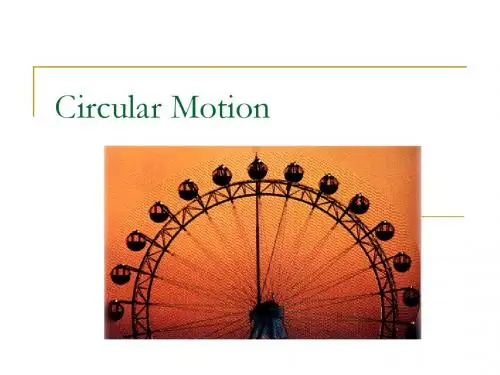
Section5CircularMotion
- 格式:ppt
- 大小:1.26 MB
- 文档页数:15



六年级下册前五课英语作文小练笔科普版全文共3篇示例,供读者参考篇1My Amazing Brain and BodyHi there! My name is Emma and I'm a 6th grader. In English class this semester, we've been learning all about the human body and brain. It's been super fascinating, so I wanted to share some of the cool facts I've learned with you!Let's start with the brain since that's sort of like the control center for our whole body. Did you know that the brain is made up of about 100 billion neurons? Neurons are special cells that transmit information through electrical and chemical signals. They have branched extensions called dendrites that receive signals, and a single long extension called an axon that sends out signals to other neurons or muscles. The place where neurons connect to each other or to a muscle is called a synapse.Different parts of the brain control different functions. The cerebrum is the largest part and handles things like reasoning, emotions, learning and fine motor skills. It has a deeply wrinkledsurface called the cerebral cortex that gives it a really big surface area to pack in more neurons. Isn't that cool?The cerebellum is a smaller section at the back that coordinates muscular movements and balance. That's why people with cerebellum damage have trouble walking properlyor playing sports. The brain stem connects the brain to the spinal cord and controls automatic functions like breathing, heart rate and digestion.Our brains are protected by the skull, but also cushioned by cerebrospinal fluid that flows around it. The brain uses about 20% of the body's energy, even though it only makes up 2% of our body weight! It needs a constant supply of oxygen and nutrients from blood. That's why exercise that gets our hearts pumping is so important.Moving on to the rest of our amazing bodies, let's talk about the skeletal system. We're born with about 270 bones, but many fuse together as we grow up, leaving 206 bones in an adult. Bones give structure and protection to our bodies, allow us to move by providing surfaces for muscles to pull on, make blood cells, and store calcium.Our skeletal system has several types of joints where bones connect, like ball-and-socket joints in the shoulders and hips thatallow for a wide range of circular motion. Hinge joints in the knees and elbows allow folding or back-and-forth movements. Each joint is cushioned by cartilage and lubricated by synovial fluid to reduce friction and wear.Did you know the smallest bones in your body are in your ear? They're called ossicles and they help transmit sound vibrations from the eardrum to the inner ear. The longest, heaviest bone is the femur in your upper leg. Adult femurs are about 19 inches long and amazingly strong - they can support up to 30 times your body weight!Skeletal muscles attach to bones with tough connective tissues called tendons and pull on the bones to create movement. There are over 600 skeletal muscles making up about 40% of our body weight. Some of the largest are the quadriceps in the front of your thighs and the gluteus maximus that makes up your butt muscles. Small muscles in your hands and feet allow for fine motor movements.Muscles can only pull on bones, they can't actively lengthen or push out. So muscles work in pairs of flexors and extensors. The biceps is a flexor that pulls the forearm up, while the triceps is an extensor that straightens it back out. When your biceps contracts and gets shorter, it pulls on the radius bone to bendyour elbow. Then your triceps contracts to straighten your arm again. Pretty neat, huh?Cardiac and smooth muscles in organs like the heart, stomach and intestines allow involuntary movements like heartbeats and digestion that happen automatically without us thinking about it. I won't go into too much detail about all the different body systems, but I did want to mention a few more neat facts.Our muscular system is supported by our skeletal system, but also works together with the nervous system that coordinates muscle contractions through nerve impulses traveling from the brain. We have over 600 skeletal muscles, but our bodies also have about 60,000 miles of blood vessels to circulate nutrients and oxygen! And get this - we breathe about 17,000 times per day on average!I know that was a ton of information to take in all at once. But I find the human body and brain so endlessly fascinating. We're these incredibly complex biological machines with trillions of cells, all working together through synchronized chemical processes. Just thinking about how every part of us is designed to function in harmony blows my mind! From our hardworking hearts to our quadrillions of microscopic mitochondria, ourbodies are true modern marvels of nature. I can't wait to learn even more in our next unit!篇2The Wonderful World of ScienceScience is all around us, and it's so cool to learn about! In our English textbook this semester, we're going to explore some really fascinating scientific topics. Let me tell you a bit about the first five lessons.Lesson 1: The Magic of MagnetismHave you ever played with magnets and been amazed at how they can attract certain metals? That's because magnets have an invisible force called magnetism. Some metals like iron are magnetic, while others like gold or aluminum are not.Magnets are made from magnetic materials like iron, nickel, cobalt or rare earth metals. The strongest permanent magnets are made from an alloy called neodymium. These super strong magnets allow us to make powerful electric motors and generators.But magnets don't just attract metal - they can also attract or repel other magnets! You've probably seen how opposite poles(North and South) attract each other, while likepoles repel. This is what causes the spinning action in electric motors and generators.Magnets have so many uses, from compasses for navigation to MRI machines for medical imaging. They make our modern technology possible. Who knew those little magnetic rocks could be so magical?Lesson 2: The Shocking Truth About ElectricitySpeaking of modern technology, it wouldn't exist without electricity! Electricity is the flow of tiny particles called electrons through a material like a metal wire. This flow is what powers all our electronics and appliances.Electricity can be created in several ways, like from batteries through chemical reactions or from power plants that burn fossil fuels or use renewable sources like wind or solar. Once the electricity is generated, it flows through wires to wherever it's needed.But electricity can also occur naturally, like in lightning! When clouds build up positive and negative charges, the huge voltage difference causes a giant spark of electricity we calllightning. Thunder is just the sound made by the rapid heating and expansion of air from the lightning bolt.Electricity is amazing, but it can also be dangerous if not handled properly. That's why it's so important to follow electrical safety rules. But used correctly, electricity has powered our modern way of life.Lesson 3: The Hidden Wonders of MicrobesThis one is about some of the smallest lifeforms on Earth - microbes! Microbes are tiny organisms like bacteria, viruses, fungi and protozoa that are too small to see without a microscope.Microbes might be little, but they are incredibly important. Some microbes like bacteria help us digest food, while others are essential for making foods like yogurt, cheese and bread. Other bacteria take nitrogen from the air and 'fix' it into the soil to help plants grow.However, certain microbes can also make us sick. Viruses like the flu or coronavirus can spread through coughs and sneezes and make people ill. And harmful bacteria in undercooked food or water can cause nasty illnesses like food poisoning.The key is that not all microbes are bad - in fact, we couldn't survive without many of the good microbes all around us! As long as we practice good hygiene and handle microbes safely, these tiny organisms play a huge role in our world.Lesson 4: Exploring the Plant KingdomGet ready to learn all about the incredible world of plants! Plants are living organisms that use sunlight, water and carbon dioxide to produce their own food through photosynthesis. This process also releases the oxygen that animals like us need to breathe.There are so many amazing types of plants out there, from tiny mosses to towering redwood trees. All plants have certain parts like roots, stems, leaves, flowers and seeds. The roots anchor the plant and absorb water and nutrients from the soil. The stems provide support and transport water and nutrients. The leaves capture sunlight for photosynthesis. And the flowers allow plants to reproduce by producing fruits with seeds inside.Plants are absolutely vital - they produce most of the world's oxygen, provide food for humans and animals, act as habitats for countless species, and help prevent soil erosion. And many plants also have medicinal properties to treat diseases. Just imagine a world without these incredible organisms!Lesson 5: The Animal Kingdom ComethIf you think the plant kingdom is fascinating, just wait until you learn about animals! Animals are a huge group of multicellular organisms that get their energy from eating food rather than photosynthesis.There are over a million known species of animals on Earth, ranging from tiny insects to massive whales. Scientists group them into major groups like mammals, birds, reptiles, amphibians, fish and invertebrates.One thing all animals have in common is that they are made up of many different cell types that perform specialized functions. Animals also need to consume food, water and oxygen to survive, and expel waste. Most can move around in search of those resources.Animals have evolved some truly incredible abilities over millions of years. Some can fly, some can breathe underwater, some can camouflage themselves, some can run extremely fast. And of course, the human animal has developed advanced intelligence and technology.The animal kingdom is endlessly fascinating to study. These creatures are not just our companions on planet Earth, but livingexamples of the wonders of biology and evolution. I can't wait to learn more!Well, those are just the first five lessons, but I'm already hooked! Science helps us understand the amazing natural world around us. And the more we know, the better we can take care of our one and only planet. Get ready to explore and be amazed this semester!篇3The First Five LessonsLesson 1 - The History of the English LanguageDid you know that English started out as the language of just a few tribes living on a small island? It's crazy to think that the language we use every day at school comes from those small beginnings! English has its roots in the Anglo-Saxon languages spoken by Germanic peoples who migrated to Britain way back in the 5th century AD. Their langauge was heavily influenced by the invasion of Norse Viking raiders beginning in the 8th century. Then in 1066, the Norman French conquered England and brought their French language with them. Over the centuries, English absorbed huge numbers of French words and became the unique hybrid language we recognize today.The most amazing thing about English is how widely it spread across the globe. As the British Empire expanded through exploration and colonization in the 16th-19th centuries, English took root all over the world. That's why countries like the United States, Canada, Australia, New Zealand, and India all use English as an official language today even though they're so far from England! English truly went from tiny island roots to becoming a true world language spoken by over 1 billion people. How cool is that?Lesson 2 - Space ExplorationOne of the most exciting frontiers for human exploration is outer space! Although we've been studying the stars for thousands of years, the Space Age really began in 1957 when the Soviet Union launched Sputnik 1, the first human-made satellite to orbit the Earth. Just a few years later in 1961, Soviet cosmonaut Yuri Gagarin became the first person in space when he orbited the Earth aboard the spaceship Vostok 1.The most famous milestone was in 1969, when American astronauts Neil Armstrong and Buzz Aldrin landed on the moon aboard the Apollo 11 mission. As Armstrong took his first steps on the lunar surface, he said the iconic words "That's one small step for man, one giant leap for mankind." In all, a total of 12American astronauts walked on the moon between 1969-1972 before the Apollo program ended.Since then, space exploration has continued with robotic probes visiting every planet in our solar system, the Hubble Space Telescope capturing incredible images of distant galaxies, and the International Space Station allowing humans to conduct long-term experiments in low-Earth orbit. Perhaps the most exciting new frontier is the dream of sending human explorers to Mars. NASA plans to land astronauts on the Red Planet sometime in the 2030s. It seems like science fiction, but a new age of space travel and discovery may just be beginning!Lesson 3 - Protecting Wildlife HabitatsOne of the biggest threats facing many species of plants and animals today is the destruction of their natural habitats. As human civilization has spread across the planet, activities like deforestation, urbanization, mining, and pollution have disrupted or eliminated the environments where endangered species live and breed. Without their habitats, they can't survive.That's why it's so important for us to protect areas like rainforests, wetlands, prairies, and coral reefs from overdevelopment or contamination. These places are biodiversity hotspots that nurture the amazing variety of life onour planet. Scientists estimate that over a million species are threatened with extinction due to habitat loss and other human activities. We have to take action!Governments have established thousands of national parks, wildlife refuges, and other protected areas to preserve the last wild spaces and ecosystems for endangered species. These safe havens keep land, water, and air resources unpolluted so that vulnerable plants and animals can repopulate. Nonprofit organizations also work to buy up land and return it to its natural state. Everyone can help by reducing consumption, cutting waste, and being good stewards of the environment.Lesson 4 - Renewable Energy SolutionsYou've probably heard a lot about climate change caused by humans burning fossil fuels like coal, oil, and natural gas. The carbon dioxide released into the atmosphere is trapping extra heat and warming up our planet. That's a big problem! But part of the solution could come from tapping into renewable energy sources.Solar power is one of the most promising clean energy technologies. Photovoltaic cells collect energy directly from sunlight and convert it into electricity with zero emissions or pollution. Major improvements have made solar panels muchmore efficient and affordable for homeowners to install. Some day, entire cities could run on solar farms!Wind power is another clean, renewable option. Massive wind turbines use their spinning blades to generate electricity from the kinetic energy of wind. Onshore and offshore wind farms are sprouting up to provide sustainable power to communities. And unlike fossil fuels which are limited resources, the winds will never run out!New innovations like tidal power, geothermal energy, biofuels, and nuclear fusion could also help us transition away from dirty fossil fuels to a greener energy future. We have the ability to stop climate change and protect our planet - we just have to be willing to change!Lesson 5 - The Science of NutritionYou know that saying, "you are what you eat?" Well, it's very true - the foods we put into our bodies have a huge impact on our overall health and wellness. That's why it's so important to understand nutrition and make smart choices about our diet.One of the basic building blocks of nutrition are the three main macronutrients: carbohydrates, proteins, and fats. Carbs give us energy, proteins build and repair tissues, and fats insulatethe body and allow absorption of vitamins. We need a balanced diet containing all three macronutrients, plus vitamins, minerals, fiber, and water.Too much of any one macronutrient can cause health problems. Overeating carbs or fats leads to weight gain and obesity, while not getting enough protein can prevent proper muscle growth. Micronutrient deficiencies in vitamins and minerals can also cause conditions like anemia, osteoporosis, and immune disorders.The key is moderation and variety - eating reasonable portions of nutrient-rich foods like fruits, veggies, whole grains, lean proteins, and healthy fats. Combined with regular physical activity, a balanced diet gives our bodies and brains all the fuel they need to function optimally. It's a healthy lifestyle we can all strive for each day!。