
Chapter 2 The development of the English Vocabulary
- 格式:ppt
- 大小:171.00 KB
- 文档页数:32

江苏省镇江句容市2019-2021年(三年)七年级第二学期期中考试英语试卷分类汇编阅读理解专题江苏省镇江市句容市2020-2021学年七年级下学期期中学情分析英语试卷四、阅读理解(共10小题;每小题2分, 满分20分)阅读下面的三篇短文,根据短文内容,从短文后各题所给的A、B、C、D四个选项中,选择最佳答案。
AStudy the contents (目录) page of a book and choose the right answer to each of the following questions.ContentsPart IThe history and culture of DantuChapter 1 The long history of Dantu (1)Chapter 2 The rich culture of Dantu (17)Part IIThe development (发展) of Dantu in the past 40 yeasChapter 3 Buildings and st reets (32)Chapter 4 Roads and traffic (46)Chapter 5 Food and drinks (58)Chapter 6 Companies and factories (71)Chapter 7 Parks and shopping malls (86)Part IIIChapter 8 Plans for the future (101)Part IVTo our readers (121)51. Which part should you read if you want to know some old stories of Dantu?A. Part I.B. Part II.C. Part III.D. Part IV.52. If you want to introduce some parks to visitors to Dantu, which chapter should you read?A. Chapter 4.B. Chapter 5.C. Chapter 6.D. Chapter 7.53. Which of the following may NOT be included in Part IV?A. How much is the book?B. How do they write the book?C. Why do they write this book?D. What can you get from the book?BOften, there are noisy (吵闹的) neighbors where many people live close together. And this can be more of a problem when you share walls, floors or ceilings with neighbors in a flat. A noisy neighbor can make life difficult, especially if noise (噪音) goes well into night, or happens during early morning hours. How can we well deal with (处理) the problem? Just try the steps below.You should first try to tell your noisy neighbors about the noise. When doing so, you should be polite, even friendly. You can begin like this, “I am not sure whether you know or not.” Then tell the neighbors the problem in an honest way, and ask them to turn down the music, or not to hold parties until 3 a.m. At the end, you can say that you know they hear your noise too, and that you will take care with your behavior (行为) to make as little noise as possible.You should know that not all neighbors are going to follow your requirement (要求), and some may act in a bad manner. If the noisy neighbors don’t change their behavior, the next step should be tonoise was quite terrible. For example, if your neighbor has noisy parties every Friday night that go on into the early morning then write down those dates.If the noise keeps going on, you should report it to local authorities (权力部门), or even the police station.Remember that you cannot always require noisy neighbors to be quiet. If you have finished the steps and letter but the noise keeps going on, don’t start hitting walls in your home or turning up the music to make your neighbors angry. Just have patience and remember that communication is the most important.54. According to the writer, which of the following is NOT true?A. Being polite and friendly may help when dealing with the problem.B. Saying you yourself will make little noise may help when dealing with the problem.C. Writing down the noisy dates in the letter may help when dealing with the problem.D. Hitting the walls or turning up the music may help when dealing with the problem.55. What does the underlined word in the last paragraph most probably mean?A. 沟通B. 报警C. 斗争D. 冷静56. Which of the following is the best title for the passage above?A.What’s life like with noisy neighbors?B. How should you talk to your noisy neighbors?C. What should you write to your noisy neighbors?D. How should you deal with your noisy neighbors?CSmart phones have become part of our daily lives. However, to protect young students’ eyesight, make sure they spend enough time on their school work and help them fight the addiction (瘾) to the internet and games, primary and middle schools will have more rules to limit (限制) students’ mobile phone use at school in January.According to a notice from the Ministry of Education in January, primary and middle school students shall be limited from carrying phones to school. Those who still want to bring their phones to school must get their parents’ approval (许可) and hand their phones over during class time.A report by the China Internet Network Information Center in 2020 shows that China had 175 million internet users under the age of 18 in 2019, with 74 percent having their own smart phones.This is worrying because long-time use of smart phones is bad for children’s eyesight, cervical vertebrae and even the brain, according to the World Health Organization.On Feb 19, a notice from Beijing Municipal Education Commission required all local primary and middle schools to include rules on smart phone use in school management. Schools should make clear where, how and who will take care of the phones for students who have received approval to bring them.Many schools have taken steps to limit students’ phone use. According to Zhou Dandan, an English teacher at Beijing No.2 High School, every classroom in her school has a box for students to keep their phones during class.57. What’s the function (作用) of the underlined word in paragraph one?A. 表递进B. 表转折C. 表并列D. 表举例58. From the passage we know that ▲.A. all students must leave their phones at home before going to schoolB. in 2019 about 129 million internet users under 18 had their own smart phonesC. long-time use of smart phones is only bad for children’s eyesightD. schools won’t look after the smart phones students bring to school59. Why does the writer speak of Teacher Zhou Dandan?A. To show she is a good teacher.B. To show her ideas on the limit.C. To show readers an example.D. To show she is from Beijing.60. What does the passage mainly tell us?A. Schools will have more rules to limit students’ smart phone use.B. Our country and schools take good care of students.C. Long-time use of smart phones is very bad for students.D. Students mustn’t use smart phones at school at all.阅读理解(每题2分,共20分)51--53 ADA 54--56 DAD 57--60 BBCA江苏省镇江市句容市2019-2020学年七年级下学期期中学情检测英语试题四、阅读理解(共20小题;每小题2分,满分20分)AA. OneB. TwoC. SevenD. Five 47. Lin’s parents take Lin a nd her little brother to the City Museum, Lin is 12 and her little brother is 6, they should pay .A. $ 14B. $17C. $11D. $1948. If Jack goes to the museum from the railway station at 8:30 a.m. on Monday, he canto save time. A. walk there B. take the undergroundC. take a taxiD. take a busBThe students in the United States think that the long summer holiday can be a great time to learn or to do some new things. Here are some ways for you to plan an interesting summer holiday.Taking time outThe summer holiday can be a great time to do something for the next school year. You can have some time to think about your wish. That’s important for you .Being a volunteerAre you thinking about helping others? The summer holiday gives you time to do something for them. Helping others can make you happy. You can also make new friends when working as a volunteer.ReadingDon’t let your brain (大脑) get lazy. You need to make your brain run. Visit the library or bookstore and find books that are interesting for you. You can learn a lot from books.Other thingsThink about other things you wish to do. Write a book? Study English? Get a job? Make a trip to some interesting places?Now it’s time to talk to your parents about your holiday plan. Then have a great summer holiday!49. The summer holiday is a great time to .A. meet old friendsB. play with parentsC. think about othersD. do some new things50. Which of the following is TRUE according to the passage?A. It’s terrible to think about your wish in the summer holiday.B. It’s good for you to help others in the summer holiday.C. Visiting the library or bookstore is usually boring.D. Parents need to make holiday plans for their children.51. The passage mainly talks about .A. students in the United StatesB. the plan for the summer holidayC. interesting books and placesD. how to learn new thingsCAfter I graduated (毕业) from middle school, I went to Tamarindo Beach (海滩) with some of my classmates. That was my first time to the beach, so I still remember it after two years.We left at 6 a.m. to Tamarindo and arrived at about 10 a.m. As soon as we got to the hotel, we bought some ice cream to eat. It was too hot. Then we had a good sleep. In the afternoon, we began to enjoy our great trip. We played beach volleyball on the beach for one hour and then swam in the swimming pool of the hotel. Before the dinner we watched the sunset (日落). It was beautiful and we told stories about our lives and talked about our dreams. It was a cool day for all of us.The next morning we took a bike and rode to another beach. We took many funny pictures along the way. When we rode to the Conchal Beach, we spent the rest (剩下的) time of the day there. The Conchal Beach was very beautiful and there were not many people. We went fishing in the afternoon and watched stars on the beach at night. We feel tired but happy on the second day.On the third day, we got up early and went back home.52. When did the writer go to the beach for the first time?A. When he was two.B. When he was in Grade Two.C. Two years before.D. Before he graduated from middle school.53. What is the right order (顺序) of activities on the first day?① played beach volleyball ② ate ice cream ③ had dinner ④ watched the sunset⑤ swam in the swimming poolA. ②①⑤④③B. ②①⑤③④C. ②⑤①③④D. ②⑤④③①54. Which of the following is TRUE according to the passage?A. They spent five hours to get to Tamarindo.B. They went fishing on the second day.C. They saw many people on the Conchal Beach.D. They went back home in the evening.55. What is the best title for the passage?A. A happy day on the beachB. I want to go to the beachC. My first trip to the beachD. Welcome to Tamarindo Beach四、阅读理解(共10小题;每小题2分,满分20分)46-50 CDBDB 51-55 BCABC江苏省镇江市句容市2018-2019学年七年级下学期期中学情分析英语试题四、阅读理解 (共10小题;每小题2分,满分20分)( A ).A. 010-6699 6644B. 010-6697 3219C. 010-6699 9977D. 010-6699 383447. My father is a member of Sunshine Theatre, he will pay when he watches a play there.A. ¥15B. ¥20C. ¥30D. ¥4048. Mrs. Wang will go to Sunshine Modern Cinema for a film with her 65-year-old father and her13-year-old little son, she should pay .A. ¥80B. ¥90C. ¥110D. ¥120( B )How much do you know about school life in Singapore?In Singapore, many middle school students spend a lot of time on their studies. People there always think that good schooling is the ticket to success (成功). So, many of these students try their best to get good results in their exams. They have a lot of homework every day and exams are usually a big problem to them. Sometimes, a few even have to go to evening classes after school. Schools have many activities outside school hours. The students can join in sports and games, music and dance, swimming and rock climbing. They also join in community service.In their free time, most students like to listen to pop music. Hollywood movies, Hong Kong and Singapore movies are very popular, too. Many of them also spend their free time searching the Internet, chatting with their friends, playing computer and video games. They sometimes go to cafes, fast-foodSo life for middle school students in Singapore is not easy but rich and colorful.49.What do people in Singapore always think is the ticket to success?A. A good school.B. Good schooling.C. Doing much homework.D. Having evening classes.50. Students in Singapore have many activities outside school hours. Which of the followingactivities are NOT mentioned (提及)?A. Doing sports and playing games.B. Listening to music and dancing.C. Going swimming.D. Visiting museums.51. The passage tells us that many students in Singapore would like to .A. go swimmingB. write letters to their friendsC. read books in big bookstoresD. get good results in the exams( C )Anne and Joseph are talking about an interesting question. Why do some people change (改变) their names? There can be many reasons. Hanna changed her name to Anne because she thought it would be easier for people to remember. On the other hand, Joseph is thinking about changing his name to an unusual (不寻常的) name because he wants to be different.People have a lot of reasons for changing their names. Film stars, singers, sportsmen and some other famous people often change their names because they want names that are not ordinary (普通的), or that have special (特殊的) sound. They chose the “new name” for themselves instead of (代替) the name their parents gave them when they were born.Some people have another reason for changing their names. They have moved to a new country and want to use a name that is usual there. For example, Li Kaiming changed his name to Ken Lee when he moved to the United States. He uses the name Ken at his job and at school. But with his family and Chinese friends, he uses Li Kaiming. For some people, using different names makes life easier in their new country.In many countries, a woman changes her family name to her husband’s after she gets married (结婚). But today, many women are keeping their own family name and not using their husband’s. Sometimes, women use their own name in some situations (情况) and their husband’s in other situations. And some use both their own name and their husband’s.52.Hanna changes her name to Anne because “Anne” is for people to remember.A. louderB. easierC. prettierD. hard53. Famous people want their new names to .A. have special soundB. be ordinaryC. have no meaningD. be unknown54. Mr. Li uses his new name when he .A. stays with his familyB. is at his jobC. is among Chinese friendsD. comes back to China55. What is the best title (标题) of this passage?A. Family namesB. Women’s namesC. Changing namesD. Special names四、阅读理解 (共10小题;每小题2分,满分20分)46-50 DCABD 51-55 DBABC。
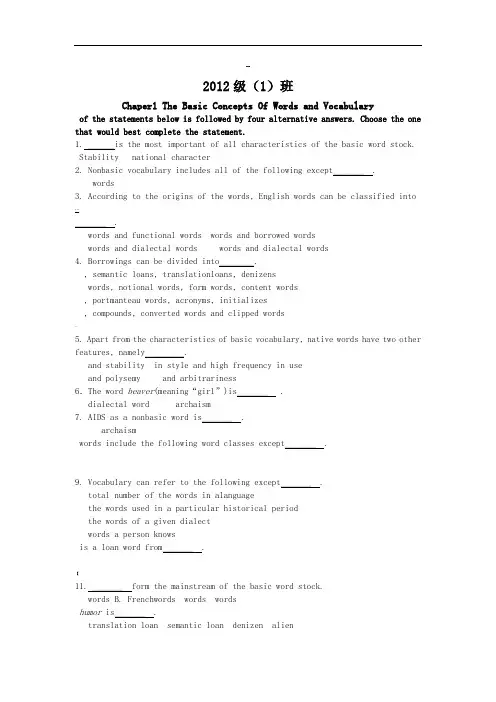
…2012级(1)班Chaper1 The Basic Concepts Of Words and Vocabularyof the statements below is followed by four alternative answers. Choose the one that would best complete the statement.1. ______is the most important of all characteristics of the basic word stock. Stability national character2. Nonbasic vocabulary includes all of the following except_______ .words3. According to the origins of the words, English words can be classified into…_______ .words and functional words words and borrowed wordswords and dialectal words words and dialectal words4. Borrowings can be divided into________., semantic loans, translationloans, denizenswords, notional words, form words, content words, portmanteau words, acronyms, initializes, compounds, converted words and clipped words-5. Apart from the characteristics of basic vocabulary, native words have two other features, namely_________.and stability in style and high frequency in useand polysemy and arbitrariness6.The word beaver(meaning“girl”)is_______ .dialectal word archaism7. AIDS as a nonbasic word is_______ .archaismwords include the following word classes except_______ .^9. Vocabulary can refer to the following except_______ .total number of the words in alanguagethe words used in a particular historical periodthe words of a given dialectwords a person knowsis a loan word from_______ .【11. _______ form the mainstream of the basic word stock.words B. Frenchwords words wordshumor is_______ .translation loan semantic loan denizen alienand numerals are semantically_______ and have limited_______ .;use and stability ;collocability and stability;use and productivity ;productivity andcollectabilityis_______ .(archaism,words fall into functional words and content words.frequency formation16. The symbolic connection between sound and meaning is almost always_______ .17. _______ are loan words that have become assimilated in English.A.Denizens loans loans, which means “police”,is a(n) _______ word.[19. Wherein which means “in what”is a(n)word. _______difference between sound and form due to all the following except _______. phonemes than lettersB. stabilization of spelling by printingof spelling by early scribesof pronunciationthe following statements with proper words or expressions according to the course book\1. Lexicology is a branch of linguisticsstudying the origins and_______ of words .2. A word is a minimal free form of language that has a given sound, meaning and_______ function.3. In spite of the differences between sound and form,at least_______ percent of the English words fit consistent spelling patternsthe words in language make up its_______ .word stock is the foundations of the vocabulary accumulated over centuries and form the common core of the language.,begin is a native word.7. _______ vocabulary include cant,jargon and argot.8. There is no_______ relationship between the sound which stands for a thing or an idea and the actual thing and idea itself.{9. _______ are the basic units of sentences.10. Early borrowings are mostly_______ whereas later loan words remain foreign in sound and spelling.whether the following statements are true or false( ) word can be defined in different ways from different points of view.( ) no circumstances can sound and meaning be intrinsically related.( ) introduction of printing press resulted in a lot more differences betweensound and form.( ) words a person can use in speaking and writing form his active vocabulary. ( ) principles by which to classify words are usage, notion and origin.(( ) words are more popular than foreign words.( ) words enjoy the same features as the basic word stock and more.( )(meaning “old”)is an instance of archaism.( ) a loan word known as an alien.( ) time no see is a case of translation loan.a term for each of the following definitions.1.Sub-standard words often used on informal occasions.( )2.Specialized vocabulary common in certain professions.( )3.>4.Words used by sub-culturegroups, particularly by understood society.( )5.Words that have clear notions.( )6.Words of Anglo-Saxon origin.( )7.Words borrowed by way of translation. ( )8.Old words with new meanings.( )9.Words which have become assimilated.( )10.Native forms whose meanings are borrowed.( )11.Words essential to native speakers’ daily communication.( ):the following questions .Your answers should be clear and short.1.What is the relationship between sound and meaning2.Why are there so many differences between sound and form3.What are the criteria for classification of words4.What are the characteristics of the basic word and word stock[Answers](eighty) 10assimilated!2. Fwords words loans loan word stockV.1.The relationship is almost always arbitrary and conventional ana there is nological connection between sound and meaning.2.There are four major reasons.(1)The internal reason:the English alphabet wasadopted from the Romans,which have more phonemes than letters,so there is nota separate letter to represent each sound.(2)Pronunciation has changed morerapidly than spelling.(3)The spelling forms were changed by the early scribes to make theeir writing more recognizable.(4)Borrowing.3.There are mainly there criteria for may fall into:the basic word stock andnonbasic vocabulary by use frequency;content words and functional words by notion;native words and borrowed words by prigin.4.The basic word stock has five charecteristic:(1)all nationalcharacter,(2)stability,(3)productivi-ty,(4)polysemy,(5)productivity.)Chapter2 The Development Of the English Vocabularyof the statements below is followed by four alternative answers. Choose the one that would best complete the statement.1.It is assumed that the world has 3000 languages, which can be grouped intoroughly_______ language families on the basis of similarities in their basic word stock and grammar.2. The following languages all belong to the Eastern set except_______ .3. In the Eastern set,Armenian and_______ are the sole modern languages in the two respective families.(language does not belong to the Italic.early inhabitants of the British Isles spoke_______ .Germanic speakers took permanent control of the land that was later called_______ (the land of Angles).English has a vocabulary of about 50000 to 60000 words,which is entirely Germanic with only a few borrowings from_______ and Scandinavian.·influx of French words into English did not occur until after_______ .the Middle English period,the three main dialects of the land were Northern, _______ and Midland.10. _______ is the chief ancestor of Modern English,not Southern.Norman Conquest started a continual flow of_______ words into English.*is an_______ dialect,as its name implies, and intelligible to Northerner and Southerners alike.number of_______ words that poured into English was unbelievably great and covered every realm of culture and society in the Middle English period.English regained social status in Middle English period,those imposer spoke French;those who were literate read and wrote _______ ;those who could educate their children taught them in _______ ;and any young man who sought to earn his living as a scribe learned_______ or_______ .;French;Latin;French ;French;French;English;French;Latin;French ;French;Greek;French…the early period of modern English,Europe saw a new upsurge in learning ancient Greek and Roman classic,which is known in history as the_______ .the beginning of the 20th century, particularly after World War II,although borrowing remains channel of English vocabulary expansion,more words are created by_______ .Anglo-Saxon in the Old English period was almost a “_______ ”language,which created new words from its own compound elements with few foreign words.one scholar notes,old English was characterized by “_______ endings”,Middle English by “leveled endings”,and Modern English by “_______ endings”.;lost ;full ;pure ;lost—English which was a_______ language has evolved to the present_______ language.;synthetic ;analytic;analytic ;syntheticall the foreign languages from which we have borrowed words,Latin ,Greek,French,and_______ stand out as the major contributors.the Pre-Anglo-Saxon period,the words borrowed naturally from reflected the new experience in_______ and _______ .;economy ;agriculture ;shrinethe Old English period,borrowings from Latin came in because of the introduction of Christianity,such as, _______ and _______ .…;candle ;sack ;shrine ;circlecenturies were especially prolific in Latin borrowingsunder the influence of Renaissance.and 13th and 14th and15th and 16thlate borrowings from Latin still retain their Latin of the following was borrowed in the Modern English periodB . Focusof the following does not come from Greekis from_______ and tatami is from_______ .:;African ;Japanese ;Turkish ;JapaneseEnglish vocabulary develops through_______ .,analogyand ,semantic and borrowing,archaisms,and semantic change,denizens and argotof the following contemporary English vocabulary is from the rapid growth of science and technologysuit belt jacketsScandinavian languages:Norwegian,Swedish,Danish,and Icelandic,constitute the_______ branch of the Germanic group.^archaic or_______ words also contributes to the growth of English vocabulary though insignificant.II.Decide whether the following statements are true or false.( ) is more closed related to German than French.( ) languages refer to Icelandic,Norwegian,Danish,and Swedish( ) English was a highly infected language.( ) early Middle English period,English,Latin,and Celtic existed side by side. ( ) introduction of printing into England marked the beginning of Modern English period."( ) English is considered to be an analytic language.( ) four major foreign contributors to English vocabulary in earlier times are Latin,French,Scandinavian and Italian.( ) modern times,borrowing brings less than percent of modern English vocabulary. ( ) three major factors that promote the growth of modern English vocabulary are advances in science and technology,influence of foreign cultures and languages. ( ) most important mode of vocabulary development in present-day English is creation of new words by means of word-formation.( ) English vocabulary was in essence Germanic with a small quantity of words borrowed from Latin and Scandinavian.( ) English absorbed a tremendous number of foreign words but with little change in word endings.the following terms.1.,2.the Indo-European Language Family3.Old English4.foreign elements5.creation6.semantic changefollowing answers should be clear and short1.Why did Middle become the chief ancestor of Modern English2.What are the characteristics of Modern English3.、4.What are the reasons for the growth of contemporary English vocabulary5.What are the general characteristics of the world-wide appeal of Englishand comment on the following.1.Soft drinks and minerals sold here.Tell what“soft drink” and “mineral” mean respectively and explain why they take on those meanings in modern American English.2.“Moon”was originally written as “moan”and the pronuncia tions of the twowords are different,too .Explain the reasons for the change in spelling and pronunciation.AnswersI./II.III.1.The Indo-European Language Family is made up of most languages of Europe,theNear East,and to the geographical distribution,these languages fall into ten principal groups,belonging to two sets,namely an Eastern set and a Western Eastern set consists of:Balto-Slavic,Indo-Iranian,AmericanandAlbanian; the Western set comprises:Celtic,Italic, Hellenic, Germanic, Hittite and Tocharian.2.Old English grew out of the Anglo-Saxon,which has a vocabulary of about 50000to 60000 vocabulary is almost monogamous and entirely Geomantic with only a few borrowings from Latin and Scandinavian.3.English vocabulary owes most of its words to foreign words borrowed from otherlanguages are known as foreign elements in the English vocabulary.4.Creation refers to the formation of new words by using the existingmaterials,namely roots,affixes and other modern times,this is the most important way of vocabularyexpansion.5.Semantic change refers to an old form whichtakes on a new meaning to meet thenew does not increase the number of word forms but create many new usage of the existing words.IV.1. There are several reasons:(1)The midland included London,which was then the capital of England,naturally the political,economical and cultural center.(2)Two great writers Wycliffe and Chaucer employed the Midland dialect in their writings.(3)Midland is an intermediate dialect,as its name implies,and intelligible to Northerners and Southerners alike,whereas these speakers could not often understand each other using their own dialects respectively.(4)When Caxton introduced the printing press in 1477, the printerspatronized theMidland dialect, and any English man who wanted to be published had to write in that dialect.2. Modern English has a huge vocabulary of different elements. Most of the words have actually been borrowed from other languages. Word endings are mostly lost with just a few exceptions.3. Generally there are three main sources of new words:the rapid development of modern science and technology;social,economic and political changes;the influenceof other cultures and languages.4. The more obvious and striking features are summed up as follows:(1)receptivity, adaptability and heterogeneity;(2)simplicity of inflection(3)relatively fixed word-order.V.1.(1) “soft drink” means “carbonated drinks” and “mineral” means “mineralwater” in present American English.(2)“soft drink” means “non-alcoholic beverage” and “mineral” means “ore”in British English, but these words no longer have such meanings in present British English.(3) American English has revived the old meaning of “soft drink” and that of“mineral”. This is because it is easy to understand and remember.2. (1) “Mona” is an early borrowed word but the original form did not conform to the English way of pronunciation and spelling.(2) In later development, the word became well assimilated into English languages.(3) At present “mona”is written as “moon”, conforming to the English way of pronunciation and spelling.。
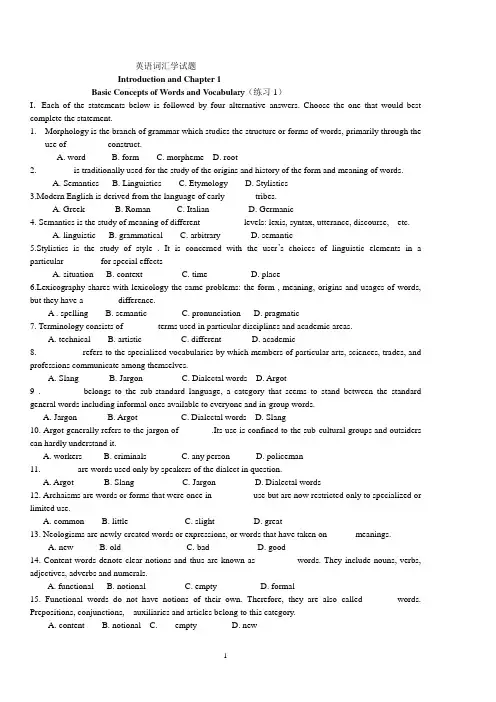
英语词汇学试题Introduction and Chapter 1Basic Concepts of Words and Vocabula ry(练习1)I.Each of the statements below is followed by four alternative answers. Choose the one that would best complete the statement.1.Morphology is the branch of grammar which studies the structure or forms of words, primarily through theuse of _________construct.A. wordB. formC. morphemeD. root2.________ is traditionally used for the study of the origins and history of the form and meaning of words.A. SemanticsB. LinguisticsC. EtymologyD. Stylistics3.Modern English is derived from the language of early ______ tribes.A. GreekB. RomanC. ItalianD. Germanic4. Semantics is the study of meaning of different _________ levels: lexis, syntax, utterance, discourse, etc.A. linguisticB. grammaticalC. arbitraryD. semantic5.Stylistics is the study of style . It is concerned with the user’s choices of linguistic elements in a particular________ for special effectsA. situationB. contextC. timeD. place6.Lexicography shares with lexicology the same problems: the form , meaning, origins and usages of words, but they have a _______ difference.A . spelling B. semantic C. pronunciation D. pragmatic7. Terminology consists of _______ terms used in particular disciplines and academic areas.A. technicalB. artisticC. differentD. academic8. __________refers to the specialized vocabularies by which members of particular arts, sciences, trades, and professions communicate among themselves.A. SlangB. JargonC. Dialectal wordsD. Argot9 ._________ belongs to the sub-standard language, a category that seems to stand between the standard general words including informal ones available to everyone and in-group words.A. JargonB. ArgotC. Dialectal wordsD. Slang10. Argot generally refers to the jargon of _______.Its use is confined to the sub-cultural groups and outsiders can hardly understand it.A. workersB. criminalsC. any personD. policeman11.________ are words used only by speakers of the dialect in question.A. ArgotB. SlangC. JargonD. Dialectal words12. Archaisms are words or forms that were once in _________use but are now restricted only to specialized or limited use.A. commonB. littleC. slightD. great13. Neologisms are newly-created words or expressions, or words that have taken on ______meanings.A. newB. oldC. badD. good14. Content words denote clear notions and thus are known as_________ words. They include nouns, verbs, adjectives, adverbs and numerals.A. functionalB. notionalC. emptyD. formal15. Functional words do not have notions of their own. Therefore, they are also called _______words. Prepositions, conjunctions, auxiliaries and articles belong to this category.A. contentB. notionalC. emptyD. newII. Complete the following statements with proper words or expressions according to the course book.16.Lexicology is a branch of linguistics, inquiring into the origins and _____of words.17.English lexicology aims at investigating and studying the ______ structures of English words and word equivalents, their semantics, relations, _____development, formation and ______.18.English lexicology embraces other academic disciplines, such as morphology, ______,etymology, stylistics,________.19.There are generally two approaches to the study of words , namely synchronic and _______.nguage study involves the study of speech sounds, grammar and_______.III. Match the words or expressions in Column A with those in Column B according to 1) basic word stock and nonbasic vocabulary 2) content words and functional words 3) native words and borrowed words4)characteristics of the basic word stock.A B21 . Stability ( ) A. E-mail22. Collocbility( ) B. aught23. Jargon( ) C. por24. Argot ( ) D. upon25.Notional words( ) E. hypo26. Neologisms ( ) F. at heart27. Aliens ( ) G. man28. Semantic-loans( ) H. dip29. Archaisms ( ) I. fresh30. Empty words ( ) J. emirIV. Study the following words or expressions and identify 1) characteristics of the basic word stock 2) types of nonbasic vocabulary.31. dog cheap ( ) 32 a change of heart ( )33. can-opener ( ) 34.Roger ( )35. bottom line ( ) 36.penicillin ( )37. auld ( ) 38. futurology ( )39.brethren ( ) 40. take ( )V. Define the following terms.41. word 42. Denizens 43. Aliens 44. Translation-loans 45. Semantic-loansVI. Answer the following Questions46.Illustrate the relationship between sound and meaning, sound and form with examples.47. What are the main characteristics of the basic word-stock? Illustrate your points with examples.48. Give the types of nonbasic vocabulary with examples.VII. Analyze and comment on the following.49. Classify the following words and point out the types of words according to notion.earth, cloud, run, walk, on, of, upon, be, frequently , the, five, but, a , never.50. Group the following borrowed words into Denizens, Aliens, Translation-loans, Semantic-loans.Dream, pioneer, kowtow, bazaar, lama, master-piece, port, shirtKey to Exercises:I. 1. A2.C3.D4.A5.B6.D7.A8.B9.D10.B11.D12.A13.A14.B15.CII.16.meanings17.morphological, historical, usages 18. semantics, lexicography19.diachronic20.vocabularyIII.21. G 22. F23. E24. H25. C26. A27. J28.I29.B30.DIV.31. the basic word stock; productivity32. the basic word stock; collocability33.the basic word stock; argot34.nonbasic word stock; slang35. nonbasic word stock; jargon36. nonbasic word stock ;terminology37.nonbasic word stock; dialectal words38. nonbasic word stock ,neologisms39. nonbasic word stock; archaisms40. the basic word stock; polysemyV-----VI. (see the course book)VII. 49. Content words: earth, clould, run, walk, frequently, never, fiveFunctional words: on, of, upon, be, the, but, a.50. Denizens: port, shirt,Aliens: bazaar, kowtowTranslation-loans: lama, masterpieceSemantic-loans:dream, pioneerChapter 2 The Development of the English Vocabulary and Chapter 3 Word Formation I(练习2)I. Each of the statements below is followed by four alternative answers. Choose the one that would best complete the statement.1.It is assumed that the world has approximately 3,000( some put it 5,000)languages, which can be groupedinto the basis of similarities in their basic word stock and grammar.A. 500B. 4000C. 300D. 20002.The prehistoric Indo-European parent language is thought to be a highly ______language.A. inflectedB. derivedC. developedD. analyzed3.After the _________, the Germanic tribes called Angles ,Saxons, and Jutes came in great numbers.A. GreeksB. IndiansC. RomansD. French4.The introduction of ________had a great impact on the English vocabulary.A. HinduismB. ChristianityC. BuddhismD. Islamism5.In the 9th century the land was invaded again by Norwegian and Danish Vikings. With the invaders, many________words came into the English language.A. GreekB. RomanC. CelticD. Scandinavian6.It is estimated that at least ______ words of Scandinavian origin have survived in modern English.A. 500B. 800C. 1000 .D. 9007.The Normans invaded England from France in 1066. The Norman Conquest started a continual flow of______ words into English.A. FrenchB. GreekC. RomanD. Latin8.By the end of the _______century , English gradually came back into the schools, the law courts, andgovernment and regained social status.A. 12thB. 13thC. 14thD.15th9.As a result , Celtic made only a ________contribution to the English vocabulary.A. smallB. bigC. greatD. smaller10. The Balto-Slavic comprises such modern languages as Prussian, Lithuanian, Polish, Czech, Bulgarian, Slovenian and _______.A. GreekB. RomanC. IndianD. Russian11.In the Indo-Iranian we have Persian , Bengali, Hindi, Romany, the last three of which are derived from thedead language.A. SanskritB. LatinC. RomanD. Greek12.Greek is the modern language derived from _______.A. LatinB. HellenicC. Indian D . Germanic13.The five Roamance languages , namely, Portuguese, Spanish, French, Italian, Romanian all belong to theItalic through an intermediate language called _______.A. SanskritB. LatinC. CelticD. Anglo-Saxon14.The ________family consists of the four Northern European Languages: Norwegian, Icelandic, Danishand Swedish, which are generally known as Scandinavian languages.A. GermanicB. Indo-EuropeanC. AlbanianD. Hellenic15.By the end of the _______century , virtually all of the people who held political or social power and manyof those in powerful Church positions were of Norman French origin.A. 10thB.11thC.12thD. 13thII. Complete the following statements with proper words or expressions according to the course book.16.Now people generally refer to Anglo-Saxon as _______.17.. If we say that Old English was a language of full endings , Middle English was one of ______.18.It can be concluded that English has evoked from a synthetic language (Old English) to the present _____language.19.The surviving languages accordingly fall into eight principal groups , which can be grouped into anEastern set: Balto-Slavic , Indo-Iranian ,Armenian and Albanian; a Western set :Celtic, Italic, Hellenic, _______.20.It is necessary to subdivide Modern English into Early (1500-1700)and _____ Modern English.III. Match the words or expressions in Column A with those in Column B according to 1) origin of the words2)history off English development 3) language family.A B21. Celtic ( ) A.politics22. religious ( ) B.moon23.Scandinavian ( ) C. Persian24. French ( ) D.London25. Old English ( ) E. abbot26.Dutch ( ) F. skirt27.Middle English ( ) G. sunu28. Modern English ( ) H. lernen29. Germanic family ( ) I. freight30.Sanskrit ( ) J. NorwegianIV.Study the following words or expressions and identify types of morphemes underlined.31. earth ( ) 32.contradict ( )33. predictor ( ) 34. radios ( )35. prewar ( ) 36. happiest ( )37. antecedent ( ) 38. northward ( )38. sun ( ) 40. diction ( )V. Define the following terms.41. free morphemes 42. bound morphemes 43. root 44. stem 45.affixesVI. Answer the following questions. Your answers should be clear and short.46. Describe the characteristics of Old English .47. Describe the characteristics of Middle English.48. Describe the characteristics of Modern English.VII. Answer the following questions with examples.49. What are the three main sources of new words ?50. How does the modern English vocabulary develop ?Key to exercises:I. 1.C 2.A 3.C 4.B 5.D 6.D 7.A 8.B 9.A 10.D 11.A 12.B 13.B 14.A 15.BII.16.Old English 17. Leveled endings 18. analytic 19. Germanic te(1700-up to the present )III.21. D 22. E 23. F 24. A 25. G 26. I 27. H 28. B 29. J 30. CIV.31. free morpheme/ free root 32. bound root 33. suffix 34. inflectional affix35. prefix 36. Inflectional affix 37. prefix 38. suffix 39. free morpheme/free root40.bound rootV.-VI ( See the course book )VII. 49. The three main sources of new words are :(1)The rapid development of modern science and technology ,e.g. astrobiology, green revolution ;(2)Social , economic and political changes; e.g. Watergate, soy milk;(3)The influence of other cultures and language; e.g. felafel, Nehru Jackets.50. Modern English vocabulary develops through three channels: (1) creation, e.g. consideration, carefulness; (2) semantic change, e.g. Polysemy, homonymy ; (3) borrowing ;e.g. tofu, gongful.Chapter 3 The Development of the English V ocabulary and Chapter 4 Word Formation II(练习3)I.Each of the statements below is followed by four alternative answers. Choose the one that would best complete the statement.1.The prefixes in the words of ir resistible, non classical and a political are called _______.A.reversative prefixesB. negative prefixesC. pejorative prefixesD. locative prefixes2.The prefixes contained in the following words are called ______: pseudo-friend, mal practice, mis trust.A. reversative prefixedB. negative prefixesC. pejorative prefixesD. locative prefixes3.The prefixed contained in un wrap, de-compose and dis allow are _________.A. reversative prefixedB. negative prefixesC. pejorative prefixesD. locative prefixes4.The prefixes in words extra-strong, overweight and arch bishop are _____ .A . negative prefixes B. prefixes of degree or size C. pejorative prefixes D. locative prefixes5.The prefixes in words bi lingual ,uni form and hemis phere are ________.A. number prefixesB. prefixes of degree or sizeC. pejorative prefixesD. locative prefixes6.________ are contained in words trans-world, intra-party and fore head.A.Prefixes of orientation and attitudeB. Prefixes of time and orderC. Locative prefixesD. Prefixes of degree or size7. Rugby ,afghan and champagne are words coming from ________.s of booksB. names of placesC. names of peopleD. tradenames8. Omega,Xerox and orlon are words from _________.s of booksB. names of placesC. names of peopleD. tradenames9.Ex-student, fore tell and post-election contain________.A.negative prefixesB. prefixes of degree or sizeC. prefixes of time and orderD. locative prefixes10.Mackintosh, bloomers and cherub are from _______A. names of booksB. names of placesC. names of peopleD. tradenames11.The prefixes in words new-Nazi, autobiography and pan-European are ________.A.negative prefixesB. prefixes of degree or sizeC. prefixes of time and orderD. miscellaneous prefixes12.The prefixes in words anti-government , pro student and contra flow are _____-.A.prefixes of degree or sizeB. prefixes of orientation and attitudeC. prefixes of time and orderD. miscellaneous prefixes13.Utopia ,odyssey and Babbit are words from ________.s of booksB. names of placesC. names of peopleD. tradenames14.The suffixes in words clockwise, homewards are ______.A. noun suffixesB. verb suffixesC. adverb suffixesD. adjective suffixes15.The suffixes in words height en, symbol ize are ________.A. noun suffixesB. verb suffixesC. adverb suffixesD. adjective suffixesII. Complete the following statements with proper words or expressions according to the course book.16. Affixation is generally defined as the formation of words by adding word-forming or derivational affixes to stem. This process is also known as_____.pounding , also called ________, is the formation of new words by joining two or more stems . Words formed in this way are called _________.18. __________ is the formation of new words by converting words of one class to another class.19. _________ is the formation of new words by combining parts of two words or a word plus a part of another word . Words formed in this way are called blends or _____words.20 A common way of making a word is to shorten a longer word by cutting a part off the original and using what remains instead. This is called _______.III. Match the words or expressions in Column A with those in Column B according to types of suffixation.A B21. Concrete denominal noun suffixes( ) A. priceless22. Abstract denominal noun suffixes ( ) B. downward23. Deverbal noun suffixes(denoting people.)() C. engineer24. Deverbal nouns suffixes( denoting action,etc) () D. darken25. De-adjective noun suffixes()Eviolinist26. Noun and adjective suffixes ( ) F.happiness27. Denominal adjective suffixes ( ) G. arguable28. Deverbal adjective suffixes ( ) H.dependent29. Adverb suffixes ( ) I. adulthood30. Verb suffixes ( ) J. survivalIV.Study the following words or expressions and identify 1) types of clipping 2) types of acronymy and write the full terms.31.quake ( ) 32. stereo ( ) 33. flu ( ) 34. pub ( ) 35. c/o ( )36. V-day ( ) 37. TB ( ) 38. disco ( ) 39.copter ( ) 40. perm ( )V.Define the following terms .41. acronymy 42. back-formation 43. initialisms 44. prefixation 45. suffixationVI. Answer the following questions with examples.46. What are the characteristics of compounds ?47. What are the main types of blendings ?48. What are the main types of compounds ?VII. Analyze and comment on the following:49. Use the following examples to explain the types of back-formation.(1) donate ----donation emote----emotion(2) loaf—loafer beg------beggar(3) eavesdrop---eavesdropping babysit---babysitter(4) drowse—drowsy laze---lazy50. Read the following sentence and identify the types of conversion of the italicized words.(1) I’m very grateful for your help. (2) The rich must help the poor.(3)His argument contains too many ifs and buts. (4) They are better housed and clothed.(5) The photograph yellowed with age. (6) We downed a few beers.Key to exercises :1. B2. C3. A4. B5. A6.C7.B8.D9.C 10.C 11.D 12.B 13.A 14.C 15.BII. 16. derivation position, compounds 18. Conversion 19. Blending(pormanteau) 20.clippingIII. 21.C 22. I 23. H 24. J 25.F 26.E 27.A 28.G 29.B 30.DIV.31. Front clipping, earthquake32. Back clipping, stereophonic33.Front and back clipping, influenza34.Phrase clipping, public house35. Initialisms, care of36. Acronyms, Victory Day37. Initialisms, tuberculosis38. Back clipping, discotheque39. Front clipping, helicopter40. Phrase clipping, permanent wavesV-VI. (See the course book)VII.49. There are mainly four types of back-formation.(1)From abstract nouns (2) From human nouns (3) From compound nouns and others(4) From adjectives50. (1)Verb to noun (2) Adjective to noun (3) Miscellaneous conversion to noun(4 ) Noun to verb (5) Adjective (6) Miscellaneous conversion to verbChapter 5 Word Meaning (练习4)I. Each of the statements below is followed by four alternative answers. Choose the one that would best complete the statement.1. A word is the combination of form and ________.A. spellingB. writingC. meaningD. denoting2._______is the result of human cognition, reflecting the objective world in the human mind.A. ReferenceB. ConceptC. SenseD. Context3.Sense denotes the relationships _______the language.A. outsideB. withC. beyondD. inside4. Most English words can be said to be ________.A. non-motivatedB. motivatedC. connectedD. related5.Trumpet is a(n) _______motivated word.A. morphologicallyB. semanticallyC. onomatopoeicallyD. etymologically6.Hopeless is a ______motivated word.A. morphologicallyB. onomatopoeicallyC. semanticallyD. etymologically7.In the sentence ‘ He is fond of pen ’ , pen is a ______ motivated word.A. morphologicallyB. onomatopoeicallyC. semanticallyD. etymologically8.Walkman is a _______motivated word.A. onomatopoeicallyB. morphologicallyC. semanticallyD. etymologically9.Functional words possess strong _____ whereas content words have both meanings, and lexical meaning inparticular.A. grammatical meaningB. conceptual meaningC. associative meaningD. arbitrary meaning10._______is unstable, varying considerably according to culture, historical period, and the experience of the individual.A.Stylistic meaningB. Connotative meaningC. Collocative meaningD. Affective meaning11.Affective meaning indicates the speaker’s _______towards the person or thing in question.A. feeling .B. likingC. attitudeD. understanding12. _________ are affective words as they are expressions of emotions such as oh, dear me, alas.A. PrepositionsB. InterjectionsC. ExclamationsD. Explanations13. It is noticeable that _______overlaps with stylistic and affective meanings because in a sense both stylistic and affective meanings are revealed by means of collocations.A.conceptual meaningB. grammatical meaningC. lexical meaningD. collocative meaning14.In the same language, the same concept can be expressed in ______.A. only one wordB. two wordsC. more than threeD. different words15.Reference is the relationship between language and the ______.A. speakersB. listenersC. worldD. specific countryII. Complete the following statements with proper words or expressions according to the course book.16.In modern English one may find some words whose sounds suggest their ______pounds and derived words are ______ words and the meanings of many are the sum total of themorphemes combined.18._______ refers to the mental associations suggested by the conceptual meaning of a word.19.The meanings of many words often relate directly to their ______. In other words the history of the wordexplains the meaning of the word.20.Lexical meaning itself has two components : conceptual meaning and _________.III. Match the words or expressions in Column A with those in Column B according to 1) types of motivation 2) types of meaning.A B21. Onomotopooeic motivation ( ) A. tremble with fear22. Collocative meaning ( ) B. skinny23. Morphological motivation ( ) C. slender24. Connotative meaning ( ) D. hiss25. Semantic motivation ( ) E. laconic26. Stylistic meaning ( ) F. sun (a heavenly body)27. Etymological motivation ( ) G.airmail28. Pejorative meaning ( ) H. home29. Conceptual meaning ( ) I. horse and plug30. Appreciative meaning ( ) J. pen and awordIV.Study the following words or expressions and identify 1)types of motivation 2) types of meaning.31. neigh ( ) 32. the mouth of the river ( )33. reading-lamp ( ) 34. tantalus ( )35. warm home ( ) 36. the cops ( )37. dear me ( ) 38. pigheaded ( )39. handsome boy ( ) 40. diligence ( )V.Define the following terms .41. motivation 42. grammatical meanings 43. conceptual meaning 44. associative meaning 45. affective meaningVI.Answer the following questions . Your answers should be clear and short.46. What is reference ? 47. What is concept ? 48. What is sense ?VII.Analyze and comment on the following.49. Study the following words and explain to which type of motivation they belong.50. Explain the types of associative meaning with examples.Key to exercises:I. 1. C 2.B 3.D 4.A 5.C 6.A 7.C 8.D 9.A 10.B 11.C 12.B 13.D 14.D 15.CII.16. meanings 17.multi-morphemic 18.Semantic motivation 19.origins 20.associative meaningIII.21. D 22.A 23.G 24.H 25.J 26.I 27.E 28.B 29.F 30.CIV.31. Onomatopoeic motivation 32. Semantic motivation33. Morphological motivation 34. Etymological motivation35. Connotative meaning 36.Stylistic meaning37. Affective meaning 38. pejorative39. collocative meaning 40. appreciativeV-VI. See the course book.VIII.49. (1) Roar and buzz belong to onomatopoeic motivation.(2)Miniskirt and hopeless belong to morphological motivation.(3) The leg of a table and the neck of a bottle belong to semantic motivation.(4) Titanic and panic belong to etymological motivation.50. Associative meaning comprises four types:(1)Connotative meaning . It refers to the overtones or associations suggested by the conceptual meaning,traditionally known as connotations. It is not an essential part of the word-meaning, but associations that might occur in the mind of a particular user of the language. For example, mother , denoting a ‘female parent’, is often associated with ‘love’, ‘care’, etc..(2)Stylistic meaning. Apart feom their conceptual meanings, many words have stylistic features, whichmake them appropriate for different contexts. These distinctive features form the stylistic meanings of words . For example, pregnant, expecting, knockingup, in the club, etc., all can have the same conceptual meaning, but differ in their stylistic values.(3)Affective meaning. It indicates the speaker’s attitude towards the person or thing in question. Wordsthat have emotive values may fall into two categories :appreciative or pejorative. For example, famous, determined are words of positive overtones; notorious, pigheaded are of negative connotations implying disapproval, contempt or criticism.(4)Collocative meaning. It consists of the associations a word acquires in its collocation. In other words,it is that part of the word-meaning suggested by the words before or after the word in discussion. For example, we say : pretty girl, pretty garden; we don’t say pretty typewriter. But sometimes there is some overlap between the collocations of the two words.Chapter 6 Sense Relations and Semantic Field (练习5)I.Each of the statements below is followed by four alternative answers. Choose the one that would best complete the statement.1.Polysemy is a common feature peculiar to ______.A. English onlyB. Chinese onlyC. all natural languagesD. some natural languages2.From the ______ point of view, polysemy is assumed to be the result of growth and development of thesemantic structure of one and same word .A. linguisticB. diachronicC. synchronicD. traditional3._______ is a semantic process in which the primary meaning stands at the center and the secondarymeanings proceed out of it in every direction like rayes.A Radiation B. Concatenation C. Derivation D. Inflection4. _________ is the semantic process in which the meaning of a word moves gradually away from its first sense by successive shifts until, in many cases, there is not a sign of connection between the sense that is finally developed and that which the term had at the beginning.A. DerivationB. RadiationC. InflectionD. Concatenation5.One important criterion to differentiate homonyms from polysemants is to see their ______.A. spellingB. pronunciationC. etymologyD. usage6. ________refer to one of two or more words in the English language which have the same or very nearly the same essential meaning.A. PolysemantsB. SynonymsC. AntonymsD. Hyponyms7. The sense relation between the two words tulip and flower is _______.A. hyponymyB. synonymyC. polysemyD. antonymy8. _________ are words identical only in spelling but different in sound and meaning, e.g. bow/bau/; bow/beu/.A. HomophonesB. HomographsC. Perfect homonymsD. Antonyms9. The antonyms: male and female are ______.A. contradictory termsB. contrary termsC. relative termsD. connected terms10.The antonyms big and small are ______.A. contradictory termsB. contrary termsC. relative termsD. connected terms11.The antonyms husband and wife are ______.A. contradictory termsB. contrary termsC. relative termsD. connected termsposition and compounding in lexicology are words of _______.A. absolute synonymsB. relative synonymsC. relative antonymsD. contrary antonyms13.As homonyms are identical in sound or spelling, particularly ______, they are often employed in aconversation to create puns for desired effect of humor, sarcasm or ridicule.A. homographsB. homophonesC. absolute homonymsD. antonyms14.From the diachronic point of view, when the word was created, it was endowed with only one meaning .The first meaning is called ______.。
