
How to Prepare your Paper for SCI Journal
- 格式:ppt
- 大小:1.43 MB
- 文档页数:38

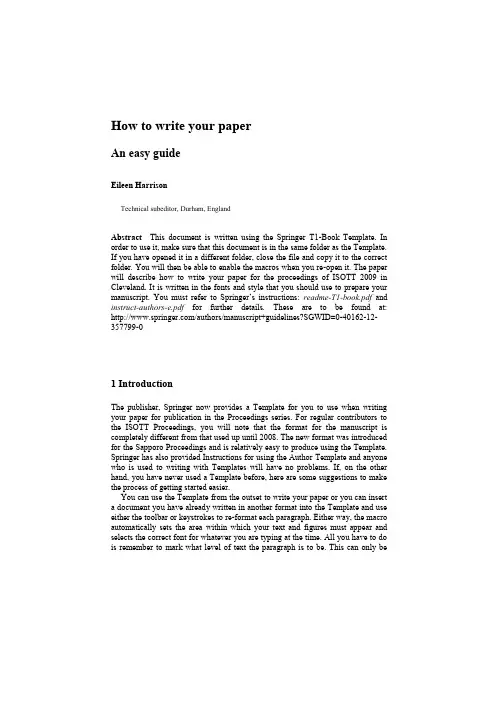
How to write your paperAn easy guideEileen HarrisonTechnical subeditor, Durham, EnglandAbstract This document is written using the Springer T1-Book Template. In order to use it, make sure that this document is in the same folder as the Template. If you have opened it in a different folder, close the file and copy it to the correct folder. You will then be able to enable the macros when you re-open it. The paper will describe how to write your paper for the proceedings of ISOTT 2009 in Cleveland. It is written in the fonts and style that you should use to prepare your manuscript. You must refer to Springer’s instructions:readme-T1-book.pdf and instruct-authors-e.pdf for further details. These are to be found at: /authors/manuscript+guidelines?SGWID=0-40162-12-357799-01 IntroductionThe publisher, Springer now provides a Template for you to use when writing your paper for publication in the Proceedings series. For regular contributors to the ISOTT Proceedings, you will note that the format for the manuscript is completely different from that used up until 2008. The new format was introduced for the Sapporo Proceedings and is relatively easy to produce using the Template. Springer has also provided Instructions for using the Author Template and anyone who is used to writing with Templates will have no problems. If, on the other hand, you have never used a Template before, here are some suggestions to make the process of getting started easier.You can use the Template from the outset to write your paper or you can insert a document you have already written in another format into the Template and use either the toolbar or keystrokes to re-format each paragraph. Either way, the macro automatically sets the area within which your text and figures must appear and selects the correct font for whatever you are typing at the time. All you have to do is remember to mark what level of text the paragraph is to be. This can only be2done by giving the correct command whilst the cursor is in a paragraph. You choose whether to use the toolbar or keystrokes to give the commands2 MethodsIn order to use the Template from the outset to write your paper, after downloading it from the website you will want to put it in the directory where you want to save your manuscript whilst working on it. To do this follow the instructions on the first page of Springer’s Instructions for using the Author Template to open Word and set Macro Security. Then open My Computer or Windows Explorer and double click on the Template to create a new document. Word will open automatically. A warning may appear about macros: just click on “Activate Macros” or its equivalent. Note the warning: DO NOT OPEN THE TEMPLATE VIA FILE → OPEN. Now save the document you have just created as n ormal, naming it with the first author’s surname. If you have more than one paper by the same first author add a subject keyword (from the title, for example) to the file name to identify it. From now on you can open the file in Word.To start writing, use the mouse to click on “Chap. Title” on the Toolbar at the top of the screen and type the title of your paper. It will automatically appear in the correct position and font. At the end of the title press return. Before starting to enter the Subtitle (if yo u have one) click on “Subtitle” in the Toolbar. If you have no subtitle and want to enter the authors next, click on “Author” and type the names of the authors. Again, the correct spacing and font will be selected for you. Press return and repeat the procedure to enter the Abstract. At the end of the abstract, press return and this time click on “H1” so you can type your first order heading “Introduction”. These headings are to be numbered: type the number followed only by a space before typing the heading. Press return and the macro switches to normal text. The first paragraph of every section after the heading is NOT indented, the following paragraphs ARE indented by 0.42cm and this should happen automatically. Now you can continue to write your paper as normal.3 Instructions to AuthorsPlease read the Instructions to Authors documents carefully. Manuscripts that do not comply will be returned for correction. The following should be noted in particular.3 3.1 LengthThe designated maximum length of 6 pages must include the abstract, all tables, figures and references and must not be exceeded. Do NOT include keywords in the manuscript they should be supplied separately to the editors.3.1.1 Sub-HeadingsYou will note from this section that the use of multiple sub-headings takes up a lot of space due to the prescribed spaces between the headings and text.3.2 FiguresFor vector graphics, the preferred format is EPS; for halftones, please use TIFF format. MS Office files are also acceptable. Each figure should be submitted as a separate file.3.3 TablesTables should be prepared using the Table function in Word preferably using the Simple 1 format. Do not include tables as graphic files or pictures.3.4 How to Cite ReferencesReferences should be cited in the text in square brackets [1, 2] in the order they are cited in the text. The reference list should be similarly numbered in order of citation. When listing publications with more than 3 authors, “et al” should be used after the name of 3rd author4 ConclusionsIf you use the above guidelines in conjunction with the two Springer documents, you should be able to prepare you manuscript easily and correctly. Acknowledgments This document was prepared to help authors.4References1. Sorensen LT, Jorgensen T, Kirkeby LT et al (1999) Smoking and alcohol abuse are major riskfactors for anastomotic leakage in colorectal surgery. Br J Surg 86:927-9312. Harrison DK, Hawthorn IE (2005) Amputation level viability in critical limb ischaemia:Setting new standards. Adv Exp Med Biol 566:325-332。

how to write a good academic paper如何写一篇好的学术论文?写一篇好的学术论文是每个学术界从业者和学生的共同目标。
一篇优秀的学术论文应该具有清晰的结构,准确的语言,充分的证据支持和原创的观点。
本文将介绍一些撰写学术论文的关键步骤,以帮助您提高您的写作技巧。
第一步:选择一个适当的主题选择一个适当的主题是撰写学术论文的第一步。
您可以考虑自己感兴趣的研究领域或者在学术界尚未得到充分研究的领域。
确保主题是具有独特性和可行性的。
如果您选择了一个宽泛的主题,可以考虑缩小范围或找到一个更具体的研究问题。
第二步:进行详尽的文献综述进行详尽的文献综述是学术论文写作的重要一步。
这将帮助您了解当前研究中的争议和空白,以及前人对该主题的观点和实证研究。
通过文献综述,您可以确保自己的研究问题与已有研究紧密相关,并找到需要补充或扩展的观点。
第三步:制定研究问题和目标在确定了主题和进行了文献综述后,您需要制定明确的研究问题和目标。
一个好的研究问题应该具有明确性,可以通过可行的研究方法解决,并且可以为学术界或实践者提供新的见解。
第四步:设计合适的研究方法设计合适的研究方法是一篇好的学术论文的关键。
您需要选择和阐述您的研究方法,以确保您可以回答您的研究问题,并获得准确和可靠的结果。
您的研究方法可以采用定性研究方法或定量研究方法,也可以结合两者,具体取决于您的研究问题和研究对象。
第五步:收集和分析数据在您完成研究方法设计后,您需要收集并分析相关数据。
收集数据的方法可能包括实地调查、实验、访谈或文献研究。
根据您的研究方法和研究目标,您可以使用不同的数据分析方法,如统计分析、内容分析、主题分析等。
第六步:撰写论文的各个部分一篇好的学术论文通常包括引言、文献综述、方法、结果、讨论和结论等部分。
在撰写论文的各个部分时,您应该注意以下几点:引言部分:引言应该饱含背景知识,引出研究问题和目标,并概述本文的结构。
How to prepare for a job interview(一)If you wish to pursue your professional career successfully, it is essential to find a satisfactory job.A job interview, in some cases, can be of critical importance for you to obtain a job you like.Since a job interview is so important, we should be well-prepared for it. Here are some tips for you. First of all, take account of your qualifications, and background and decide whether they satisfy the requirements of the job. If they do, get familiar with them in case you are asked about them during the interview. Secondly, remember your special abilities or hobbies, such as playing sports or music, and mention them if necessary, which may attracts the interviewers. My final advice is that you should take special care of your appearance. Though we should not judge a person by his appearance, the first impression is very important for one to have a job interview.Above all, job interview is becoming more popular nowadays. So to make full preparations for the job interview plays a critical part in your success. If you want to find a job successfully, be sure to be self-condition, select proper words and pay attention to the ways of talking in an interview besides your full preparations.(二)It’s that time of the year when you’re fretting because the end of summer means that you need to enter the big bad world of jobs.With your results in hand, you set out to find your perfect job only to realise you screwed up during your interview! Sounds familiar? Even experienced workers face this problem. So, whether you’re a newbie or a pro at the job hunting game, here are a few tips to make that solid first impression.PreparationWhile applying for a job, you need to show that you know about the organisation and what it does.A little homework goes a long way in showing that you genuinely care about the company you wish to join. The simplest way of doing this is to go to the company’s website and read the ‘About Us’ section. If there are profiles of some senior personnel, read up on them too. The more you know about the organisation, the better your chances of cracking the interview.PoiseDuring your interview, you need to be in a Zen state of mind. You may be asked difficult and uncomfortable questions. If you can demonstrate an ability to stay calm when you are put under pressure it tells your potential employers that you can do the same when it comes to handling their projects.PracticeThere is no getting around this. Sit in front of mirror and practice your responses to standard questions you will asked during your interview. Questions like, ‘Why do you want to join us?’, ‘Where do you see yourself in five years?’ will be asked. Get your responses in order, get them checked with a superior if possible and speak with experience when asked.PolishKnowing the dress code of your potential employer is important. You do not want to land at a corporate office wearing jeans and your Nirvana tee. On the other hand, an ad agency or any other creative company will look upon format attire as a sign of having a closed mind. Apart from this, ensure that you look proper. Cut your nails, shave properly, get your hair in order and hide your tattoos as far as you can.ReworkGo over your resume once again. Many of us carry old versions of our re sumes’ and use it for each company. It is necessary to tweak your past experience for each particular company. This will also help you to keep your resume updated. Check if a covering letter is required. Write one accordingly and check for errors. Fix them. If references are asked for, ensure that they are in order.Be confident, ensure you’ve taken all the documents you need and reach at least 15 minutes before time.Once you've made sure that you have checked and re-checked everything, you’re ready to ace that interview. So, just go for it!(三)How to Prepare For a Job Interview?As more and more applicants have applied for one position by holding the identical resume, including their major and experience, employers have determined to evaluate the employee through job interview. Faced with the new challenge, achievement is founded on diligence and wasted upon recklessness.First of all, we need to have a full list of the process in our mind once although it’s just an imagined one. According to the list, we can figure out what we need to prepare and what the problems and situation we’re likely to come across in the interview. If it’s the case, how can we behave properly.Then, based on the clear classification of the materials we may need, we can wisely choose various means to collect information, respectively overall. Such as surfing the internet, going to the library or the professional bookstore to find more about your major and the company and the special interview skills.Besides, we could ask for advice from the predecessors in the same major, our friends or teachers, especially those who had managed to work in the field, or a manager. We should respect the experience of their own and try to learn something invaluable for us and revise our resume to be a brilliant one. This method does helpful and beneficial in a practical way.Above all, learning more specific mattters about the history of the company,its development, the position in the market,and its needs as much as possible can really make a difference. In a word, we should make a overall picture of the company to make a good impression. Therefore, we 'll build our communication process more comfortably and happily.At last, we’d better recheck the information we’ve gotten and apply the prin ciples and tips into our resume before we send it to the company. With the adequate preparation, we can successfully get the offer just on one condition that please be confident, honest and friendly.(四)How to Prepare for a Job InterviewDuring a job interview, you have the opportunity to sell yourself to the prospective employer. Making the most of it by planning ahead is the key work for getting the job. There are a few advices as follows that a job candidate can take when preparing for a job interview.Firstly, you’d better make a great first impression. On one hand, you should dress up and behave appropriately. On the other hand, it is very important to find out as much as you can about the culture of the company you are interviewing with by studying its materials. Meanwhile,researching the company and take notes about recent news items such as a new client or contract. These are things you can mention in the interview to make a great first impression.Secondly, make a list of your“winning characteristics” that will mostly likely convince the employer to hire you over other candidates. These “winning characteristics” must be qualities you possess that the company suggest it desires in a job candidate. For example, if the job description says “we're looking for someone who are good at communicating” and you know that you have this quality, so add it to your list.The last but not the least, you can design several potential interview questions an employer may ask and give the answers. What’s more, you’d better practice them before you go to the interview. This can release your pressure and help you to become positive and active during the job interview.With the adequate preparation, you can successfully achieve the purpose just on anther condition that you must be confident in yourself. If you can follow all above of these basic steps, you are almost guaranteed to succeed in getting that job.。
Maxine Clarke takes us through the processes involved in submitting apaper to a scientific journal.Before submitting a paper to a scientific journal, two factors should be kept in mind. The first is the need to ensure that you have a clear,logical message. The second is to present your paper in the correct format for the journal to which you intend to submit the paper.The first of these is the most important. However careful and beautiful the presentation, a paper will not be published unless it has a clear, sound conclusion (editors of reputable journals will always be happy to advise authors whose scientific conclusions are publishable but who havedifficulty in presenting these conclusions in, say, a foreign language).Before submitting a paper, therefore, be sure that you have something important and publishable to say. To know this, you should discuss your results with others working in the field, both in your own institution and elsewhere.The best way to do this is to present your results at scientific meetings — if you can get to them. An additional (or alternative) strategy is tojoin an email list relevant to your field, and use that to obtain feedback about your research plans, and learn about results from others in the field.Discuss your ideas and proposed paper with people whose work you respectand admire. It may be a good idea to send one or two key scientists a brief summary of your paper, and ask them to send you some informal comments on whether it is worth your while writing a full paper, or if whether you should to do some more work first (and if so, what).Use the Internet and email if you cannot speak to people directly at meetings. If you can discuss your work by telephone, then do so; but send the recipient a synopsis or draft of your proposed publication first, sothat you have something concrete to discuss.Writing a draftWhen you are sure you are ready to write up the paper, prepare a first draft, including the figures, and repeat the consultation process. Ask people at this stage which journal they think would be most appropriate for publication of your work.Once you feel you have a solid conclusion to present, you need to prepare a final draft of your paper (see "How to write a scientific paper") in the format of the journal to which you intend to submit.In deciding on the journal, you should bear in mind the advice you have received from others in the field (some of whom may be academic editors of journals and referees themselves, and hence experienced at judging which journal is most appropriate).You should also be aware of which journals are publishing similar papers to yours, and whether the journal that you have selected has any rules that make it particularly easy — or difficult — for you to submit.For example, some journals impose page charges (although many do not), which are typically US$50–100 per page but vary greatly. A journal will state its page charges in its instructions to authors. If your institution cannot pay these, you should ask the journal before you submit whether it will waive the charges — many do under such circumstances.Another factor to bear in mind is that although some journals allow electronic submission via the Internet or by email, others only allow'hard-copy' submission by post. This may affect your decision about where to submit.Most journals or their publishers (for example, a scientific society) have websites containing information that will help you to make this decision. Alternatively you may be able to look at the journal of your choice in your library.Follow the guidelinesMake sure you read thoroughly the journal's editorial policy, guidelines to authors and any other relevant information — for example, which people in your scientific field are on the editorial board — before you submit.Author information of this type is usually on 'free access' areas of journals' websites, even if the content of the journal is only available to subscribers. But if your library does not subscribe to the journal of your choice and that journal has an online version, it is worth sending the journal an email saying that you are planning to submit a paper, and asking the journal if it will arrange for you to have online access to its contents for a limited time.This will allow you to look at the level and format of published papers, information that will be helpful when you prepare the final version of your own paper.Submitting your paperOnce you have read the journal's instructions to authors and prepared your paper, you must submit it according to the journal's instructions.Different journals have different rules about number of copies of papers to submit, how to prepare figures and tables, whether to include other information supplementary to your paper, whether all the authors have to sign the letter of submission (known as the 'cover letter') or just one,and so on.When you submit your paper, the cover letter should contain: ∙Your name, address, phone and fax numbers and email address;∙Alternative contact details if you will be away for any length of time;∙ A brief statement, in a sentence or two, why you think the paper is important and why the journal should publish it (in other words,state the main conclusion of the paper);∙Names of anyone in the field who has commented on the paper previously particularly if they are individuals of high standing inthe field and/or if they are on the editorial board of the journal;∙Suggestions of a particular person you would like to referee the paper (although you must be confident that the person is independent, in other words does not collaborate with you or have any other reason to be biased in your favour);∙Details of anyone you would not like to review your paper because you think they would not give an objective assessment; and ∙Any other details you think are relevant.It is important to keep this cover letter as short as possible, as theeditor who will read it probably receives many papers, and will find it easier to assess yours if you can be succinct.Reacting to a journal's responseWhen your paper has been submitted, the journal will probably acknowledge receipt. If you do not hear anything from the journal for a couple of weeks, send the editor a short email asking for an acknowledgement of receipt of your paper, a reference number, and the name of the editor who is handling it.Use this reference number in any subsequent status enquiries. A journal usually provides an email address on its list of staff (known as the'masthead') that is published in each issue, usually on the front or the back page.When the journal has assessed your paper (usually with the help of referees, who are independent scientists in the field selected by the journal's editors), the editor will write to you with a decision about publication, and enclosing referees' reports.Sometimes an editor's letter will be clear, and it is obvious how youshould revise your paper for resubmission. If the letter is not clear,write back to the editor (by email) explaining what you do not understand, and ask for an explanation — for example if the referees' comments are difficult to understand, or you are not sure what the editor means in hisor her instructions for revising your paper.What to do if your paper is rejectedIf the journal declines to publish your paper, it is a usually a good ideato discuss this decision with a colleague in the field, showing them the reports and editor's letter, before proceeding further. It might be worth appealing the decision, or it might be better to submit your paper to another journal.If you do decide to appeal the journal's decision, send a letter stating your case, sticking to scientific points (for example, those parts of your conclusions that may have been misunderstood or not appreciated).Do not send angry or abusive letters, as this will not help your case.What to do if your paper is acceptedIf your paper is accepted for publication, ask the editor immediately, certainly before the paper is published, about the journal's policy on copyright and reprints, and whether there are other conditions of publication.A journal may provide you with some reprints free of charge if you do not have funds to pay for them. But it is important to ask about this before your paper is published; the journal may not be able to provide freereprints after publication, as they are much more expensive to produce than reprints made at the time of publication of your article.Alternatively the journal may be prepared to waive its standard copyright restrictions. But you will probably need to ask for such concessions, explaining your circumstances.When you are given a publication date for your paper, tell your institution so that it can include this information in its annual report or other documents promoting its research.Finally, remember to thank personally all those who have helped you in preparing the paper, letting them know that it will be published and in which journal.Maxine Clarke is the executive editor of Nature.This article was previously part of 's e-guide to science communication and has been reformatted to become this practical guide.。