牛津8B_Unit1知识点归纳、难点解析汇报、语法复习---沈毅
- 格式:doc
- 大小:86.05 KB
- 文档页数:10
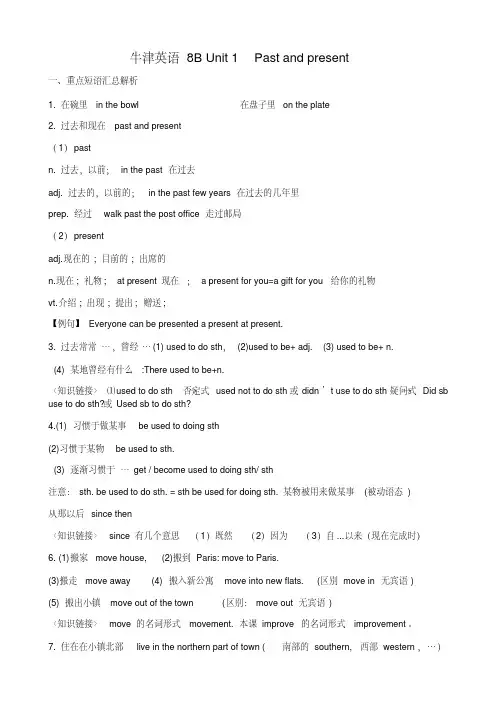
8B Unit 1 Past and present【短语学习重点】Comic strip &Welcome to the unit1.an hour ago 一小时前 p.6ed to share food with me 过去常常与我分享食物 p.63.go to school by bike 骑自行车上学 p.74.take a bus to school 乘公共汽车上学 p.7 Reading5 . know…very well 非常了解… p.86. since I was born 自我出生以来 p.87 . live in the northern part of town住在城镇的北部 p.88. get married 结婚 p.89. move two blocks away 搬到两个街区以外 p.810. since then 从那以后 p.811. change a lot 改变许多 p.812. over the years 在这些年期间 p.813. in the town centre 在镇中心 p.814. turn…into…把…变成… p.815. a steel factory 一家钢铁厂 p.916. put the waste into the river 把废料扔进河里 p.917. take action to improve the situation 采取行动改善情况 p.918. much cleaner 干净得多 p.919.in some ways 在某种程度上,在某些方面 p.920. have a beautiful modern town 拥有一个美丽现代化的城镇 p.921. most of my old friends 我的大多数老朋友 p.922.move away 搬走 p.923. see each other as often as before 和过去一样频繁的见到彼此 p.924 play cards and Chinese chess 打牌,下中国象棋 p.925. feel a bit lonely from time to time 有时感到有点孤单 p.926.the amazing changes 令人惊奇的改变 p.927.have an interview with sb. 采访某人 p.928. all one’s life 一生 p.11 Grammar29.repair over ten bicycles 修十多辆自行车 p.1430.the changes in Beijing 的变化 p.1431.over the past century 上个世纪期间 p.1432.learn more about 更多了解关于…… p.14Integrated skills33.clean and fresh air 干净新鲜空气 p.1534.living condition 居住环境 p.1535.railway station 火车站 p.1536.travel to and from the town by bus 乘公交进出城镇 p.1637.another big change 另一个大变化 p.16ed to live in old houses 过去住在旧房子里 p.1639.move into new flats 搬进新的公寓 p.1640.return from the USA 从美国回来 p.1641.go abroad 出国,去国外 p.1642.at primary school 在小学 p.1643.keep in touch with each other 互相保持联络 p.16municate by email 通过电子交流 p.1645.make communication much easier 使沟通更容易 p.16Study Skills46.be/get used to (doing) sth 习惯于(干)某事 p.1747.on one’s own 独自地,独立地 p.17Task48.narrow and dirty roads 又窄又脏的公路 p.1949.wide and clean streets 宽阔而干净的街道 p.1950.green trees on birth sides 两边绿树 p.1951.open spaces 开阔的空地 p.1952.in their free time 在他们的空闲时间 p.1953.enjoy a comfortable life 享受舒服的生活 p.19【句型学习重点】1.You used to be so kind to me. 你过去对我那么好。
P.62.It took a long time to wait for the next one.等下一辆公共汽车要花费很长时间。
p.73.Do you know Sunshine Town very well, Mr Chen?先生,你对镇很了解吗? p.84.When I got married in 1965, my wife and I moved two blocks away and we’ve lived in this area since then.当我1965年结婚时,我和我的妻子搬到两个街区以外,此后一直住在这里。
p.85.It has become impossible for us to see each other as often as before.对我们来说像以前一样经常见面变得不可能。
p.86.Anyway, it’s good to see the amazing changes in the town.不管怎样,能看到小镇这些令人惊叹的变化,还是不错的。
p.87.We haven’t seen each other since then. p.16我们自从那时就再也没见过。
8.Many changes have taken place in Moonlight Town over the years.这些年月光镇发生了许多变化。
p.19【难点解析】重要语言点讲解1.Have you seen my food?解析:此句时态是现在完成时疑问形式。
现在完成时由“主语+have/has +动词过去分词形式”构成。
它的要义在于表达过去已经发生的事情对现在造成的某种影响,或者,强调过去发生的事情一直持续到现在的状态。
1)I’ve (I have) eaten it.(eat—ate—eaten)2)You’ve changed ./ You’ve changed too.For example:A: Have you studied English for ten years?B: Yes, I have. And you?A: No, I haven’t.B: Then how many years have you learnt English?A:I have learnt it for eight years.2. I've just eaten it.我刚才把它吃了。
just adv. 意为“刚才”常与完成时连用。
他们刚刚到达。
They have just arrived.注意:just now 意为“刚才”,相当于“a moment ago”通常与一般过去时连用。
我刚才去了图书馆。
I went to the library just now.3.You used to share food with me!你过去常与我分享食物!used to do sth. 意为“过去经常做某事,以前常常做某事”,表示过去的习惯。
本身已是过去时态,没有人称和数的变化,暗含现在已不再如此。
1)他的父母过去住在乡下。
His parents used to live in the countryside.2)Tom 过去常常早起,不是吗?Tom used to get up early, didn't he?/usedn't he?be used to doing sth.习惯于做某事我父亲习惯晚饭后读报。
My father is used to reading newspapers after dinner.be used to do 被用来做……A pen is used to write with.笔是用来写的。
4.share v. 共用;分享分享某物 share sth和某人分享某物 share sth with sb注意:share sb sth ×没有这种表达方式!5.past n. 意为“过去”。
她正在回忆过去。
She is thinking of the past.past adj.意为“过去的”他病了三周了。
He has been ill for the past three weeks.in the past 过去in the past few years 在过去的几年中6.present n. 现在,目前 at presentn.礼物7.to the north of 在……北面(围之外)in the north of 在……北部(围之)on the north of 在……北边(接壤)Our school is to the north of the times supermarket .我们学校在时代超市北面。
Beijing is in the north of China.在中国北部。
Shandong is on the north of Jiangsu.位于北面。
8.lonely, alone的区别:Lonely作表语,表示心灵部的孤独寂寞。
alone指单独、独自的意思,作表语。
例如:He is alone, but he never feels lonely.他虽然单身一人,但从不感到孤独寂寞。
此外 lonely 还能作定语,表示荒凉的、偏僻的、偏远的a lonely village 一个遥远的村庄9.from time to time 不时,有时,偶尔sometimes 有时 some times 几次 sometime 某时 some time一段时间1)He feels lonely from time to time.2)He feels lonely sometimes.3)He spent some time doing his homework.10.a lot; lots of;a bit; a little;a few.1)Thanks a lot.2)There are lots of birds in the tree.3)He feels a bit/a little lonely from time to time.4)There is a bit of/a little water in the cup.5)A few students are good at drawing.11.turn;turn …into1)The tree turns green. (vt)2)It’s your turn now. (n.)3)They turned the place into a big cinema.12.marry vt/vi marry sbmarried adj. be/get married (to sb)1)The boy will marry the pretty girl and the girl is willing to marry him.那个男孩子将会娶那个女孩子,那个女孩也愿意嫁给他。