
词汇学chapter 2
- 格式:ppt
- 大小:5.62 MB
- 文档页数:76
Chapter 4
Affixation 词缀法(30%-40%)
Compounding 复合构词法(28%-30%)
Conversion 转类法(26%)
Shortening 缩略法 (8%-10%)包括(clipping截短法 acronymy 首字母拼音法)
Blending 拼缀法 (1%-5%)
一. Affixation 词缀法
Affixation, also called derivation派生法(derivatives派生词) ,is the formation
of new words by adding affixes to stems.
Affixation is the formation of word by adding word-forming or derivational affixes
to stems.
Prefixation 前缀法
Prefixation is the formation of new words by adding prefixes to stems.
Feature: prefixes do not generally change the word –class of the stem but only modify
its meaning.
Classification: we shall classify prefixes on a semantic basis into nine groups.
Negative prefixes否定意义的词缀:a-,dis-,in-(il-,ir-,im-),non-,nu-.
Reversative prefixes逆向意义的词缀:de-,dis-, un-. . de-compose ,unwarp.
Pejorative prefixes贬义的词缀: mal-, mis- ,pseudo-. . mistrust , pseudo-friend.
The Development of the English Vocabulary英语词汇的发展
In the study of words, it is important to know about the origin and growth of the vocabulary. The
vocabulary of the language develops as the language develops. The English language is not the
language of
the early inhabitants 住户of the British Isles岛. But where does it come from?
Why is it known as English? In what way is English related to other languages? What is the size of
the vocabulary of the first settlers殖民者? How has it developed into what is now a huge
modern vocabulary? This chapter will give an answer to all these questions.
2.1 The Indo-European Language Family印欧语系
It is assumed that the world has approximately 3,000(some put it 5,000) languages, which can be
grouped into roughly 300 language families on the basis of similarities in their basic word stock
Chapter 4
Affixation 词缀法(30%-40%)
Compounding 复合构词法(28%-30%)
Conversion 转类法(26%)
Shortening 缩略法 (8%-10%)包括(clipping截短法 acronymy 首字母拼音法)
Blending 拼缀法 (1%-5%)
一. Affixation 词缀法
Affixation, also called derivation派生法(derivatives派生词) ,is the formation of new words by
adding affixes to stems.
Affixation is the formation of word by adding word-forming or derivational affixes to stems.
Prefixation 前缀法
Prefixation is the formation of new words by adding prefixes to stems.
Feature: prefixes do not generally change the word –class of the stem but only modify its
meaning.
Classification: we shall classify prefixes on a semantic basis into nine groups.
Negative prefixes否定意义的词缀:a-,dis-,in-(il-,ir-,im-),non-,nu-.
Reversative prefixes逆向意义的词缀:de-,dis-, un-. e.g. de-compose ,unwarp.
Pejorative prefixes贬义的词缀: mal-, mis- ,pseudo-. e.g. mistrust , pseudo-friend.
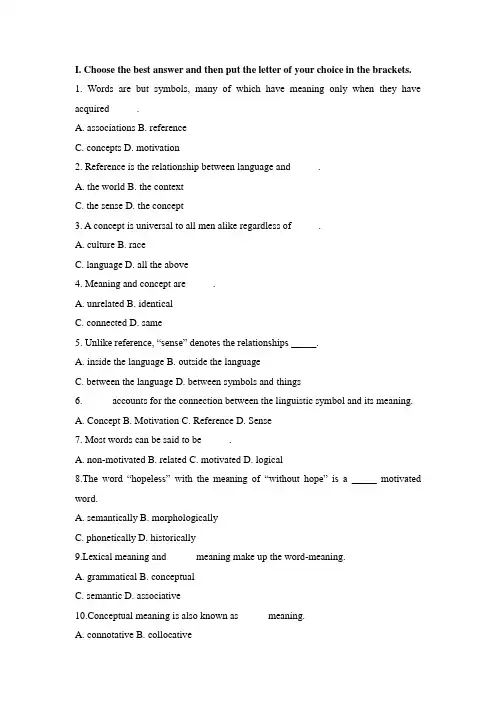
I. Choose the best answer and then put the letter of your choice in the brackets.
1. Words are but symbols, many of which have meaning only when they have
acquired _____.
A. associations B. reference
C. concepts D. motivation
2. Reference is the relationship between language and _____.
A. the world B. the context
C. the sense D. the concept
3. A concept is universal to all men alike regardless of _____.
A. culture B. race
C. language D. all the above
4. Meaning and concept are _____.
A. unrelated B. identical
C. connected D. same
5. Unlike reference, “sense” denotes the relationships _____.
A. inside the language B. outside the language
C. between the language D. between symbols and things
6. _____ accounts for the connection between the linguistic symbol and its meaning.
A. Concept B. Motivation C. Reference D. Sense