广州版四年级英语下册全册知识点归纳
- 格式:docx
- 大小:40.48 KB
- 文档页数:15
广州版四年级英语下册全册知识点归纳
Module 1: People
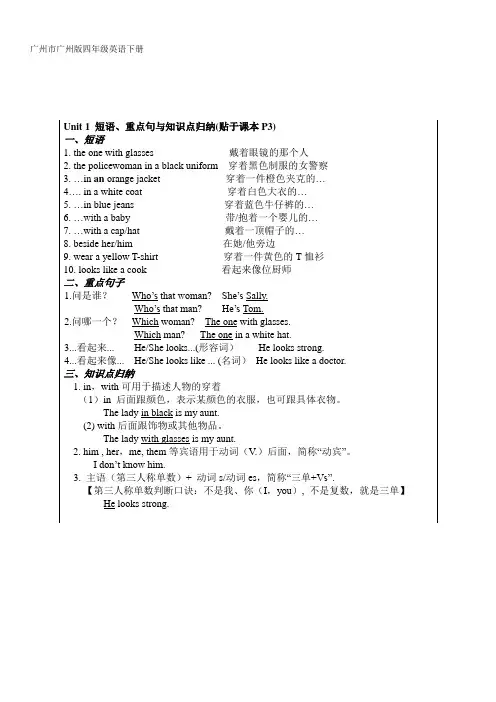
Unit 1: n
In this unit。we will learn how to identify people and ask
about their XXX。We will use the following sentence structures:
Who's that (man/woman)?
Which one?
Who are those two people?
They're my parents.
The one with the yellow hat.
Unit 2: Describing People
In this unit。we will learn how to XXX。We will use the
following sentence structures:
What is he/she like?
XXX.
He/She has long hair/big eyes。etc.
XXX。etc.
Key Points:
1.We will XXX words containing "c," ".ck," "as(s)," "au/aw,"
and "air."
2.XXX "in" can be used to describe someone's clothing。while "with" can be used to describe something they have or are
carrying.
3.We will learn how to use "which" to ask about specific
items。such as pXXX.
4.We will review the subjects we have learned。such as
Chinese。maths。English。music。art。PE。and science.
5.We will review the different forms of pronouns。including
subject。object。and possessive.
Note: Be aware of the different uses of subject and object
pronouns。such as "me" and "I," and use them appropriately in
sentences.
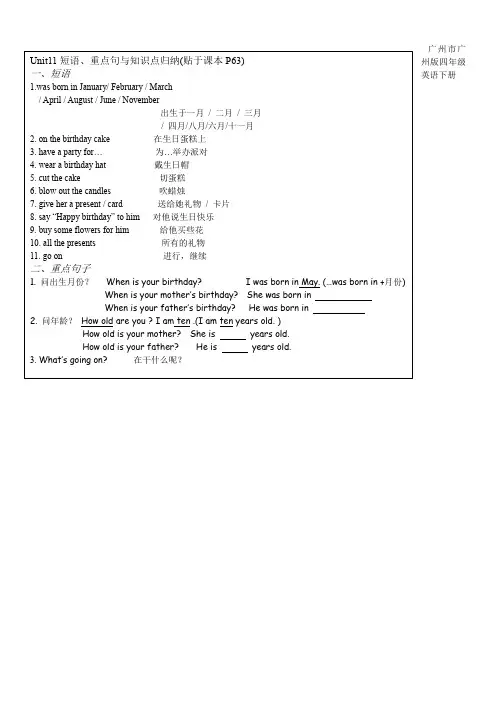
Module 2: Daily Routine
Unit 3: What Time is it?
The basic objective of this unit is to learn how to tell time in
English。For example。when it is seven thirty。we say "It's
seven thirty." nally。we will learn how to express the time to do
certain activities。such as "It's time for breakfast" or "It's time to
go to sleep." Lastly。we will practice saying "Let's go to school."
Unit 4: Our Daily Routine
In this unit。we will learn about our daily routine。We wake
up at eight o'clock and have lessons from eight in the morning until
four in the afternoon.
Key Points:
1.n rules: We will review some words that we learned in us
modules。such as "good," "grape," "grow," "garden," "gym,"
"orange," and "large." We will also learn how to pronounce words
with "ea" (like "head" and "heavy")。"ey" (like "they" and "grey")。"er" (like "mother," "teacher," and "farmer")。"ear" (like "ear" and
"near")。and "ere" (like "here" and "there").
2.It's time for vs。It's time to: We will learn that "It's time
for" is followed by a noun。while "It's time to" is followed by a
verb。For example。we say "It's time for bed/school/class/XXX"
and "It's time to get up/go to school/have XXX/go to bed."
3.Tired: We will learn that "tired" cannot be used as a verb。Instead。it must be used with "be" or "look(s)." For example。we
say "I'm very tired" and "She looks tired."
4、表示时间有两种基本的方法:倒读法和顺读法。例如,七点可以表示成Seven o’clock或o’clock Seven,七点零五分可以表示成seven oh five或five past seven,七点十分可以表示成seven ten或ten past seven,七点十五分可以表示成seven
fifteen或a quarter past seven,七点二十分可以表示成seven
enty-five past seven,七点三十分可以表示成seven thirty或half
past seven,七点三十五分可以表示成seven enty-five to eight,七点四十五分可以表示成seven forty-five或a quarter to eight,七点五十分可以表示成seven fifty或ten to eight。
5、XXX。表示“从。到。”。例如,From seven am to eight
pm表示“从早上七点到晚上八点”,from one to one XXX表示“从一到一百”。
6、am(a.m.)表示“上午”,pm(p.m.)表示“下午”。
7、注意时间与介词的连用。例如,at seven o’clock、at
half past five表示“在七点钟、在五点半”,in the morning、XXX、in the evening、XXX表示“在早晨、在下午、在晚上、在夜晚”。
8、用数字表示时间,小时与分钟之间可以用“:”号或“.”号。例如,7:30或7.30表示“七点半”。
二、基本目标
Unit 5
1) 询问今天是星期几,例如“What day is it today?”、“Is it
Monday?”、“It’s Sunday.”
2) 询问对某一天的喜爱程度,例如“What’s your favourite
day?”、“Which day do you like best?”
Unit 6
1) 询问放学后通常做什么,例如“What do you usually do
after school?”
2) 询问是否在某一天进行锻炼,例如“Do you
usually/often/sometimes take XXX?”。
三、重、难点分析
1、本模块总结了含有tr的单词的发音规则,例如tree、trousers。需要注意的是,要区别于ch和ts的发音。
1.没有格式错误或明显有问题的段落需要删除。 2.周日可以缩写为Sun。周一为XXX。周二为Tue。周三为Wed。周四为Thur。周五为Fri。周六为Sat。
3.使用“favourite”可以引出问题,如“你最喜欢的日子/运动/颜色/科目是什么?”
4.表示日期的介词通常用“on”,如“on Sunday”、“on
Saturday morning”、“XXX”。而表示时间的介词则有“at”(如“at six o’clock”、“XXX”)和“in”(如“in the morning”、“XXX”、“in the evening”、“at night”、“XXX”)。
5.“Like”有两个意思,一个是“喜欢”,一个是“像”。
6.表示频度的副词有always(总是)、usually(通常)、often(经常)、sometimes(有时)、seldom(极少)和never(从不),这些词通常放在行为动词前或be动词后,如“I
always help my parents after school”、“I am always here on
Sunday”。有时也可以放在句前或句后,如“Sometimes I go
shopping with my parents”、“I go there very often”。
7.两个动词之间,后一个动词通常用不定式“to do”,如“I
want to buy a T-shirt”、“I like to play music”、“I use this pen to
write”。
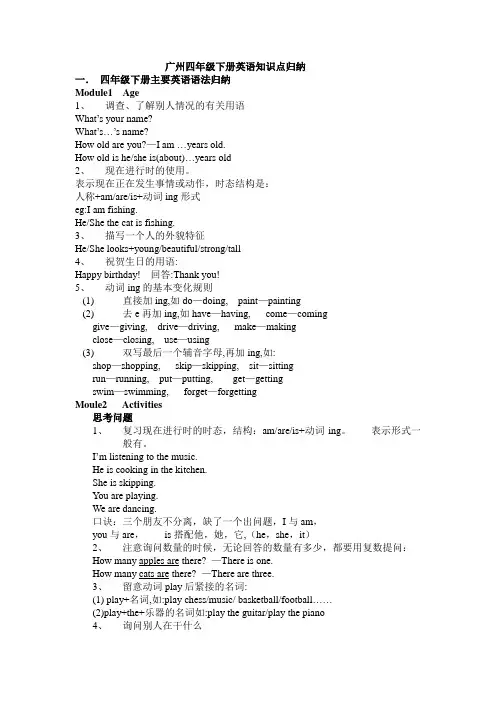
Module 4 Activity