
高一英语上册语法复习课件3
- 格式:pdf
- 大小:592.72 KB
- 文档页数:9


关系代词的用法whoseWhomWhoWhichThat是否可省略所作成分指代人;物物人人人、物主语;宾语主语;宾语主语;宾语宾语定语作宾语可省作宾语可省作宾语可省可省不可省高一英语上册语法复习
The Attributive Clause
定语从句
1.定义:在复合句中用来用来修饰名词或代词的从句叫定语从句。
2.先行词:被定语从句所修饰的名词或代词叫先行词(antecedent)。
3.关系代词、关系副词:引导定语从句的词
关系代词:Who, whom, whose, which, that等
关系副词:When, where, why等
关系代词和关系副词的作用:
1、引导作用2、替代作用
3、在定语从句中担当某个成分的作用
Eg: 1.Those who want to go please sign your names here.
2.This is the house where he was born.
3. Bill, who was here yesterday, asked me a lot of questions.
关系代词的用法
关系副词的用法whyWhereWhen是否可省略所作成分指代时间状语否地点状语否原因状语否
关系副词的用法
判断下列引导词在句中的用法指代、所作成分、是否可省略.
Eg: 1.He is such a man who never tells a lie.
2. He is the model worker whom/who we should learn from.
3. A dictionary is a book which often helps us to know the meanings of the words.
4. This is the film which I like best.
高一(上)英语必修二Unit2 The Olympic Games
语法巩固(将来时的被动语态)
一.The Future Passive Voice(将来时的被动语态)
1) 一般现在时被动语态(am/is/are done)和一般过去时被动语态(was/were done)
2) 将以下句子改成被动语态
1. She often waters the flowers every morning.
____________________________________________
2. He invites me to the party.
____________________________________________
3. The teacher blamed him for his being late yesterday.
____________________________________________
4. I saw them swimming in the sea.
____________________________________________
3) 将来时的被动语态(will/shall/be going to + be done)
5. We will send him there tomorrow.
____________________________________________
6. The rabbits will eat the carrots.
____________________________________________
7. They will finish this project in five years.
____________________________________________
8. They are going to encourage children to take more exercise.

期中复习
一、必会句型/短语:
What’s your name?你叫什么名字?
答My name is+名字(缩写My name’s+名字)
Who are you ?你是谁?
答I’m+名字或I am +名字
This is +名字(物品)
This is Kate. 这是凯特。
This is my pencil.这是我的铅笔。
in the morning 在早晨,在上午
Welcome !欢迎! boys and girls 孩子们
Act like a monkey !表演猴子!
Act like a dog! 表演狗!
Act like a bird! 表演鸟!
Open your pencil-box. 打开你的铅笔盒。
Take out your ruler. 拿出你的尺子。
Show me your pencil. 向我展示你的铅笔。
Point at your pen. 指一指你的钢笔。
Here you are ! 给你。
Nod your head. 点一点你的头。
Open your mouth. 张开你的嘴。
Close you eyes. 闭上你的眼睛。 Touch your neck. 摸一摸你的脖子。
Clap your hands. 拍一拍你的手。
Wave your arm. 挥动你的胳膊。
Show me your foot. 向我展示你的脚。
Touch your nose. 摸一摸你的鼻子
Touch my nose. 摸一摸我的鼻子
Draw a face,please.请画一张脸。
Draw a bird.画一只鸟。
Colour it. 给它涂色。
Cut it out .把它剪下来。
Stick it to some tape. 把它粘在一些胶带上。
Stick it to your hand and say:把它粘在你的手上并说:
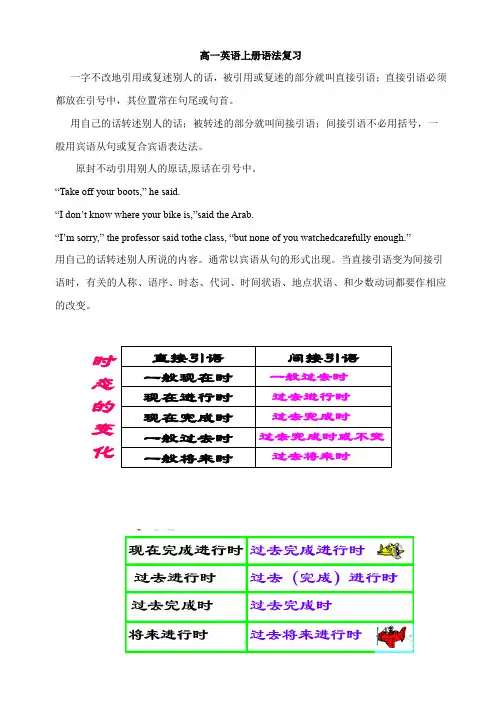
时态的变化一般将来时一般过去时现在完成时现在进行时一般现在时间接引语直接引语一般过去时过去进行时过去完成时过去完成时或不变过去将来时高一英语上册语法复习
一字不改地引用或复述别人的话,被引用或复述的部分就叫直接引语;直接引语必须都放在引号中,其位置常在句尾或句首。
用自己的话转述别人的话;被转述的部分就叫间接引语;间接引语不必用括号,一
般用宾语从句或复合宾语表达法。
原封不动引用别人的原话,原话在引号中。
“Take off your boots,” he said.
“I don’t know where your bike is,”said the Arab.
“I’m sorry,” the professor said tothe class, “but none of you watchedcarefully enough.”
用自己的话转述别人所说的内容。通常以宾语从句的形式出现。当直接引语变为间接引
语时,有关的人称、语序、时态、代词、时间状语、地点状语、和少数动词都要作相应的改变。
代词时间状语地点状语少数动词mustmaycanbringcomenowherethesethis间接直接thatthosetherethengotakecouldmighthad to
间接直接the followingdayThe nextdaytomorrowtheday beforeyesterdaythat daytodaythe followingyearnext yearthenextweeknext weekthatyearthisyearthe week beforelast weektheyear beforelast yearthree years beforethree years ago时间状语
陈述句:
引语前用that引导,有时也可以不用。
He said, “I opened the window this morning.”