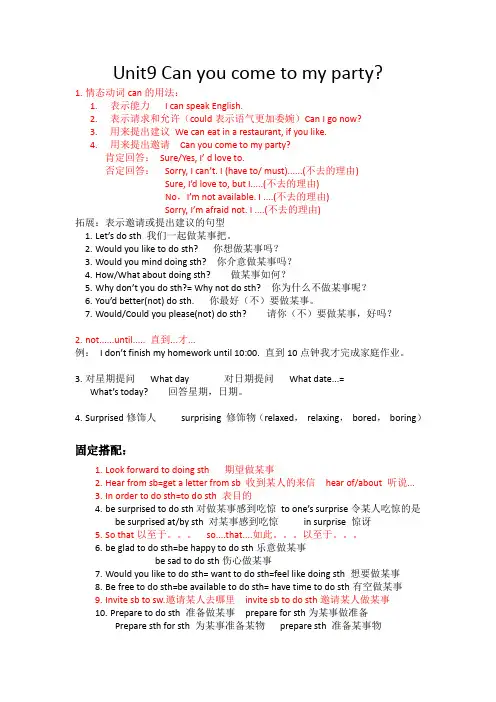
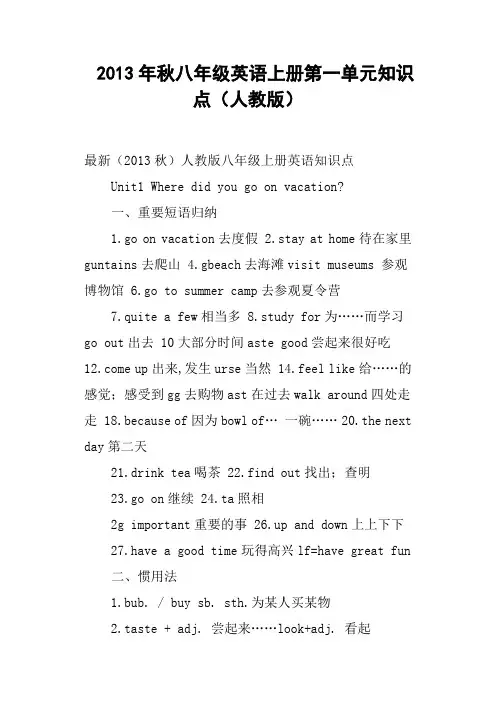
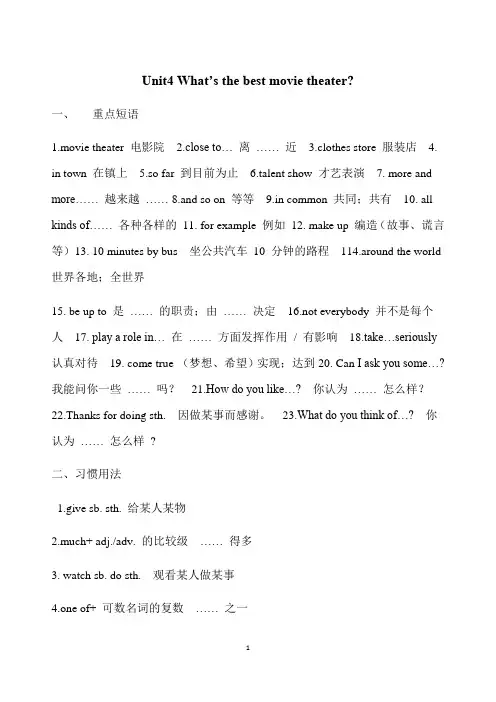
人教 英语 八年级上册 单元知识点笔记
- 格式:docx
- 大小:50.82 KB
- 文档页数:18
Unit1 Where did you go on vacation?
1. 过去式
1. 过去时态的结构: V+ed.
2. 过去时态的时间标志词:1.yesterday, the day before yesterday, just now, in the past
st +时间 3. 时间+ ago 4. in+ 过去的年,月
3. 变一般疑问句:用Did 来引导,动词变回原形。(把Was/ Were 提前大写。)
4. 一般疑问句的回答: Yes,sb+ did. No, sb+didn’t.
Yes, sb was. No, sb wasn’t. Yes, sb were. No, sb weren’t.
5. 变否定句:在动词前加didn’t, 动词变回原形。
(在was/ were 后加not, 缩写为wasn’t, weren’t )
2.复合不定代词的用法:
Something, anything, everything, nothing,
Someone , anyone, everyone, no one
Somebody, anybody, everybody, nobody
Somewhere, anywhere, everywhere, nowhere
1. 复合不定代词作主语,谓语用单数。
Everyone is here. Someone likes English.
2.形容词修饰复合不定代词,形容词放复合不定代词后面。
I did something special.
3. 反身代词的构成:一,二人称为形容词性物主代词+self/ selves
Myself, ourselves, yourself, yourselves
三人称为人称代词宾格+self/ selves
Himself, herself, itself, themselves
Learn sth by oneself 自学 help yourself (yourselves)to…. 请顺便吃。。。
4. Enough的用法:1. 直接修饰名词。 2. 修饰形容词,放形容词后面
I have enough friends. 我有很多朋友。 She is beautiful enough. 她很漂亮。
5. Because of和because的区别:
Because of+ 单词、短语 because+句子
例:I like English, because I like Kevin.
Because of the bad weather, I didn’t go out on weekends.
6. 再。。。几个 ,还。。。几个:another+数字+名词= 数字+more+名词
I’m still hungry. I want to have another 2 bowls of rice. / 2 more bowls of rice.
7. as +adj/ adv + as +sb/sth 和。。。一样。。。。。
He is as smart as a monkey. 他和猴子一样聪明。
He speaks English as well as Kevin. 他说英语说得和Kevin 一样的好。
8. 多多少少的区别:
Many+可数名词复数 =a lot of= lots of= quite a few 许多的。。
Much+不可数名词 = a lot of= lots of 许多的。。。
A few+ 可数名词复数 一些。。。
A little+ 不可数名词 一点。。。
Few+ 可数名词复数 几乎没有
Little+ 不可数名词 几乎没有 (解题技巧:先看空格后面的名词是可数还是不可数,再根据句子意思是表肯定还是表否定。)
9. 价格高低用 high 和low 东西昂贵便宜用expensive 和cheap
The price of the book is high. / low 这本书的价格高。 低
The book is expensive./ cheap 这本书贵。 便宜
10. What do you think of…..= How do you like…..= How do you feel about…=How be…..
固定搭配:
1,Decide to do sth 决定做某事
2,Feel like doing sth = want to do sth = would like to do sth 想要做某事
3,Try to do sth 尽力做某事 try doing sth 尝试做某事
4,Sb seem to do sth= It seem (s/ed) that sb do sth 某人看起来好像要做某事
5,Have a good time(in) doing sth= have fun doing sth= enjoy oneself doing sth
做某事玩得开心
6,Enjoy doing sth 喜欢做某事 (finish, practice)
7, keep doing sth 继续做某事 keep sb doing sth 让某人保持做某事
8, It’s one’s first time to do sth 某人第一次做某事
9. wait for sb / sth 等某人/某物 can’t wait to do sth 迫不及待做某事
10. come up 升起来
11, arrive at+ 小地点 arrive in+大地点 = get to+地点 = reach+地点
重点句型: 1. I visited my uncle and I also visited the museum.
翻译:我拜访了我的叔叔,也参观了博物馆。
2. I didn’t really see anything I liked.
我真的没有看见我喜欢的一些东西。
3.What a difference a day makes!
多么迥然不同的一天啊!
重点词汇:
1. go on vacation 去度假 go to sw. on vacation 去…..度假
2. be on vacation 在度假 be on vacation in sw. 在。。。度假
3. stay at home 待在家里 4. go to summer camp 去夏令营
5. go to the beach 去海滩
6. quite a few 相当多
7. of course 当然
8. do something interesting 做有趣的事情
9. study for a test 备考
10. get bored 感到无聊
11. keep a diary 写日记
12. rain hard 下大雨= rain heavily
13. a bag with food and water 装有食物和水的包
14. visit the museum 参观博物馆
重点单词:
Anyone, anywhere someone, something, everyone, myself, yourself, quite a few,
wonderful, seem, bored, try, difference, wait, because of, below, enough, as, dislike,
activity, diary, nothing, most,
Unit2 How often do you exercise?
1. 频率副词:
Always 总是 usually经常 often常常, sometimes有时, hardly ever几乎不 ,never 从不
100% 90% 70% 40% 5% 0%
频率副词的用法:be或情态动词之后,实意动词前。
I’m always on time. I hardly ever arrive late.
频率词:every day 每天, once a week一周一次, twice a week一周两次, three
times a week一周三次, one or two times a week,一周一两次,three to five times
a week,一周三到五次
对频率提问用 How often 多久一次。
I play basketball twice a week. -------- How often do you play basketball?
注意:对次数提问用How many times, 对段时间提问用 How long
I play basketball twice a week. ------- How many times do you play basketball a week?
I play basketball twice a week. ------ How long do you play basketball twice?
2. Although 尽管,虽然,不与but 连用。用其一 (because 与so 也不能连用。)=though
Although he is 5 years old, he can speak English very well.
He is 5 years old, but he can speak English very well. 尽管他5岁,但是他说英语说得非常好