
Unit 4 I used to be afraid of the dark Section A 3a-3c
- 格式:ppt
- 大小:4.45 MB
- 文档页数:39


人教版英语九年级Unit 4《I used to be afrd of the dark》全单元说课稿一. 教材分析人教版英语九年级Unit 4的主题是“I used to be afrd of the dark”,通过讲述一个人过去害怕黑暗,但现在不再害怕的故事,引导学生学习一般过去时态和过去习惯的表达方式。
本单元还包括两个任务,分别是讨论过去的习惯和谈论过去发生的事情。
教材内容丰富,贴近学生生活,有利于激发学生的学习兴趣和积极性。
二. 学情分析九年级的学生已经掌握了基本的英语语法和词汇,具备一定的听说读写能力。
但他们对过去时态的理解和运用还不够熟练,需要通过本节课的学习进一步巩固。
此外,部分学生可能在表达自己的过去经历时存在语言障碍,需要教师的引导和鼓励。
三. 说教学目标1.知识目标:学生能够掌握一般过去时态的构成和用法,学会表达过去的习惯和经历。
2.能力目标:学生能够运用一般过去时态进行交流,提高口语表达能力。
3.情感目标:学生能够克服恐惧,积极面对生活中的困难。
四. 说教学重难点1.重点:一般过去时态的构成和用法。
2.难点:过去习惯的表达方式和过去发生的事情的描述。
五. 说教学方法与手段1.情境教学法:通过设定情境,让学生在实际语境中学习和运用一般过去时态。
2.任务型教学法:通过完成两个任务,引导学生积极参与课堂活动,提高口语表达能力。
3.合作学习法:学生分组讨论,互相交流,共同完成任务。
4.激励评价法:教师及时给予鼓励和评价,激发学生的学习兴趣和自信心。
六. 说教学过程1.导入:教师通过提问学生是否有过害怕黑暗的经历,引出本节课的主题。
2.新课呈现:教师通过讲解和示范,教授一般过去时态的构成和用法。
3.实践环节:学生分组讨论过去的习惯和经历,用一般过去时态进行交流。
4.任务一:学生分组完成第一个任务,讨论过去的习惯,并展示给其他小组。
5.任务二:学生分组完成第二个任务,谈论过去发生的事情,并展示给其他小组。
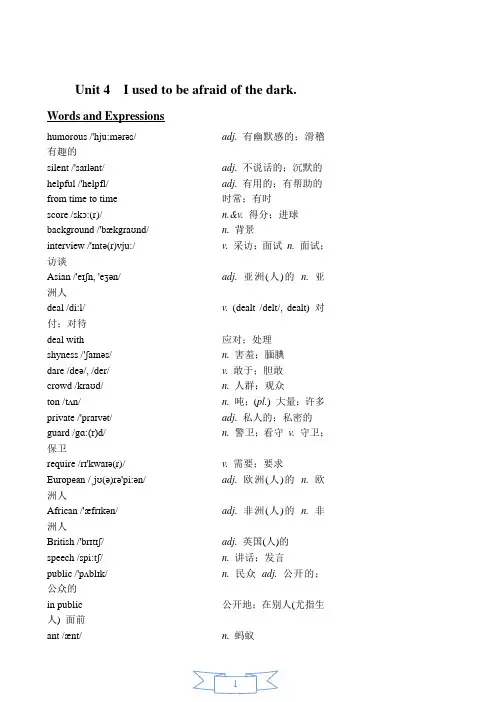
Unit 4 I used to be afraid of the dark. Words and Expressionshumorous /'hju:mərəs/ adj. 有幽默感的;滑稽有趣的silent /'saɪlənt/ adj.不说话的;沉默的helpful /'helpfl/ adj.有用的;有帮助的from time to time 时常;有时score /skɔ:(r)/ n.&v.得分;进球background /'bækgraʊnd/ n. 背景interview /'ɪntə(r)vju:/ v. 采访;面试n.面试;访谈Asian /'eɪʃn, 'eʒən/ adj.亚洲(人)的n.亚洲人deal /di:l/ v. (dealt /delt/, dealt) 对付;对待deal with 应对;处理shyness /'ʃaɪnəs/ n. 害羞;腼腆dare /deə/, /der/ v. 敢于;胆敢crowd /kraʊd/ n. 人群;观众ton /tʌn/ n. 吨;(pl.) 大量;许多private /'praɪvət/ adj. 私人的;私密的guard /gɑ:(r)d/ n. 警卫;看守v.守卫;保卫require /rɪ'kwaɪə(r)/ v. 需要;要求European /ˌjʊ(ə)rə'pi:ən/ adj. 欧洲(人)的n. 欧洲人African /'æfrɪkən/ adj. 非洲(人)的n. 非洲人British /'brɪtɪʃ/ adj.英国(人)的speech /spi:tʃ/ n. 讲话;发言public /'pʌblɪk/ n.民众adj. 公开的;公众的in public 公开地;在别人(尤指生人) 面前ant /ænt/ n. 蚂蚁insect /'ɪnsekt/ n. 昆虫seldom /'seldəm/ adv. 不常;很少influence /'ɪnfluəns/ v.&n.影响absent /'æbsənt/ adj.缺席;不在fail /feɪl/ v. 不及格;失败;未能(做到)examination /ɪgˌzæmɪ'neɪʃn/ n.考试;审查boarding /'bɔ:dɪŋ/ school 寄宿学校in person 亲身;亲自exactly /ɪg'zæktli/ adv. 确切地;精确地pride /praɪd/ n. 自豪;骄傲take pride in 为…感到自豪proud /praʊd/ adj. 自豪的;骄傲的be proud of 为…骄傲;感到自豪general /'dʒenrəl/ adj. 总的;普遍的;常规的n.将军introduction /ˌɪntrəˈdʌkʃn/ n. 介绍Paula /'pɔ:lə/ 葆拉(女名)Alfred /'ælfrɪd/ 艾尔弗雷德(男名)Billy /'bɪli/ 比利(男名)Candy /'kændi/ 坎迪(女名)Jerry /'dʒeri/ 杰里(男名);杰丽(女名) Emily /'emɪli/ 埃米莉(女名)Role-play the conversation.Alfred: This party is such a great idea!Gina: I agree. It’s been three years since we last saw our primary school classmates.Alfred: It’s interesting to see how people have changed.Gina: Billy has changed so much! He used to be so shy and quiet. Alfred: Yeah, his face always turned red when he talked to girls! Gina: I used to see him reading in the library every day.Alfred: That’s because he was a really good student. He studied hard and got good scores on his exams.Gina: Did he use to wear glasses?Alfred: Yes, and he used to be thin, too. But look how big andstrong he is now!Gina: He’s so popular now. Look at all the girls around him!Reading 1Read the article and identify the paragraphs in which thefollowing information appears. Number the information [1–3].____ how Candy’s li fe has changed____ Candy’s advice to young people____ Candy’s backgroundFrom Shy Girl to Pop Star1 For this month’s Young World magazine, I interviewed19-year-old Asian pop star Candy Wang. Candy told me that sheused to be really shy and took up singing to deal with hershyness. As she got better, she dared to sing in front of her class,and then for the whole school. Now she’s not shy anymore andloves singing in front of crowds.2 I asked Candy how life was different after she became famous.She explained that there are many good things, like being able totravel and meet new people all the time. “I didn’t use to bepopular in school, but now I get tons of attention everywhere Igo.” However, too much attention can also be a bad thing. “Ialways have to worry about how I appear to others, and I have tobe very careful about what I say or do. And I don’t have muchprivate time anymore. Hanging out with friends is almostimpossible for me now because there are always guards aroundme.”3 What does Candy have to say to all those young people whowant to become famous? “Well,” she begins slowly, “you haveto be prepared to give up your normal life. You can neverimagine how difficult the road to success is. Many times Ithought about giving up, but I fought on. You really require a lotof talent and hard work to succeed. Only a very small number ofpeople make it to the top.”3b Read the article again and complete the sentences about Candy.1.She used to be shy, but now she’s not shy ____________.2.She didn’t use to be ___________ in school, but now she getslots of attention.3.She used to ___________ with friends, but it is almostimpossible now.4.She didn’t use to ___________ how she appears to others, butnow she does.Grammar Focus重点句型:used to…过去常常……肯定句:I used to be short.否定句:I didn’t use to be popular in school.I usedn’t (used not) to be popular in school.疑问句:Did he use to wear glasses?—Yes, he did. / No, he didn’t.反意句:You used to be short, didn’t you?—Yes, I did. / No, I didn’t.Did she use to live in Shanghai?= Used she to live in Shanghai?Did you use to play the piano?= Used you to play the piano?—He used to drink milk, didn’t he?—Yes, he did.—No, he didn’t.—He used to drink milk, usedn’t he?—Yes, he did. / Yes, he used to.—No, he didn’t. / No, he usedn’t to.used to do sth. be used to (doing) sth. be used to do sth.She ______ live alone. But she ______ living alone because she feels lonely.A. used to; doesn’t used toB. is used to; was used toC. used to; is not used toD. was used to; doesn’t used to4a Write sentences about the past using used to.1.Grace / watch a lot of TV / watch a lot of moviesGrace used to watch a lot of TV. She didn’t use to watch a lot of movies.2.My mom / have curly hair / have straight hair____________________________________________________ __________________3.Jerry / read books on European history / read books on Africanculture____________________________________________________ __________________.4.Sandy / teach British English / teach American English____________________________________________________ __________________.Reading 2Read the passage and put the sentences [A-D] in the correctHe Studies Harder Than He Used toLi Wen is a normal 15-year-old boy from the countryside. He works very hard and does well in school. It is hard to believe that he used to have difficulties in school. When he was a little boy, he seldom caused any problems, and his family spent a lot of time together. ____________. His parents moved to the city to look for jobs, and his grandparents came to take care of him. But he missed his parents so much and he often felt lonely and unhappy.Li Wen’s unhappiness began to influence his schoolwork. He became less interested in studying. Sometimes he was absent from classes and he failed his examinations. Finally, Li Wen’s parents made the decision to send him to a boarding school. However, Li Wen was shy and was not able to make friends quickly in school. He found life there difficult. One day he told his teacher that he wanted to leave the school. _________ and she called his parents. She advised them to talk with their son in person. So his parents took a 24-hour train and a 5-hour bus ride to get to Li Wen’s school._____________. “It was exactly what I needed,” he said. “Now I understand that even though they are busy, they are always thinking of me. They take pride in everything good that I do.”After that, Li Wen’s parents hadmuch more communication withtheir son than they used to._____________. He becamemore outgoing and made somegood friends in school. He evenjoined the school basketball team and became active in many other activities. “I’m much happier now, and I work ever harder than I used to. I know my parents love me and they’re always proud of me,”says Li Wen. “It’s veryimportant for parents to be there for their children.”2e Complete the passage with the proper forms of the words and phrases in the box.Li Wen is a 15-year-old boy. He works hard and does well in school. It is hard to believe that he used to have difficulties in school. When his parents moved to the city to work, they could not be at home to _____________ him. So he became less interested in studying and _____________ classes. Then his parents ___________ to send him to a boarding school. He found life there difficult. One day he told his teacher he wanted to leave the school. His teacher advised his parents to talk with their son in person. This conversation ____________ his life. He realized that his parents would always love him, and they would _____________ everything good that he did. Now he is much happier and more outgoing than he used to be.3b Write about how you have changed. What did you use to be like? Which change is the most important one, and why?H ow I’ve Changed!My life has changed a lot in the last few years. I used to _______________________________________________________________________________ __________________.Now I’m_______________________________________________________ __________.The biggest change in my life was _________________________________________.This is the most important change because ______________________________________________________________________________________________ __________________.Self Check1 Fill in the blanks with the correct forms of the words in the1.The mother traveled for many hours to return home to talkto her child ______.2.He used to be a very quiet teenager. He remained _______most of the time and _______ talked to other people.3.If you are always _______ from class, you will _______ theexaminations.4.The teacher _______ helping his students win the Englishcompetition.5.Kate’s grandparents have had a great _______ on her.6.That British teacher is very _______. He always tells usinteresting jokes.7.People are usually _______ to give a generalself-introduction in a job _______.8.Tina played very well in the basketball game and herparents _______ her.2 What did you use to be like when you were in primaryschool? Complete these statements.I used to wear_______________________________________________________ ___.My hair used to be______________________________________________________.I used to watch_______________________________________________________ __.I used to play_______________________________________________________ ____.I used to be_______________________________________________________ _____.Exercises1. Candy told me that she ________ (以前) be really shy and________ (开始) singing to ________ (克服) her shyness.2. I ________ have much private time ________ (不再).3. She still plays the piano ________ (时常).4. It’s polite to keep our voice down ________.5. Wearing red can help you make a ________ (decide).6. 我爸爸过去常常开车上班,现在坐公交车了。
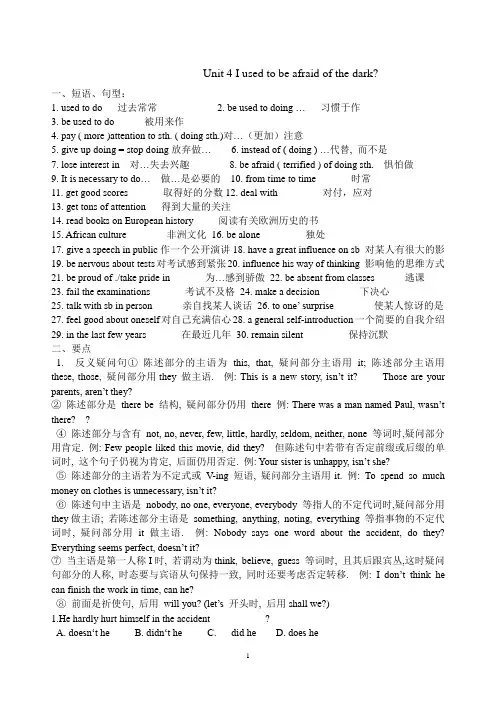
Unit 4 I used to be afraid of the dark?一、短语、句型:1. used to do 过去常常2. be used to doing … 习惯于作3. be used to do 被用来作4. pay ( more )attention to sth. ( doing sth.)对…(更加)注意5. give up doing = stop doing放弃做…6. instead of ( doing ) …代替, 而不是7. lose interest in 对…失去兴趣8. be afraid ( terrified ) of doing sth. 惧怕做9. It is necessary to do… 做…是必要的10. from time to time 时常11. get good scores 取得好的分数12. deal with 对付,应对13. get tons of attention 得到大量的关注14. read books on European history 阅读有关欧洲历史的书15. African culture 非洲文化16. be alone 独处17. give a speech in public作一个公开演讲18. have a great influence on sb 对某人有很大的影19. be nervous about tests对考试感到紧张20. influence his way of thinking 影响他的思维方式21. be proud of ./take pride in 为…感到骄傲22. be absent from classes 逃课23. fail the examinations 考试不及格24. make a decision 下决心25. talk with sb in person 亲自找某人谈话26. to one’ surprise 使某人惊讶的是27. feel good about oneself对自己充满信心28. a general self-introduction一个简要的自我介绍29. in the last few years 在最近几年30. remain silent 保持沉默二、要点1. 反义疑问句①陈述部分的主语为this, that, 疑问部分主语用it; 陈述部分主语用these, those, 疑问部分用they 做主语. 例: This is a new story, isn’t it? Th ose are your parents, aren’t they?②陈述部分是there be 结构, 疑问部分仍用there 例: There was a man named Paul, wasn’t there? ?④陈述部分与含有not, no, never, few, little, hardly, seldom, neither, none 等词时,疑问部分用肯定. 例: Few people liked this movie, did they? 但陈述句中若带有否定前缀或后缀的单词时, 这个句子仍视为肯定, 后面仍用否定. 例: Your sister is unhappy, isn’t she?⑤陈述部分的主语若为不定式或V-ing 短语, 疑问部分主语用it. 例: To spend so much money on clothes is unnecessary, isn’t it?⑥陈述句中主语是nobody, no one, everyone, everybody 等指人的不定代词时,疑问部分用they做主语; 若陈述部分主语是something, anything, noting, everything 等指事物的不定代词时, 疑问部分用it 做主语. 例: Nobody says one word about the accident, do they? Everything seems perfect, doesn’t it?⑦当主语是第一人称I时, 若谓动为think, believe, guess 等词时, 且其后跟宾丛,这时疑问句部分的人称, 时态要与宾语从句保持一致, 同时还要考虑否定转移. 例: I d on’t think he can finish the work in time, can he?⑧前面是祈使句, 后用will you? (let’s 开头时, 后用shall we?)1.He hardly hurt himself in the accident___________?A. doesn‘t heB. didn‘t heC. did heD. does he2.Let‘s search the Internet fo r some information about famous people,______?A. will youB. won‘t youC. shall we3.Eric‘s never seen a three-D movie at the cinema,_______?A.hasn‘t he B.has he C.isn‘t he D.is he4.-He didn‘t go to the meeting this morning, did he? ----______. Though he was not feeling very well. A. No, he didn‘t. B. Ye s, he did. C. No, he did. D. Yes, he didn‘t.5. —He‘s already back to Australia, _________? — _________. He is on a visit to Shanghai.A. isn‘t he; NoB. hasn‘t he; YesC. isn‘t he; YesD. hasn‘t he; No6. —She doesn‘t like geography,does she? —_________.A. Yes,she doesB. Yes,she doesn‘tC. No,she does7. He‘s flown to Hainan for a holiday, _______ he?A. isn‘tB. hasn‘tC. wasn‘t8. ---- Let‘s go skating,_______? --- OK. Let‘s go.A. do youB. don‘t youC. will youD. shall we9. –There is little milk in the milk bag, ________ there?A. isB. isn‘tC. aren‘tD. are10. Bob, you watched the fashion show last night, ________?A. weren‘t youB. didn‘t youC. haven‘t youD. won‘t you2. used to do sth. 过去常常做某事否定形式:didn’t use to do sth. / used not to do sth. 如:He used to play football after school. 放学后他过去常常踢足球。

Unit 4 I used to be afraid of the dark.一.重点短语1. be more interested in 对…更感兴趣2.on the swim tea游泳队的队员3. be terrified of 害怕.4. gym class 体操课.5. chat with sb. 与某人闲聊6. all the time 一直, 总是7. can't afford to do sth. 负担不起做某事8. can't afford sth. 支付不起…9. hardly ever 几乎从不10. make a decision下决定,下决心11. as well as 不仅…而且, 也12. pay for 花费, 为……付出代价13. be different from 与…不同14. take the bus to school乘车去上学15. to one's surprise令某人惊讶16. take pride in sb/on sth. 以…而自豪17. all the time 一直、始终18. get into trouble with 遇到麻烦19. pay attention to sth/sb. 对…注意,留心二.固定结构:ed to do sth. 过去常常做某事2. walk to somewhere 步行到某处3. play the piano 弹钢琴4.be interested in (doing) sth. 对(做)…感兴趣5. spend…on sth. 在某事上花费(金钱、时间)6.spend…(in)doing sth.花费(金钱,时间)去做某事7. worry about sb./ sth. 担心某人/某事8. be worried about sb./sth. 担心某人/某事9. take sb. to + 地方:送/带某人去某个地方10. move to +地方:搬到某地11. a fifteenyearold boy 一个15岁的男孩三、重点句子1. I used to be afraid of the dark. 我过去常常前害怕黑暗.2.I go to sleep with my bedroom light on. 我开着卧室的灯睡觉.3. I used to spend a lot of time playing games with my friends. 以前我常常花很多时间和我的朋友们玩游戏.4. I hardly ever have time for concerts. 我几乎没有时间去听音乐会.5. My lif e has changed a lot in the last few years.6. It will make you stressed out. 那会使你紧张的.7. It seems that Yu Mei has changed a lot. 玉梅似乎变化很大.四.语法要点:1. used to的用法:used to是情态动词,其后面必须跟动词原形。