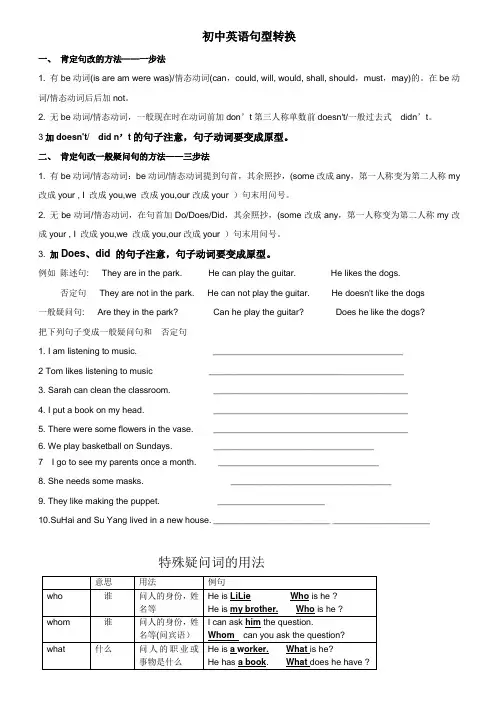
小学英语句型转换(陈述句变一般疑问句特殊疑问句及练习)
- 格式:pdf
- 大小:114.43 KB
- 文档页数:7
⼩学英语句型转换(陈述句变⼀般疑问句特殊疑问句及练
习)
⼩学英语问句总复习
★必备知识点:
1.be动词:am、is、 are、 was、 were;⼩学阶段,be动词后只接名词,形容词或动词的
ing形式。
2.助动词:do、does、did、 have、 had;助动词后的动词⽤原形。
3.情态动词can、must、will、may、need等;情态动词+动词原形
⼀、肯定句、否定句定义1.肯定句:表⽰肯定的意思, 即不含有否定词“不”。
例:我是⼀个学⽣ I am a student. 他去上学 He goes to school.2.否定句:表⽰否定的意思。
例:我不是⼀个男孩。 I am not a boy 他不去上学 He does not go to school.
⼆、⼀般疑问句
(⼀)、什么是⼀般疑问句
⽤Yes或No作答的疑问句叫⼀般疑问句。⼀般疑问句还有下列特点:1、以be动词、助动词或情态动词开头;
例:Is your father a teacher? Does Catherine like animals?Can Jenny speak French?
2、往往读升调;
3、译成汉语,都可以带上“吗”,例如上⾯三句可分别译为:你⽗亲是⽼师吗?凯瑟琳喜欢动
物吗?詹妮会说法语吗?
★(⼆)、如何将陈述句变成⼀般疑问句?
要将陈述句变成⼀般疑问句,可以遵循下列步骤:1.看句中有没有be动词(am、is、 are、 was、 were)、助动词(do、does、did、 have、 had)或情态动词(can、must、will、may等),如果有,将其提到句⾸,句末打上问号即可。
例:It was rainy yesterday. →Was it rainy yesterday?Tom's father can play the piano. →Can Tom's father play the piano?
I have finished my homework.→Have you finished your homework?
2.如果句中没有be动词、助动词或情态动词,则根据谓语动词的形式借助do的相应形式放
在句⾸。具体⽅法是:如果谓语动词是原形,则借do;如果谓语动词是⼀般现在时第三⼈称单数形式,则借does;如果谓语动词是过去式,则借did.需要注意的是,借does 或did后,原句的谓语动词要变回原形。
例:They go to school by bike. →Do they go to school by bike?Bill gets up at 6:30 every day.→Does bill get up at 6:30 every day?
The students saw a film yesterday. →Did the students see a film yesterday? ★(三).陈述句变⼀般疑问句应注意的事项陈述句变成⼀般疑问句除了遵循上述规则以外,还应注意下列⼏点:1.如果陈述句中有第⼀⼈称,则变问句时最好要变为第⼆⼈称。
例:I usually have lunch at school.
→Do you usually have lunch at school?
My father is playing soccer.
→Is your father playing soccer?
2.如果陈述句中有some, 则变问句时往往要变成any 。
例: There is some water on the playground.
→Is there any water on the playground?
3.复合句变⼀般疑问句通常只变主句,从句不变。
例:I know he comes from Canada.
→Do you know he comes from Canada?
4.如果句中含有实义动词have且表⽰“有”时,除借do外,也可将其直接提到句⾸。
例:I have some friends in America.
→Have you any friends in America?/Do you have any friends in America?
(四).⼀般疑问句的回答
⼀般疑问句往往采⽤简短回答,共由三部分(三个单词)组成,对这三部分(三
个单词)的确定可以概括例下:1.第⼀个词:不是Yes就是No。(注意:有时根据语⽓的不同,Yes可由Sure,
Certainly, Of course等代替.No可由sorry 代替.)
2.第⼆个词:问谁答谁。即答语中的主语须与问句的主语⼀致(但必须⽤主格代词)。
例:Does she clean her room every day? Yes, she does.Is Anna′s father a doctor? No,he isn′t.
如果主语是 this that,回答时⽤ it 代替,如果问句中主语是these, those
回答时⽤ they代替。3.第三个词:⽤什么问,⽤什么答。即沿⽤问句中的引导词。
例:Can Jim play soccer? Yes, he can.Does Mr Bean speak English? Yes, he does.
需要注意问题:
⽤ may 引导的问句,肯定回答⽤may,否定回答⽤ can′t 或mustn′t,
⽤ must 引导的问句,肯定回答⽤ must,否定回答⽤needn′t.
例:May I go to the park now? Yes, you may. /No, you mustn′t.Must I wash my clothes now? Yes, you must. /No, you needn′t.
4.⽤No 开头作否定回答时,结尾要加上 not 。因为回答必须是三部分,所以否 定回答必须缩写,⽽肯定回答不能缩写。
例:Did Thomas come here yesterday? Yes, he did./ No ,he didn ′t.三、特殊疑问句
(⼀)什么是特殊疑问句:以疑问词开头,对句中某⼀成分提问的句⼦叫特殊疑问句。
★(⼆)常⽤的疑问词有:
★(三)⼩学阶段,特殊疑问句句型结构有:
1、特殊疑问词+助动词+主语+动词原形+其他? eg:Where do you do study English?
2、特殊疑问词+be 动词+主语+其他?
eg:Why is your Mum so angry?
3、特殊疑问词+情态动词+主语+动词原形
+其他? eg:What can I do for you?
★(四)肯定句、否定句、⼀般疑问句和特殊疑问句的相互转换
1、肯定句变否定句:在am, is, are 后⾯加上not,
其余按顺序照抄。2、肯定句变⼀般疑问句:把am, is, are 提前放到句⾸并⼤写Am, Is, Are,其余照抄。
3、肯定句变特殊疑问句(就划线部分提问):分3步骤 第⼀步:先变⼀般疑问句
第⼆步:找合适的特殊疑问词代替划线部分
第三步:特殊疑问词提前放到句⾸,并⼤写,其余按顺序照抄,省略划线部分。 例如:1.肯定句、否定句和⼀般疑问句的互换 肯定句:This is a book. 否定句:⼀般疑问句:Is this a book?
肯定回答:Yes, it is. 否定回答:No, it isn ’t.2.就划线部分提问(变特殊疑问句) This is a book.
第⼀步:变⼀般疑问句 Is this a book?
第⼆步:找合适的特殊疑问词 Is this what ?
第三步:特殊疑问词提前放到句⾸,并⼤写,其余按顺序照抄,省略划线部分。What is this?
1do not 或者does not,其余按顺序照抄动词⽤原形 2、肯定句变⼀般疑问句:在句⾸加do 或者does 并⼤写,其余照抄。注意:动词⽤原形 3、肯定句变特殊疑问句(就划线部分提问):分3步骤 第⼀步:先变⼀般疑问句
第⼆步:找合适的特殊疑问词代替划线部分
第三步:特殊疑问词提前放到句⾸,并⼤写,其余按顺序照抄,省略划线部分。 4.划线部分不能在特殊疑问句中出现。⾮三单时⽤do,三单时⽤does 例:
⾮三单 肯定句:I like English. 三单 肯定句:He likes English.you like English? he like English? 否定句:否定句:English.
就划线部分提问:I like English.
第⼀步:先变⼀般疑问句 Do you like English?
第⼆步:找合适的特殊疑问词代替划线部分Do you like what?
第三步:特殊疑问词提前放到句⾸,并⼤写,其余按顺序照抄,省略划线部分。What do you like?
★特殊:
1.some变为any。如:There are some birds in the tree.→There aren't any birds in the tree.
但是,若在表⽰请邀请、请求的句⼦中,some可以不变。如: Would youlike some orange juice?
与此相关的⼀些不定代词如something, somebody等也要进⾏相应变化。2.and变为or。如: I have a knife and a ruler.→I don't have a knife or a ruler.
3.a lot of (=lots of)变为many或much。如:
They have a lot of friends.(可数名词)→They don't have many friends.
There is lots of orange in the bottle.(不可数名词)
→There isn't much orange in the bottle.
⼩学英语问句练习
⼀、在横线上填上适当的疑问代词1、A: is the boy in blue? B:He’s Mike.
2、A: pen is it? B:It’s mine.
3、A: is the diary? B:It’s under the chair.
4、A: is the Chirstmas Day? B: It’s on the 25th of December.
5、A: are the earphones? B:They are 25 yuan.
6、A: is the cup? B:It’s blue.
7、A: is it today? B:It’s Sunday.
8、A: was it yesterday? B: It was the 13th of October.
9、A: this red one? B:It’s beautiful.
10、A: is your cousin? B: He’s 15 years old.
11、A: do you have dinner? B: At 6 o’clock.
⼆、把下列句⼦改为⼀般疑问句。1. We need some masks.__________________ ______________