
Moxidectin_113507-06-5_DataSheet_MedChemExpress
- 格式:pdf
- 大小:70.78 KB
- 文档页数:1


Inhibitors, Agonists, Screening Libraries Data SheetBIOLOGICAL ACTIVITY:Cholesterol is the major sterol in mammals, and its importance in fundamental cellular processes is becoming more appreciated.IC50 value:Target:In vitro: GT1–7 hypothalamic cells subjected to cholesterol depletion in vitro produced 20–31% reductions in cellular cholesterol content, similar to the decrease in cholesterol synthesis observed in diabetes [1].In vivo:References:[1]. Laverdy OG, et al. Effects of glycemic control upon serum lipids and lipid transfers to HDL in patients with type 2 diabetes mellitus: novel findings in unesterified cholesterol status. Experimental and Clinical Endocrinology & Diabetes, 2015, 123(4):232–239[2]. Sandy Huey–Jen Hsu, et al. Validation of the Estimation of Low–density Lipoprotein Cholesterol by the Modified Friedewald Equation in Ethnic Chinese Adults Living in Taiwan. Internal Medicine, 54: 2291–2297, 2015[3]. Fukui K, et al. Effect of Cholesterol Reduction on Receptor Signaling in Neurons. J Biol Chem. 2015 Sep 14.Product Name:Cholesterol Cat. No.:HY-N0322CAS No.:57-88-5Molecular Formula:C 27H 46O Molecular Weight:386.65Target:Estrogen Receptor/ERR Pathway:Others Solubility:DMSO: 0.79 mg/mL (Need warming)Caution: Product has not been fully validated for medical applications. For research use only.Tel: 609-228-6898 Fax: 609-228-5909 E-mail: tech@ Address: 1 Deer Park Dr, Suite Q, Monmouth Junction, NJ 08852, USA。

Inhibitors, Agonists, Screening Libraries Data SheetBIOLOGICAL ACTIVITY:Indacaterol Maleate is an ultra–long–acting β–adrenoceptor agonist.Target: β–adrenoceptorIndacaterol inhibits cAMP production in Chinese hamster ovary cells stably transfected with human β2 adrenoceptors with pEC50 of 8.06. Indacaterol inhibits electrically induced contraction on the electrically stimulated guinea pig trachea in aconcentration–dependent manner with pEC50 of 8.23. Indacaterol induces a concentration–dependent inotropic effect with maximal efficacy of 75% in the isolated guinea pig left atrium [1]. Indacaterol reverses the carbachol–induced contraction in aconcentration–dependent manner with IC50 of 37 nM in human small airways. Indacaterol concentration dependently reverses the serotonin–induced contraction with IC50 of 10.5 nM in rat small airways. Indacaterol has the highest intrinsic efficacy of 53% in rat small airways and 73% in human small airways [2]. Indacaterol (6.7 μg/kg) inhibits 5–HT–induced bronchoconstriction with a maximal effect of 85% in the conscious guinea pig. Indacaterol (12.5 μg/kg) dose–dependently inhibits methacholine–inducedbronchoconstriction with a maximal effect of 85% in the anesthetized rhesus monkey [1].References:[1]. Battram, C., et al., In vitro and in vivo pharmacological characterization of5–[(R)–2–(5,6–diethyl–indan–2–ylamino)–1–hydroxy–ethyl]–8–hydroxy–1H–quinolin–2–o ne (indacaterol), a novel inhaled beta(2) adrenoceptor agonist with a 24–h duration of action. J Pharmacol Exp Ther, 2006. 317(2): p. 762–70.[2]. Sturton, R.G., et al., Pharmacological characterization of indacaterol, a novel once daily inhaled 2 adrenoceptor agonist, on small airways in human and rat precision–cut lung slices. J Pharmacol Exp Ther, 2008. 324(1): p. 270–5.Product Name:Indacaterol (maleate)Cat. No.:HY-14299A CAS No.:753498-25-8Molecular Formula:C 28H 32N 2O 7Molecular Weight:508.56Target:Adrenergic Receptor Pathway:GPCR/G Protein Solubility:10 mM in DMSOCaution: Product has not been fully validated for medical applications. For research use only.Tel: 609-228-6898 Fax: 609-228-5909 E-mail: tech@ Address: 1 Deer Park Dr, Suite Q, Monmouth Junction, NJ 08852, USA。
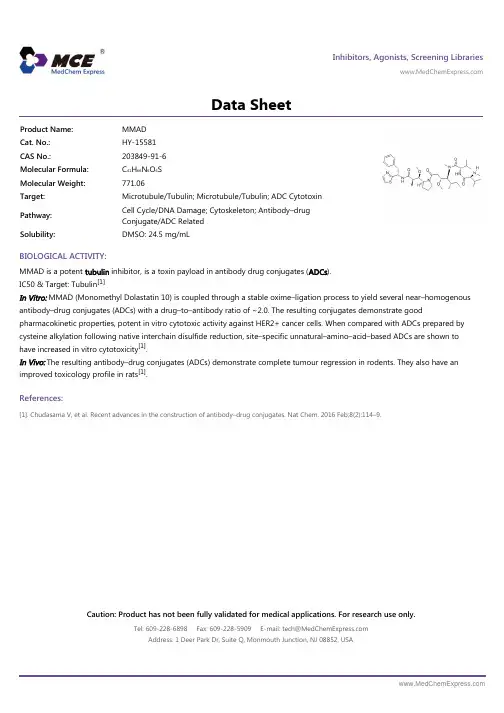
Inhibitors, Agonists, Screening Libraries Data SheetBIOLOGICAL ACTIVITY:MMAD is a potent tubulin inhibitor, is a toxin payload in antibody drug conjugates (ADCs ).IC50 & Target: Tubulin [1]In Vitro: MMAD (Monomethyl Dolastatin 10) is coupled through a stable oxime–ligation process to yield several near–homogenous antibody–drug conjugates (ADCs) with a drug–to–antibody ratio of ~2.0. The resulting conjugates demonstrate goodpharmacokinetic properties, potent in vitro cytotoxic activity against HER2+ cancer cells. When compared with ADCs prepared by cysteine alkylation following native interchain disulfide reduction, site–specific unnatural–amino–acid–based ADCs are shown to have increased in vitro cytotoxicity [1].In Vivo: The resulting antibody–drug conjugates (ADCs) demonstrate complete tumour regression in rodents. They also have animproved toxicology profile in rats [1]. References:[1]. Chudasama V, et al. Recent advances in the construction of antibody–drug conjugates. Nat Chem. 2016 Feb;8(2):114–9.Product Name:MMAD Cat. No.:HY-15581CAS No.:203849-91-6Molecular Formula:C 41H 66N 6O 6S Molecular Weight:771.06Target:Microtubule/Tubulin; Microtubule/Tubulin; ADC Cytotoxin Pathway:Cell Cycle/DNA Damage; Cytoskeleton; Antibody–drug Conjugate/ADC Related Solubility:DMSO: 24.5 mg/mLCaution: Product has not been fully validated for medical applications. For research use only.Tel: 609-228-6898 Fax: 609-228-5909 E-mail: tech@ Address: 1 Deer Park Dr, Suite Q, Monmouth Junction, NJ 08852, USA。
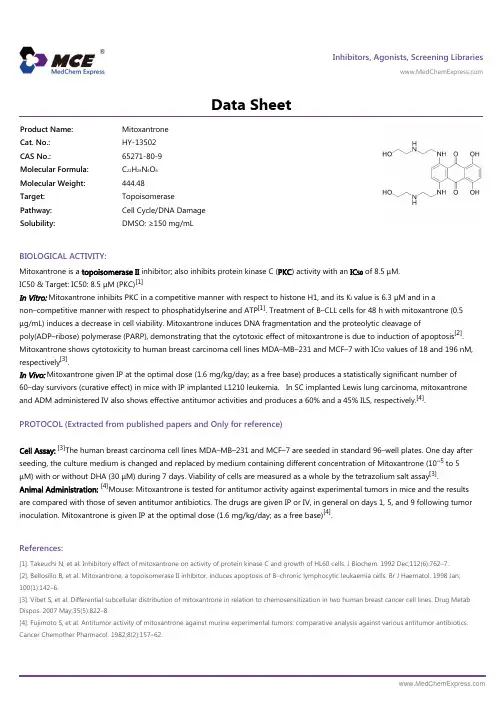
Inhibitors, Agonists, Screening Libraries Data SheetBIOLOGICAL ACTIVITY:Mitoxantrone is a topoisomerase II inhibitor; also inhibits protein kinase C (PKC ) activity with an IC 50 of 8.5 μM.IC50 & Target: IC50: 8.5 μM (PKC)[1]In Vitro: Mitoxantrone inhibits PKC in a competitive manner with respect to histone H1, and its K i value is 6.3 μM and in a non–competitive manner with respect to phosphatidylserine and ATP [1]. Treatment of B–CLL cells for 48 h with mitoxantrone (0.5μg/mL) induces a decrease in cell viability. Mitoxantrone induces DNA fragmentation and the proteolytic cleavage of poly(ADP–ribose) polymerase (PARP), demonstrating that the cytotoxic effect of mitoxantrone is due to induction of apoptosis [2].Mitoxantrone shows cytotoxicity to human breast carcinoma cell lines MDA–MB–231 and MCF–7 with IC 50 values of 18 and 196 nM,respectively [3].In Vivo: Mitoxantrone given IP at the optimal dose (1.6 mg/kg/day; as a free base) produces a statistically significant number of 60–day survivors (curative effect) in mice with IP implanted L1210 leukemia. In SC implanted Lewis lung carcinoma, mitoxantrone and ADM administered IV also shows effective antitumor activities and produces a 60% and a 45% ILS, respectively.[4].PROTOCOL (Extracted from published papers and Only for reference)Cell Assay:[3]The human breast carcinoma cell lines MDA–MB–231 and MCF–7 are seeded in standard 96–well plates. One day after seeding, the culture medium is changed and replaced by medium containing different concentration of Mitoxantrone (10–5 to 5μM) with or without DHA (30 μM) during 7 days. Viability of cells are measured as a whole by the tetrazolium salt assay [3].Animal Administration:[4]Mouse: Mitoxantrone is tested for antitumor activity against experimental tumors in mice and the results are compared with those of seven antitumor antibiotics. The drugs are given IP or IV, in general on days 1, 5, and 9 following tumor inoculation. Mitoxantrone is given IP at the optimal dose (1.6 mg/kg/day; as a free base)[4].References:[1]. Takeuchi N, et al. Inhibitory effect of mitoxantrone on activity of protein kinase C and growth of HL60 cells. J Biochem. 1992 Dec;112(6):762–7.[2]. Bellosillo B, et al. Mitoxantrone, a topoisomerase II inhibitor, induces apoptosis of B–chronic lymphocytic leukaemia cells. Br J Haematol. 1998 Jan;100(1):142–6.[3]. Vibet S, et al. Differential subcellular distribution of mitoxantrone in relation to chemosensitization in two human breast cancer cell lines. Drug Metab Dispos. 2007 May;35(5):822–8.[4]. Fujimoto S, et al. Antitumor activity of mitoxantrone against murine experimental tumors: comparative analysis against various antitumor antibiotics.Cancer Chemother Pharmacol. 1982;8(2):157–62.Product Name:Mitoxantrone Cat. No.:HY-13502CAS No.:65271-80-9Molecular Formula:C 22H 28N 4O 6Molecular Weight:444.48Target:Topoisomerase Pathway:Cell Cycle/DNA Damage Solubility:DMSO: ≥150 mg/mLCaution: Product has not been fully validated for medical applications. For research use only.Tel: 609-228-6898 Fax: 609-228-5909 E-mail: tech@Address: 1 Deer Park Dr, Suite Q, Monmouth Junction, NJ 08852, USA。