
一般过去时
- 格式:ppt
- 大小:269.00 KB
- 文档页数:33

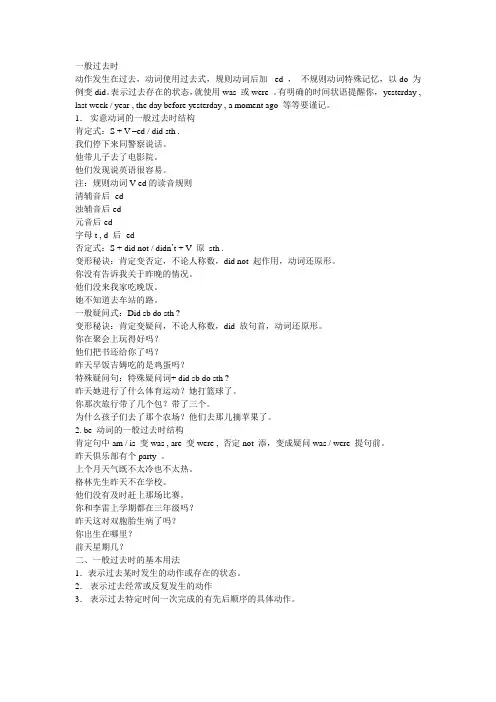
一般过去时动作发生在过去,动词使用过去式,规则动词后加- ed ,不规则动词特殊记忆,以do 为例变did。
表示过去存在的状态,就使用was 或were 。
有明确的时间状语提醒你,yesterday , last week / year , the day before yesterday , a moment ago 等等要谨记。
1.实意动词的一般过去时结构肯定式:S + V –ed / did sth .我们停下来同警察说话。
他带儿子去了电影院。
他们发现说英语很容易。
注:规则动词V-ed的读音规则清辅音后- ed浊辅音后-ed元音后-ed字母t , d 后- ed否定式:S + did not / didn’t + V 原sth .变形秘诀:肯定变否定,不论人称数,did not 起作用,动词还原形。
你没有告诉我关于昨晚的情况。
他们没来我家吃晚饭。
她不知道去车站的路。
一般疑问式:Did sb do sth ?变形秘诀:肯定变疑问,不论人称数,did 放句首,动词还原形。
你在聚会上玩得好吗?他们把书还给你了吗?昨天早饭吉姆吃的是鸡蛋吗?特殊疑问句:特殊疑问词+ did sb do sth ?昨天她进行了什么体育运动?她打篮球了。
你那次旅行带了几个包?带了三个。
为什么孩子们去了那个农场?他们去那儿摘苹果了。
2. be 动词的一般过去时结构肯定句中am / is 变was , are 变were , 否定not 添,变成疑问was / were 提句前。
昨天俱乐部有个party 。
上个月天气既不太冷也不太热。
格林先生昨天不在学校。
他们没有及时赶上那场比赛。
你和李雷上学期都在三年级吗?昨天这对双胞胎生病了吗?你出生在哪里?前天星期几?二、一般过去时的基本用法1.表示过去某时发生的动作或存在的状态。
2.表示过去经常或反复发生的动作3.表示过去特定时间一次完成的有先后顺序的具体动作。
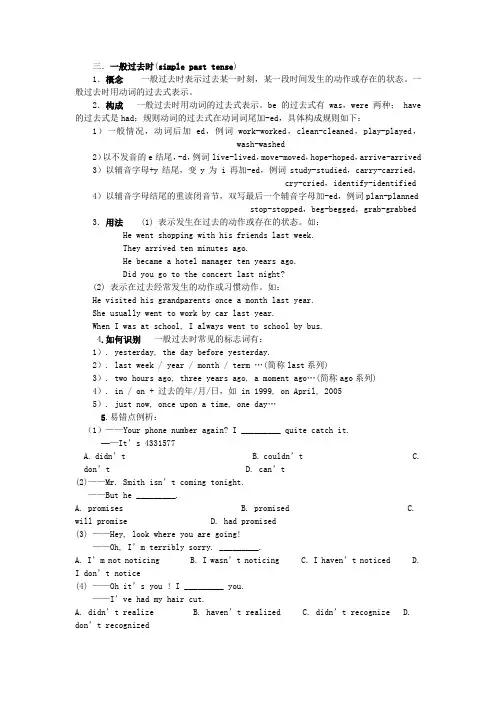
三.一般过去时(simple past tense)1.概念一般过去时表示过去某一时刻,某一段时间发生的动作或存在的状态。
一般过去时用动词的过去式表示。
2.构成一般过去时用动词的过去式表示。
be的过去式有was,were两种; have 的过去式是had;规则动词的过去式在动词词尾加-ed,具体构成规则如下:1)一般情况,动词后加ed,例词work-worked,clean-cleaned,play-played,wash-washed2)以不发音的e结尾,-d,例词live-lived,move-moved,hope-hoped,arrive-arrived 3)以辅音字母+y结尾,变y为 i再加-ed,例词study-studied,carry-carried,cry-cried,identify-identified 4)以辅音字母结尾的重读闭音节,双写最后一个辅音字母加-ed,例词plan-plannedstop-stopped,beg-begged,grab-grabbed 3.用法 (1) 表示发生在过去的动作或存在的状态。
如:He went shopping with his friends last week.They arrived ten minutes ago.He became a hotel manager ten years ago.Did you go to the concert last night?(2) 表示在过去经常发生的动作或习惯动作。
如:He visited his grandparents once a month last year.She usually went to work by car last year.When I was at school, I always went to school by bus.4.如何识别一般过去时常见的标志词有:1). yesterday, the day before yesterday.2). last week / year / month / term …(简称last系列)3). two hours ago, three years ago, a moment ago…(简称ago系列)4). in / on + 过去的年/月/日,如 in 1999, on April, 20055). just now, once upon a time, one day…5.易错点例析:(1)——Your phone number again? I _________ quite catch it.——It’s 4331577A. didn’tB. couldn’tC. don’tD. can’t(2)——Mr. Smith isn’t coming tonight.——But he _________.A. promisesB. promisedC. will promiseD. had promised(3) ——Hey, look where you are going!——Oh, I’m terribly sorry. _________.A. I’m not noticingB. I wasn’t noticingC. I haven’t noticedD. I don’t notice(4) ——Oh it’s you ! I _________ you.——I’ve had my hai r cut.A. didn’t realizeB. haven’t realizedC. didn’t recognizeD. don’t recognized(5) ——Since you’ve agreed to go, why aren’t you getting ready?——But I _________ that you would have me start at once.A. don’t realizeB. didn’t realizeC. hadn’t realizedD. haven’t realized(6) ——It’s twelve o’clock, I think I must be off now.——Oh, really? I _________ it at all.A. don’t realizeB. haven’t realizedC. didn’t realizeD. hadn’t realizedKey:ABBCBC6.中考真题及模拟(2009朝阳区一模)He went into his room, _______ the light and began to work.A. has turned onB. will turn onC. turns onD. turned on(2009海淀一模)——What’s the best food have you had in Beijing, Alex?——Roast duck! I _________to a famous restaurant to have it last week.A. have goneB. goC. will goD. went(2009宣武区一模)——Do you know how many gold medals the 23-year-old Michael Phelps _____________at the 2008 Summer Olympic Games?——Eight.A. winB. winsC. wonD. has won(2008北京)We were in Qingdao last week and __________ great fun there.A. will haveB. have hadC. hadD. have(2007北京)——What did you do after school yesterday?——I _________basketball with my friends.A. playB. playedC. will playD. am playing(2005北京)---Hi, Kate. You look tired. What’s the matter?---I ______well last night.A. didn’t sleepB. don’t sleepC. haven’t sleptD. won’t sleep (2008四川泸州)Yesterday,Tony’s family _________ a good time.A. hasB. haveC. had(2007湖南湘潭)I’m sorry you’ve missed the train. It _______10 minutes ago.A. leftB. has leftC. had left(2007福州)——Mr Green, __________you________ Three Lanes and Alleys(三坊七巷)last Sunday?——No, but I’ll visit them next week.A. will; go toB. have; been toC. did; go toD. have; gone to (2007浙江)——What did the teacher say just now?——He __________us not to play computer games all day.A. tellsB. toldC. has toldD. is told(2007江西)——Inventors have changed the way we live.——So they are famous for the great things they _________.A. doB. didC. are doingD. had done(06江西)——Where’s the cake I made this morning?——We _______ it, mum. Can you make another one for us?A. ateB. eatC. will itD. were eating。

一般过去时的知识点一.概述一般过去时表示过去某个时间发生的动作或状态,常和表示过去的时间连用,yesterday, last night, in 1990, two days ago等。
也表示过去经常或反复发生的动作,常和often, always等表示频度的时间状语连用。
I got up at 6:30 yesterday.我昨天6:30起床。
He always went to work by bus last year.去年他总是坐公交车上班。
二.一般过去时的构成一般过去时由规则动词(-ed/-d)或不规则动词的过去时表示,除be外,其余动词没有人称和数的变化。
各种动词的否定结构和一般疑问结构,与一般现在时的否定结构和疑问结构相同。
三.Be动词在一般过去时中的变化:⑴am 和is在一般过去时中变为was。
(was not=wasn’t)⑵are在一般过去时中变为were。
(were not=weren’t)⑶带有was或were的句子,其否定、疑问的变化和is, am, are 一样,即否定句在was或were后加not,一般疑问句把was或were 调到句首。
四.句中没有be动词的一般过去时的句子否定句:didn’t +动词原形,如:Jim didn’t go home yesterday.一般疑问句:在句首加did,句子中的动词过去式变回原形。
如:Did Jim go home yesterday?特殊疑问句:⑴疑问词+did+主语+动词原形?如:What did Jim do yesterday?⑵疑问词当主语时:疑问词+动词过去式?如:Who went to home yesterday?五..规则动词过去式变化规则①一般在动词末尾加-ed,如:play-played, cook-cooked②结尾是e加d,如:like-liked love-loved③末尾只有一个元音字母和一个辅音字母的重读闭音节,应双写末尾的辅音字母,再加-ed,如:stop-stopped④以“辅音字母+y”结尾的,变y为i,再加-ed,如:study-studied六.一般过去时的用法(1)表示过去某个特定时间发生的动作或存在的状态常有明确的时间状语,如yesterday,last night, some years ago,in1890等,以及由when等引导的时间状语从句。