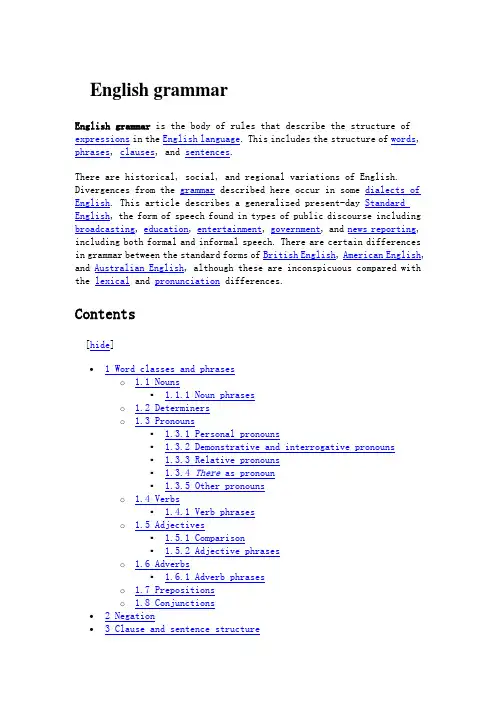
English grammarEnglish grammar is the body of rules that describe the structure of expressions in the English language. This includes the structure of words, phrases, clauses, and sentences.There are historical, social, and regional variations of English. Divergences from the grammar described here occur in some dialects of English. This article describes a generalized present-day Standard English, the form of speech found in types of public discourse including broadcasting, education, entertainment, government, and news reporting, including both formal and informal speech. There are certain differences in grammar between the standard forms of British English, American English, and Australian English, although these are inconspicuous compared with the lexical and pronunciation differences.Contents[hide]∙ 1 Word classes and phraseso 1.1 Nouns▪ 1.1.1 Noun phraseso 1.2 Determinerso 1.3 Pronouns▪ 1.3.1 Personal pronouns▪ 1.3.2 Demonstrative and interrogative pronouns▪ 1.3.3 Relative pronouns▪ 1.3.4 There as pronoun▪ 1.3.5 Other pronounso 1.4 Verbs▪ 1.4.1 Verb phraseso 1.5 Adjectives▪ 1.5.1 Comparison▪ 1.5.2 Adjective phraseso 1.6 Adverbs▪ 1.6.1 Adverb phraseso 1.7 Prepositionso 1.8 Conjunctions∙ 2 Negation∙ 3 Clause and sentence structureo 3.1 Questionso 3.2 Dependent clauseso 3.3 Other uses of inversiono 3.4 Imperativeso 3.5 Elliptical constructions∙ 4 History of English grammars∙ 5 See also∙ 6 Notes and references∙7 Bibliographyo7.1 Grammar bookso7.2 Monographs∙8 External links[edit] Word classes and phrasesThere are eight word classes, or parts of speech, that are distinguished in English: nouns, determiners, pronouns, verbs, adjectives, adverbs, prepositions, and conjunctions. (Determiners, traditionally classified along with adjectives, have not always been regarded as a separate part of speech.) Interjections are another word class, but these are not described here as they do not form part of the clause and sentence structure of the language.[1]Nouns, verbs, adjectives, and adverbs form open classes– word classes that readily accept new members, such as the noun celebutante(a celebrity who frequents the fashion circles), the adverb 24/7 (as in I am working on it 24/7), and similar relatively new words.[1] The others are regarded as closed classes. For example, it is rare for a new pronoun to be admitted to the language.English words are not generally marked for word class. It is not usually possible to tell from the form of a word which class it belongs to except, to some extent, in the case of words with inflectional endings or derivational suffixes. On the other hand, some words belong to more than one word class. For example run can serve as either a verb or a noun (these are regarded as two different lexemes).[2] Lexemes may be inflected to express different grammatical categories. The lexeme run has the forms runs, ran, and running.[2]Words in one class can sometimes be derived from those in another. This has the potential to give rise to new words. The noun aerobics has recently given rise to the adjective aerobicized.[2]Words combine to form phrases. A phrase typically serves the same function as a word from some particular word class.[2] For example, my very goodfriend Peter is a phrase that can be used in a sentence as if it were a noun, and is therefore called a noun phrase. Similarly, adjective phrases and adverb phrases function as if they were adjectives or adverbs, but with other types of phrases the terminology has different implications. For example, a verb phrase consists of a verb together with any objects and other dependents; a prepositional phrase consists of a preposition together with its complement (and is therefore usually a type of adverb phrase); and a determiner phrase is a type of noun phrase containing a determiner.[edit] NounsNouns form the largest English word class. There are many common suffixes used to form nouns from other nouns or from other types of words, such as -age(as in shrinkage), -hood(as in sisterhood), and so on,[2]although many nouns are base forms not containing any such suffix (such as cat, grass, France). Nouns are also often created by conversion of verbs or adjectives, as with the words talk and reading(a boring talk, the assigned reading).Unlike in many related languages, English nouns do not have grammatical gender(although many nouns refer specifically to male or female persons or animals, like mother, father, bull, tigress; see Gender in English). Nouns are sometimes classified semantically (by their meanings) as proper nouns and common nouns(Cyrus, China vs. frog, milk) or as concrete nouns and abstract nouns (book, laptop vs. heat, prejudice).[3] A grammatical distinction is often made between count (countable) nouns such as clock and city, and non-count (uncountable) nouns such as milk and decor.[4]Some nouns can function to be either countable or uncountable such the word "wine" (This is a good wine, I prefer red wine).Countable nouns generally have singular and plural forms.[3]In most cases the plural is formed from the singular by adding -[e]s(as in dogs, bushes), although there are also irregular forms (woman/women, medium/media, etc.), including cases where the two forms are identical (sheep, series). For more details, see English plural.Certain nouns can take plural verbs even though they are singular in form, as in The government were ...(where the government is considered to refer to the people constituting the government). This, a form of synesis, is more common in British than American English. See English plural: Singulars with collective meaning treated as plural.English nouns are not marked for case as they are in some languages, but they have possessive forms, formed by the addition of -'s (as in John's, children's), or just an apostrophe (with no change in pronunciation) in the case of -[e]s plurals and sometimes other words ending with -s (the dogs' owners, Jesus' love). More generally, the ending can be applied to noun phrases (as in the man you saw yesterday's sister); see below. The possessive form can be used either as a determiner (John's cat) or as a noun phrase (John's is the one next to Jane's). For details, see English possessive.[edit] Noun phrasesNoun phrases are phrases that function grammatically as nouns within sentences, for example as the subject or object of a verb. Most noun phrases have a noun as their head.[4]An English noun phrase typically takes the following form (not all elements need be present):D ETERMINER + P RE-MODIFIERS + NOUN + P OSTMODIFIERS/C OMPLEMENTIn this structure:∙the determiner may be an article (the, a[n]) or other equivalent word, as described in the following section. In many contexts it is required for a noun phrase to include some determiner.∙pre-modifiers include adjectives and some adjective phrases (such as red, really lovely), and noun adjuncts (such as college in the phrase the college student). Adjectival modifiers usually comebefore noun adjuncts.∙ a complement or postmodifier[4]may be a prepositional phrase (... of London), a relative clause (like ...which we saw yesterday),certain adjective or participial phrases (... sitting on the beach), or a dependent clause or infinitive phrase appropriate to the noun (like ... that the world is round after a noun such as fact orstatement, or ... to travel widely after a noun such as desire). An example of a noun phrase that includes all of the above-mentioned elements is that rather attractive young college student that you were talking to. Here that is the determiner, rather attractive and young are adjectival pre-modifiers, college is a noun adjunct, student is the noun serving as the head of the phrase, and that you were talking to is a post-modifier (a relative clause in this case). Notice the order of thepre-modifiers; the determiner that must come first and the noun adjunct college must come after the adjectival modifiers.Coordinating conjunctions such as and, or, and but can be used at various levels in noun phrases, as in John, Paul, and Mary; the matching green coat and hat; a dangerous but exciting ride; a person sitting down or standing up. See Conjunctions below for more explanation.Noun phrases can also be placed in apposition (where two consecutive phrases refer to the same thing), as in that president, Abraham Lincoln, ...(where that president and Abraham Lincoln are in apposition). In some contexts the same can be expressed by a prepositional phrase, as in the twin curses of famine and pestilence (meaning "the twin curses" that are "famine and pestilence").Particular forms of noun phrases include:∙phrases formed by the determiner the with an adjective, as in the homeless, the English (these are plural phrases referring tohomeless people or English people in general);∙phrases with a pronoun rather than a noun as the head (see below);∙phrases consisting just of a possessive;∙infinitive and gerund phrases, in certain positions;∙certain clauses, such as that clauses and relative clauses like what he said, in certain positions.[edit] DeterminersMain articles: English determiners and English articlesEnglish determiners constitute a relatively small class of words. They include the articles the, a[n] (and in some contexts some), certain demonstrative and interrogative words such as this, that, and which, possessives such as my and whose(the role of determiner can also be played by noun possessive forms such as John's and the girl's), various quantifying words like all, many, various, and numerals(one, two, etc.). There are also many phrases (such as a couple of) that can play the role of determiners.Determiners are used in the formation of noun phrases (see above). Many words that serve as determiners can also be used as pronouns (this, that, many, etc.)Determiners can be used in certain combinations, such as all the water and the many problems .In many contexts, it is required for a noun phrase to be completed with an article or some other determiner. It is not grammatical to say just cat sat on table ; one must say my cat sat on the table . The most common situations in which a complete noun phrase can be formed without a determiner are when it refers generally to a whole class or concept (as in dogs are dangerous and beauty is subjective ) and when it is a name (Jane , Spain , etc.) This is discussed in more detail at English articles and Zero article in English .[edit ] Pronouns Pronouns are a relatively small, closed class of words that function in the place of nouns or noun phrases. They include personal pronouns , demonstrative pronouns , relative pronouns , interrogative pronouns , and some others, mainly indefinite pronouns .[edit ] Personal pronounsMain article: English personal pronounsThe personal pronouns of modern standard English, and the corresponding possessive forms, are as follows:Nominative Oblique Reflexive Possessive determiner Possessive pronoun 1st pers. sing.I me myself my mine 2nd pers. sing./pl. you you yourself/yourselves youryours 3rd pers. sing. she , he , it her , him , itherself , himself , itself her , his , its hers , his , (rare: its ) 1st pers. pl.we us ourselves our ours 3rd pers. pl. they themthemselves their theirs The second-person forms such as you are used with both singular and plural reference. (An archaic set of pronouns used for singular reference is thou, thee, thyself, thy, thine .) You can also be used as an indefinite pronoun ,referring to a person in general (see generic you) compared to the more formal alternative, one (reflexive oneself, possessive one's).The third-person singular forms are differentiated according to the sex of the referent. For example, she can be used to refer to a female person, sometimes a female animal, and sometimes an object to which female characteristics are attributed, such as a ship or a country. A male person, and sometimes a male animal, is referred to using he. In other cases it can be used. (See Gender in English.) The word it can also be used as a dummy subject, in sentences like It is going to be sunny this afternoon.The third-person plural forms such as they are sometimes used with singular reference, as a gender-neutral pronoun, as in each employee should ensure they tidy their desk. This usage is sometimes considered ungrammatical. (See singular they.)The possessive deteminers such as my are used as determiners together with nouns, as in my old man, some of his friends. The second possessive forms like mine are used when they do not qualify a noun: as pronouns, as in mine is bigger than yours, and as predicates, as in this one is mine. Note also the construction a friend of mine(meaning "someone who is my friend"). See English possessive for more details.[edit] Demonstrative and interrogative pronounsThe demonstrative pronouns of English are this (plural these), and that (plural those), as in these are good, I like that. Note that all four words can also be used as determiners (followed by a noun), as in those cars. They can also then form the alternative pronominal expressions this/that one, these/those ones.The interrogative pronouns are who, what, and which(all of them can take the suffix -ever for emphasis). The pronoun who refers to a person or people; it has an oblique form whom(though in informal contexts this is usually replaced by who), and a possessive form (pronoun or determiner) whose. The pronoun what refers to things or abstracts. The word which is used to ask about alternatives from what is seen as a closed set: which (of the books) do you like best? (It can also be an interrogative determiner: which book?; this can form the alternative pronominal expressions which one and which ones.) Which, who, and what can be either singular or plural, although who and what often take a singular verb regardless of any supposed number. For more information see who.All the interrogative pronouns can also be used as relative pronouns; see below for more details.[edit] Relative pronounsMain article: English relative clauses. For "who/whom" and related forms, see also Who (pronoun).The main relative pronouns in English are who(with its derived forms whom and whose), which, and that.[5]The relative pronoun which refers to things rather than persons, as in the shirt, which used to be red, is faded. For persons, who is used (the man who saw me was tall). The oblique case form of who is whom, as in the man whom I saw was tall, although in informal registers who is commonly used in place of whom.The possessive form of who is whose (the man whose car is missing ...); however the use of whose is not restricted to persons (one can say an idea whose time has come).The word that as a relative pronoun is normally found only in restrictive relative clauses (unlike which and who, which can be used in both restrictive and unrestrictive clauses). It can refer to either persons or things, and cannot follow a preposition. For example, one can say the song that [or which] I listened to yesterday, but the song to which [not to that] I listened yesterday. The relative pronoun that is usually pronounced with a reduced vowel (schwa), and hence differently from the demonstrative that(see Weak and strong forms in English). If that is not the subject of the relative clause, it can be omitted (the song I listened to yesterday).The word what can be used to form a free relative clause– one that has no antecedent and that serves as a complete noun phrase in itself, as in I like what he likes. The words whatever and whichever can be used similarly, in the role of either pronouns (whatever he likes) or determiners (whatever book he likes). When referring to persons, who(ever) (and whom(ever)) can be used in a similar way (but not as determiners).[edit] There as pronounThe word there is used as a pronoun in some sentences, playing the role of a dummy subject, normally of an intransitive verb. The "logical subject" of the verb then appears as a complement after the verb.This use of there occurs most commonly with forms of the verb be in existential clauses, to refer to the presence or existence of something. For example: There is a heaven; There are two cups on the table; Therehave been a lot of problems lately. It can also be used with other verbs: There exist two major variants; There occurred a very strange incident.The dummy subject takes the number (singular or plural) of the logical subject (complement), hence it takes a plural verb if the complement is plural. In colloquial English, however, the contraction there's is often used where there are would be expected.The dummy subject can undergo inversion, Is there a test today?and Never has there been a man such as this. It can also appear without a corresponding logical subject, in short sentences and question tags: There wasn't a discussion, was there? There was.The word there in such sentences has sometimes been analyzed as an adverb, or as a dummy predicate, rather than as a pronoun.[6] However, its identification as a pronoun is most consistent with its behavior in inverted sentences and question tags as described above.Because the word there can also be a deictic adverb (meaning "at/to that place"), a sentence like There is a river could have either of two meanings: "a river exists" (with there as a pronoun), and "a river is in that place" (with there as an adverb). In speech, the adverbial there would be given stress, while the pronoun would not – in fact the pronoun is often pronounced as a weak form, /ðə(r)/.[edit] Other pronounsOther pronouns in English are often identical in form to determiners (especially quantifiers), such as many, a little, etc. Sometimes the pronoun form is different, as with none(corresponding to the determiner no), nothing, everyone, somebody, etc. Many examples are listed at Indefinite pronoun.[edit] VerbsMain article: English verbsVerbs form the second largest word class after nouns. The basic form of an English verb is not generally marked by any ending, although there are certain suffixes that are frequently used to form verbs, such as -ate (formulate), -fy (electrify), and -ise/ize (realise/realize).[7] Many verbs also contain prefixes, such un- (unmask), out- (outlast), over-(overtake), and under-(undervalue).[7]Verbs can also be formed from nouns and adjectives by conversion, as with the verbs snare, nose, dry, and calm.Most verbs have three or four inflected forms: a third-person singular present tense form in -s (writes), a present participle and gerund form in -ing (writing), a past tense (wrote), and – though often identical to the past tense form –a past participle(written). Regular verbs have identical past tense and past participle forms in -ed, but there are 100 or so irregular English verbs with different forms (see list). The verbs have, do and say also have irregular third-person present tense forms (has, does/dʌz/, says/sɛz/). The verb be has the largest number of irregularforms (am, is, are in the present tense, was, were in the past tense, been for the past participle).Most of what are often referred to as verb tenses (or sometimes aspects) in English are formed using auxiliary verbs. Apart from what are called the simple present(write, writes) and simple past(wrote), there are also continuous (progressive) forms (am/is/are/was/were writing), perfect forms (have/has/had written, and the perfect continuous have/has/had been writing), future forms (will write, will be writing, will have written, will have been writing), and conditionals (also called "future in the past") with would in place of will. The auxiliaries shall and should sometimes replace will and would in the first person. For the uses of these various verb forms, see English verbs and English clause syntax.The infinitive is the basic form of the verb (be, write, play), although there is also a "to-infinitive" (to be, to write, to play) used in many syntactical constructions. There are also infinitives corresponding to other aspects: (to) have written, (to) be writing, (to) have been writing. The second-person imperative is identical to the (basic) infinitive; other imperative forms may be made with let (let us go, or let's go; let them eat cake).A form identical to the infinitive can be used as a present subjunctive in certain contexts: It is important that he follow them or ... that he be committed to the cause. There is also a past subjunctive (distinct from the simple past only in the possible use of were instead of was), used in some conditional sentences and similar: if I were (or was) rich ...; were he to arrive now ...; I wish she were(or was) here. For details see English subjunctive.The passive voice is formed using the verb be (in the appropriate tense or form) with the past participle of the verb in question: cars are driven, he was killed, I am being tickled, it is nice to be pampered, etc. Theperformer of the action may be introduced in a prepositional phrase with by (as in they were killed by the invaders).The English modal verbs consist of the core modals can, could, may, might, must, shall, should, will, would, as well as ought (to), had better, and in some uses dare and need.[8]These do not inflect for person or number,[8] and do not have infinitive or participle forms (except synonyms, as with be/being/been able (to) for the modals can/could). The modals are used with the basic infinitive form of a verb (I can swim, he may be killed, we dare not move, need they go?), except for ought, which takes to (you ought to go).The copula be, along with the modal verbs and the other auxiliaries, form a distinct class, sometimes called "special verbs" or simply "auxiliaries".[9]These have different syntax from ordinary lexical verbs, especially in that they make their interrogative forms by plain inversion with the subject, and their negative forms by adding not after the verb (could I ...? I could not ...). Apart from those already mentioned, this class may also include used to (although the forms did he use to? and he didn't use to are also found), and sometimes have even when not an auxiliary (forms like have you a sister?and he hadn't a clue are possible, though becoming less common). It also includes the auxiliary do (does, did); this is used with the basic infinitive of other verbs (those not belonging to the "special verbs" class) to make their question and negation forms, as well as emphatic forms (do I like you?; he doesn't speak English; we did close the fridge). For more details of this, seedo-support.Some forms of the copula and auxiliaries often appear as contractions, as in I'm for I am, you'd for you would or you had, and John's for John is. Their negated forms with following not are also often contracted (see Negation below). For detail see English auxiliaries and contractions.[edit] Verb phrasesA verb together with its dependents, excluding its subject, may be identified as a verb phrase (although this concept is not acknowledged in all theories of grammar[10]). A verb phrase headed by a finite verb may also be called a predicate. The dependents may be objects, complements, and modifiers (adverbs or adverbial phrases). In English, objects and complements nearly always come after the verb; a direct object precedes other complements such as prepositional phrases, but if there is an indirect object as well, expressed without a preposition, then that precedes the direct object: give me the book, but give the book to me. Adverbial modifiers generally follow objects, although other positionsare possible (see under Adverbs below). Certain verb–modifier combinations, particularly when they have independent meaning (such as take on and get up), are known as "phrasal verbs".For details of possible patterns, see English clause syntax. See the Non-finite clauses section of that article for verb phrases headed by non-finite verb forms, such as infinitives and participles.[edit] AdjectivesEnglish adjectives, as with other word classes, cannot in general be identified as such by their form,[11]although many of them are formed from nouns or other words by the addition of a suffix, such as -al(habitual), -ful(blissful), -ic(atomic), -ish(impish, youngish), -ous(hazardous), etc.; or from other adjectives using a prefix: disloyal, irredeemable, unforeseen, overtired.Adjectives may be used attributively, as part of a noun phrase (nearly always preceding the noun they modify), as in the big house, or predicatively, as in the house is big. Certain adjectives are restricted to one or other use; for example, drunken is attributive (a drunken sailor), while drunk is usually predicative (the sailor was drunk).[edit] ComparisonMany adjectives have comparative and superlative forms in -er and -est,[12] such as faster and fastest(from the positive form fast). Spelling rules which maintain pronunciation apply to suffixing adjectives just as they do for similar treatment of regular past tense formation; these cover consonant doubling (as in bigger and biggest, from big) and the change of y to i after consonants (as in happier and happiest, from happy).The adjectives good and bad have the irregular forms better, best and worse, worst; also far becomes farther, farthest or further, furthest. The adjective old(for which the regular older and oldest are usual) also has the irregular forms elder and eldest, these generally being restricted to use in comparing siblings and in certain independent uses. For the comparison of adverbs, see Adverbs below.Many adjectives, however, particularly those that are longer and less common, do not have inflected comparative and superlative forms. Instead, they can be qualified with more and most, as in beautiful, more beautiful, most beautiful (this construction is also sometimes used even for adjectives for which inflected forms do exist).Certain adjectives are classed as ungradable.[12] These represent properties that cannot be compared on a scale; they simply apply or do not, as with pregnant, dead, unique. Consequently, comparative and superlative forms of such adjectives are not normally used, except in a figurative, humorous or imprecise context. Similarly, such adjectives are not normally qualified with modifiers of degree such as very and fairly, although with some of them it is idiomatic to use adverbs such as completely. Another type of adjectives sometimes considered ungradable is those that represent an extreme degree of some property, such as delicious and terrified; the same point about modifiers applies to these, although it is not rare to find them in comparative or superlative form.[edit] Adjective phrasesAn adjective phrase is a group of words that plays the role of an adjective in a sentence. It usually has a single adjective as its head, to which modifiers and complements may be added.[13]Adjectives can be modified by a preceding adverb or adverb phrase, as in very warm, truly imposing, more than a little excited. Some can also be preceded by a noun or quantitative phrase, as in fat-free, two-metre-long.Complements following the adjective may include:∙prepositional phrases: proud of him, angry at the screen, keen on breeding toads;∙infinitive phrases: anxious to solve the problem, easy to pick up;∙content clauses, i.e. that clauses and certain others: certain that he was right, unsure where they are;∙after comparatives, phrases or clauses with than: better than you, smaller than I had imagined.An adjective phrase may include both modifiers before the adjective and a complement after it, as in very difficult to put away.Adjective phrases containing complements after the adjective cannot normally be used as attributive adjectives before a noun. Sometimes they are used attributively after the noun, as in a woman proud of being a midwife (where they may be converted into relative clauses: a woman who is proud of being a midwife), but it is wrong to say *a proud of being a midwife woman. Exceptions include very brief and often established phrases such as easy-to-use. (Certain complements can be moved to after the noun, leaving the adjective before the noun, as in a better man than you, a hard nut to crack.)。