
外研版高中英语选修8 Module 2《The Renaissance》(Vocabulary)ppt课件
- 格式:ppt
- 大小:483.06 KB
- 文档页数:13


1 Module 1 Deep South
教学设计说明
话题介绍 本模块主题是介绍南极洲的一些情况以及探险家的探险活动,并介绍了Marco Polo之行。
Period 1
Introduction and
Reading INTRODUCTION Vocabulary and reading 和READING AND
VOCABULARY合并为第一课时“阅读课”。课文“Antarctica: the Last
Continent ”属说明文体,介绍了南极洲的一些情况以及探险家的探险活动。在学生课前自学、预习的基础上,以背景介绍导入新课,然后采取“自上而下”的阅读教学模式,引导学生关注文章的篇章结构、段落大意,得出“树型图”,进行“信息转换”,理解全文、复述意义。 教师还可以参考“教学资源”The Analysis of the Difficult Sentences from Module 1中的材料,帮助学生解决字、词、句等方面的问题。
Period 2
Grammar and
Usage Grammar 1 Review of subjects和7页的Grammar 2 Review of verbs合并为第二课时“语法课”,集中学习和演练the use of subjects and verbs。语法教学的方法不外乎“归纳法”、和“演绎法”。在外语教学环境中,一般采用演绎法。
Period 3
Self-Assessment 通过练习,使学生进一步熟悉和掌握本单元的重点句型和语法。
Part One Teaching Design
第一部分 教学设计
Period 1 Introduction and Reading -- Antarctica: the Last
Continent
▇ Goals
● To learn something about the North pole and South pole
学必求其心得,业必贵于专精
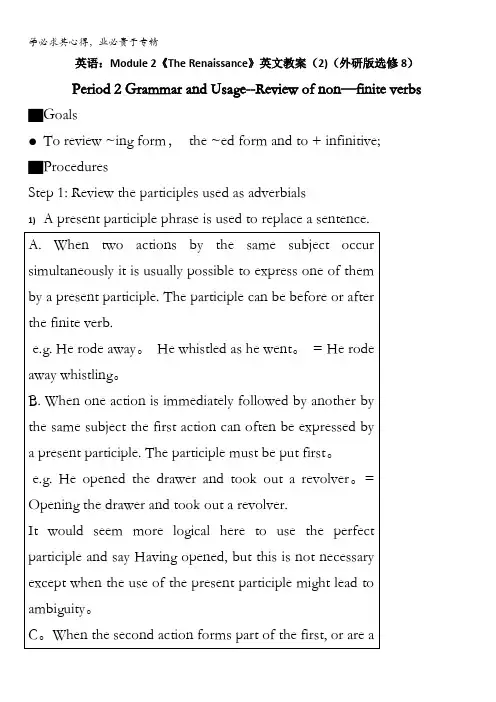
英语:Module 2《The Renaissance》英文教案(2)(外研版选修8)
Period 2 Grammar and Usage--Review of non—finite verbs
▇Goals
● To review ~ing form, the ~ed form and to + infinitive;
▇Procedures
Step 1: Review the participles used as adverbials
1) A present participle phrase is used to replace a sentence.
A. When two actions by the same subject occur
simultaneously it is usually possible to express one of them
by a present participle. The participle can be before or after
the finite verb.
e.g. He rode away。 He whistled as he went。 = He rode
away whistling。
B. When one action is immediately followed by another by
the same subject the first action can often be expressed by
a present participle. The participle must be put first。
e.g. He opened the drawer and took out a revolver。=
Opening the drawer and took out a revolver.
1 英语高二下外研版选修8 Module 2教案03(Words and Expressions)
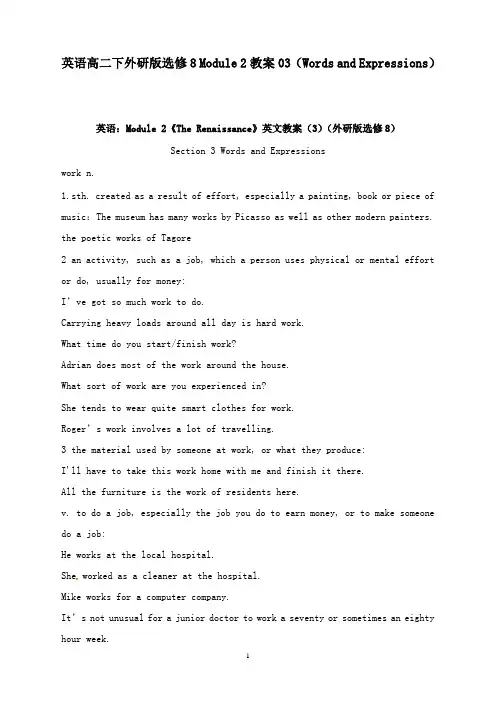
英语:Module 2《The Renaissance》英文教案(3)(外研版选修8)
Section 3 Words and Expressions
work n.
1.sth. created as a result of effort, especially a painting, book or piece of
music:The museum has many works by Picasso as well as other modern painters.
the poetic works of Tagore
2 an activity, such as a job, which a person uses physical or mental effort
or do, usually for money:
I’ve got so much work to do.
Carrying heavy loads around all day is hard work.
What time do you start/finish work?
Adrian does most of the work around the house.
What sort of work are you experienced in?
She tends to wear quite smart clothes for work.
Roger’s work involves a lot of travelling.
3 the material used by someone at work, or what they produce:
I'll have to take this work home with me and finish it there.
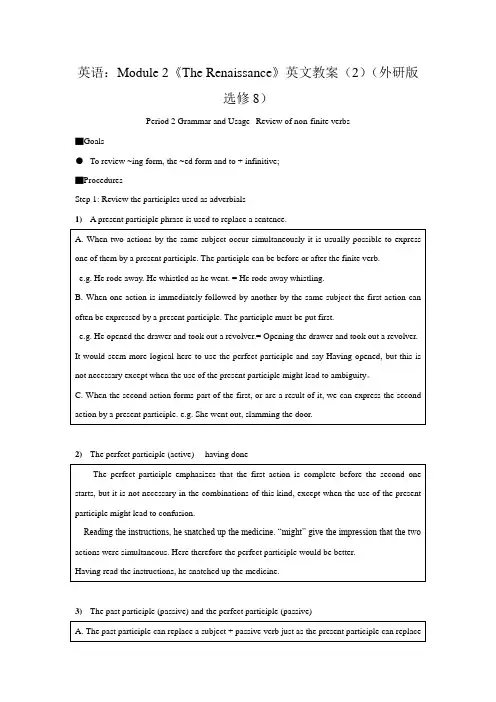
英语:Module 2《The Renaissance》英文教案(2)(外研版选修8)
Period 2 Grammar and Usage--Review of non-finite verbs
▇Goals
● To review ~ing form, the ~ed form and to + infinitive;
▇Procedures
Step 1: Review the participles used as adverbials
1) A present participle phrase is used to replace a sentence.
A. When two actions by the same subject occur simultaneously it is usually possible to express
one of them by a present participle. The participle can be before or after the finite verb.
e.g. He rode away. He whistled as he went. = He rode away whistling.
B. When one action is immediately followed by another by the same subject the first action can
often be expressed by a present participle. The participle must be put first.
e.g. He opened the drawer and took out a revolver.= Opening the drawer and took out a revolver.