鲁教版六年级英语下册unit4教案
- 格式:doc
- 大小:371.50 KB
- 文档页数:14
第 1 页 Unit 4 What time do you go
to school?
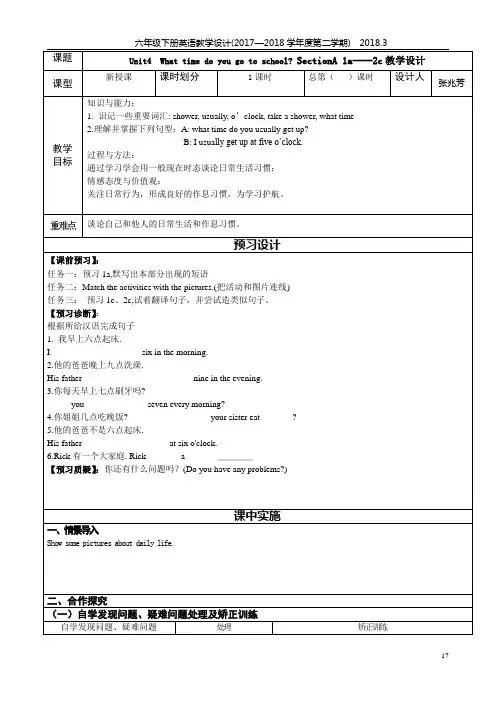
Section A 1a-2c
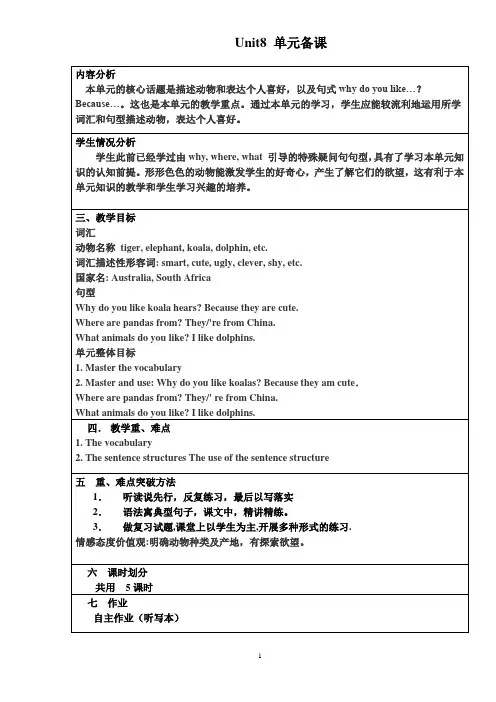
一.Teaching aims(教学目标〕
二.Language points(语言点〕
1.要求掌握以下句式:
〔1〕-What time is it?〔将3b中的语言点前移〕-It's…
〔2〕-What time do you usually…?-I/we usually…
(3)What time does he/she…?He/She usually….
2. 要求掌握以下词汇:
〔1〕名词:time, shower
〔2〕动词短语:go to school, get up, take a shower,
〔3〕副词:usually o'clock
〔4〕疑问代词:what time
三.Key points〔重点〕:
一般现在时的特殊疑问句,即掌握:
“What time do you usually…?I/We usually…〞这个句型
Teaching difficulties〔难点〕:
助动词do在一般现在时的特殊疑问句中的用法。
四.Teaching steps (教学步骤):
1.Warming-up and revision〔课堂热身和复习〕
欣赏世界名曲?钟表店?,学生交流收集到的时间谚语。 第 2 页 2、Presentation〔呈现新知识〕
T:〔拿出一个自制的钟表,此钟指针会转动〕
I have a nice clock. Do you want to have a look?Ss: Yes.
教师指着此钟:What time is it now?Ss:It's……〔T help Ss〕
T:〔教师转动指针〕What time is it now?Ss: It's…〔教师启发〕
〔教师板书:What time is it ? It's …〕
T: Follow me :“What time is it? It's…〞
Read it in groups.
T:〔教师转动指针并引导组之间对话〕Ss: What time is it?Ss:
It's…
〔操练三四次〕
3、Drill〔操练〕
T:Ok. The whole class, please write down time on the paper.
Are you ready ?
Ss: Yes
T: Well. Practise it in pairs. What time is it?It’s…
T:act 〔三四组〕
4、Consolidation〔稳固〕
Play a game and practise more on the pattern“What time is it?
It’s…〞
T:〔每大组选一个代表,分别用What time is it ?向教师发问,教师便用以下句子启发〕: 第 3 页 You can ① have breakfast 复习以前的短语
② have lunch 复习以前的短语
③ have supper 复习以前的短语
④ go to bed … 复习以前的短语
⑤ get up 〔做动作〕 为下面单词呈现作铺垫
⑥ go to school〔做动作 〕 为下面单词呈现作铺垫
⑦ take a shower〔做动作〕 为下面单词呈现作铺垫
S1:It's…
S2:It’s…
S3: It’s…
S4: It’s…
5、Presentation〔呈现新知识〕
T:〔总结上述游戏〕Now let's look at the clock .〔将时钟调整到六点钟〕
What time is it?
Ss: It's six o'clock
T: o'clock〔板书〕. Read after me.
Ss: o’clock.
T:We will……〔做“起床〞的动作,并提供一男孩起床的照片〕
Ss: get up〔T helps Ss〕
T:Follow me :get up〔板书〕
T: What time is it now?〔一边说一边将时钟调到七点〕 第 4 页 Ss: It's 7 o'clock.
T: We will……〔做“上学〞动作,并提供一群孩子上学的图片〕
Ss: go to school〔板书〕T:go to school. Together.
T: And what time is it?〔将时间调整到晚上十点〕
Ss: It's 10 o'clock.
T: We will……〔做“洗澡〞动作,并提供一男孩洗淋浴的图片〕
Ss: take a shower〔板书〕
6、Work on 1a 〔完成P651a〕
T: Ok. Please open your book.
Look at 1a, listen and match the words and the pictures.
7、Work on 1b 〔完成P651b〕
T: Now let's listen to the tape, match the times and actions.
T: Well, let's check the answers.
8、Consolidation.
T:〔当答案校对到九点钟时〕But I often take a shower at ten
o'clock.〔一边说一边高举自己洗澡的图片,此图片上课前画好〕I
usually〔突出usually〕take a shower at ten o'clock
T:Read after me: usually
T:Please hold your pictures and tell me “I usually…〞
〔这些图片包括洗淋浴,起床、上学、跑步、吃饭等日常活动,并事先叫学生在课前画好〕
S1:I usually take a shower at nine o'clock 第 5 页 S2:I usually go to school at six o'clock
S3:I usually…
S4:…
9、Work on 1c〔完成P651c〕
〔1〕T:〔针对最后一个发言的学生说的句子,问其它同学 What time
do you usually…?〕
S1:I usually…at…〔T help S1〕
T:〔再问另一学生〕What time do you usually…?
S1:I usually…at…
T:Read after me
What time do you usually
…?〔板书〕
I usually…at…〔板书〕
〔2〕T:Read it in pairs.
T: What time do you usually take a shower?
S1: I usually take a shower at …
10、Drill
〔1〕Make a similar dialogue with the person you like.
〔2〕Act.
11、变换人称练习What time does he/she usually …?〔板书〕
He/She usually…at…
12、Listen1b and repeat〔听音跟读〕
T:Now let's listen to the tape and repeat. Please try to read 第 6 页 like the tape.
13、Work on 2a.〔完成2a〕
T:But my friend Rick does the same thing with his family. Do
you know?
Ss: No.
T: Let's listen
S1:〔启发学生答复〕
T:Listen again and fill in the blanks.
14、Work on 2b.(完成2b)
T: What time do they take a shower? Listen again and complete
the shower schedule.
T:(校对答案)
15、Work on 2c.(完成2c)
T:××,When does Alicia take a shower?
S1: She takes a shower at 8:00
T : 〔Read after me〕
When does Alicia take a shower?
She takes a shower at 8:00.
Read it in groups.
T:××,when does Jerry take a shower?
S1:…
T: Look at 2b and make a dialogue like this. 第 7 页 16、Listen and repeat 〔听音跟读〕
T: Now let's listen to the tape and repeat . Please try to read
like the tape.
17、Homework:
调查朋友的作息时间:
Name
Get up
Have
breakfast
Leave home
…
学生自由组合成3~5人小组,围坐在一起,相互提问,并把答案记录在表格中。
各小组成员根据表格内容,以“……的一天〞为题,依次表达作息时间,并写成一篇短文。
Unit 4 What time do you go to school?
Section A 2d-3c
一、 知识目标:
(1)掌握Section A对话2d中出现的短语和词汇from…to … at
night ; in the morning ,be late for .
(2)能理解对话内容,并在理解的根底上进展对话表演。掌握一定的听,说技能。