It句型归纳
- 格式:docx
- 大小:32.94 KB
- 文档页数:21
It句型归纳
It 句型归纳
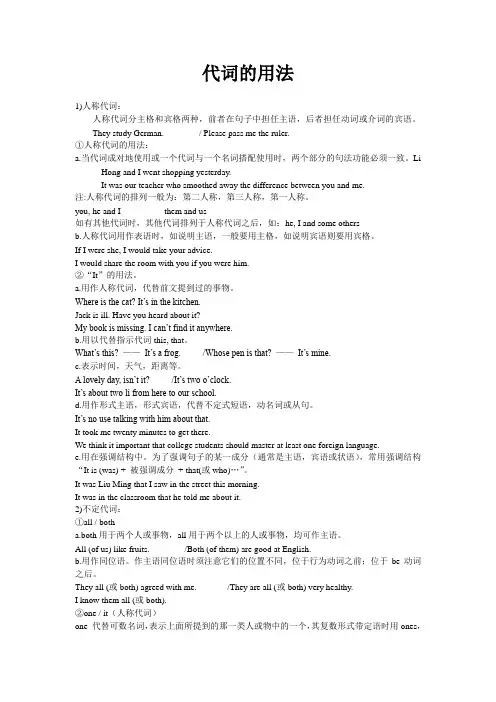
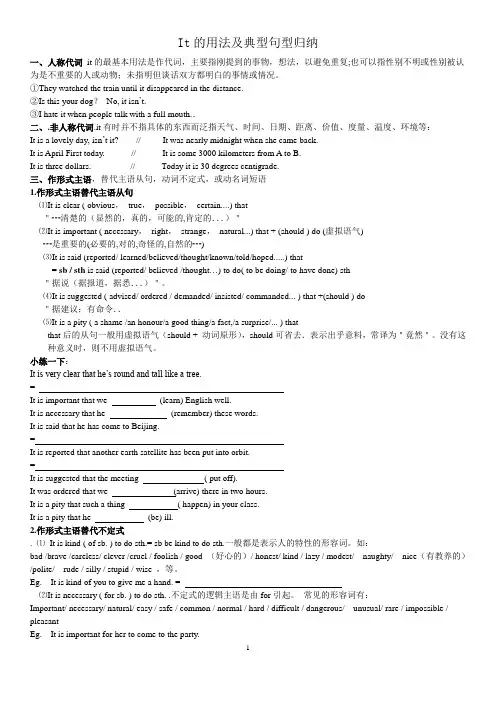
1.It is +adj.(+for sb./sth.) + to do sth.
用于此句型的形容词有:easy,hard,difficult,possible,important,impossible,necessary,good,bad,exciting,
interesting,surprising等。如:
It is necessary to change your job.
It was very hard for them to walk such a long way in the snow.
2.It is +n.(+for sb./sth.) + to do sth.
用于此句型的名词有: pity, shame, pleasure, one's duty, one's
job, fun, joy, good manners, bad manners等。如:
It is a pity for you to have missed such a wonderful play.
错过如此精彩的表演太可惜了
It is bad manners for the young to take up the seats for the
old.
占据老年人的座位这件事是不好的行为
3.It is +adj.+of sb.+to do sth.
此句型中的形容词主要描述某人的品德、特征。能用于该句型的形容词有:
kind, nice, wise, silly, polite, impolite, friendly, foolish, clever等。如:
How silly it was of you to give up such a good chance!
放弃如此好的机会,真是太傻了
It is friendly of the family to try to make me feel at home in
their house.这一家人太友好了,让我感觉到了自己家似的
4. It is +adj.(+n.)+doing sth.
此句型中的形容词和名词常见的有:no/little use, no/much
good, useless 等。如:
It's no use crying over spilt milk(无可挽回,无法弥补的损失). 哭也无可挽回这件事情了
5.It takes sb.+一段时间+to do sth.
表示"做某事花费某人多长时间"。如:
It took us half an hour to ride to the town by the sea.
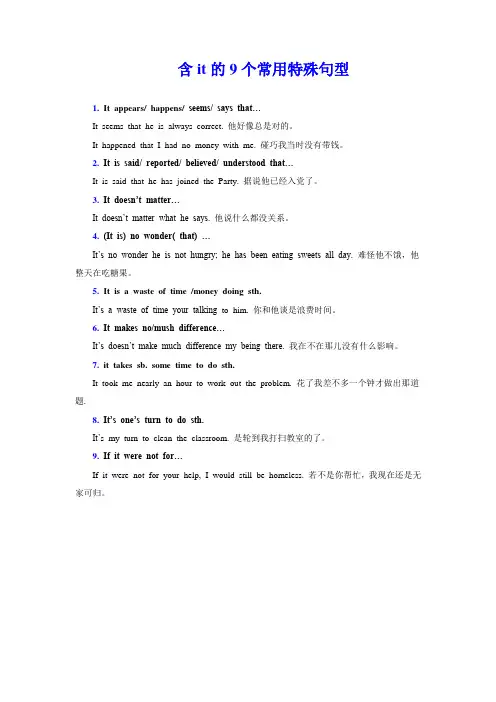
6.It is +及物动词的过去分词+that从句
此句型中常见的及物动词的过去分词有:said, told, known,
reported, recorded, thought, believed, considered等。如:
It is reported that the Russian President will visit China next
week.7.It +不及物动词+that从句
此句型中不及物动词常见的有:seem, happen, appear,
matter等。如:
It seems that there will be a heavy snow tomorrow.
It happened that I met my good friends in the museum
yesterday.
8.强调句型:It is+被强调部分+that/who从句
在使用强调句型时要注意,指人时可以用who或that,其它情况一律用that。如:It was under the bed that my brother hid the
ball this morning.
It is Mr Bell who/that often comes and looks after the old
man.
9.It is/has been+一段时间+since从句。如:
It is /has been three years since we saw each other last.
10.It is (high) time that sb. did sth.
该句型表示"某人现在该做某事了",从句常用过去时(虚拟语气)说明现在应该做的事情。如:
It's six o'clock.It is high time that we went home now.
练习 It的用法
1. My bike is missing. I can't find ____ anywhere.
A. one
B. ones C. it
D. that
2. ---- Who's that? ---- ____ Professor Li.
A. That's
B. It's
C. He's
D. This's
3. ____ was Jane that I saw in the library this morning.
A. It
B. He
C. She
D. That
4. ---- Have you ever seen a whale alive?
---- Yes, I've seen ____.
A. that
B. it
C. such
D. one
5. The color of my coat is different from ____ of yours.
A. this
B. that
C. it
D. one
6. ____ will do you good to do some exercise every morning.
A. It
B. There
C. Those
D. You
7. We think ____ our duty to pay taxes to our government.
A. that B. this
C. its
D. it
8. The climate of Shanghai is better than ____ of Nanjing.
A. that
B. it
C. which
D. what
9. ____ four years since I joined the Army.
A. There was
B. There is
C. It was
D. It is
10. How long ____ to finish the work?
A. you'll take
B. you'll take it
C. will it take you
D. will take you
11. It was through Xiao Li ____ I got to know Xiao Wang.
A. who
B. whom
C. how
D. that
12. It was in the rice fields ____ we had our league meeting.
A. where
B. that
C. in which
D. on which
13. It was on October 1st ____ new China was founded.
A. which B. when
C. as
D. that
14. Was it because he was ill ____ he asked for leave?
A. and
B. that
C. that's
D. so
15. Mary speaks in a low voice; ____ is difficult to know what
she is saying.
A. it
B. that
C. so
D. she
16. It was ____ I met Mr Green in Shanghai.
A. many years that
B. many years before
C. many years ago that
D. many years when
17. ____ is not everybody ____ can draw so well.
A. It, all
B. It, that
C. There, who
D. There, that
18. So ____ that no fish can live in it.
A. shallow is the lake
B. the lake is shallow
C. shallow the lake is
D. is the lake shallow
Keys: 1~5 CBADB 6~10 ADADC 11~15 DBDBA 16~18 CBA
“感官”动词用法:)~~
感官动词(及物)有:
see/notice/look_at/watch/notice/observe/listen_to/hear/feel(Vt)/taste(V t)/smell(Vt)
B)连缀动词(含感官不及物)
be/get/become/feel/look/sound/smell/taste/keep/stay/seem/
appear/grow/turn/prove/remain/go/run
一、see, hear, feel, watch, look,这五个动词均可作连系动词,后面接形容词作表语,说明主语所处的状态。其意思分别为"看/听/闻/尝/摸起来……"。除look 之外,其它几个动词的主语往往是物,而不是人。例如:
These flowers smell very sweet.这些花闻起来很香。
二、这些动词后面也可接介词like短语,like后面常用名词。例如:
Her idea sounds like fun.她的主意听起来很有趣。
三、这五个感官动词也可作实义动词,除look(当"看起来……"讲时)只能作不及物动词外,其余四个既可作及物动词也可作不及物动词,其主语通常是人。例如: She smelt the meat.她闻了闻那块肉。
I felt in my pocket for cigarettes.我用手在口袋里摸香烟。
四、taste, smell作不及物动词时,可用于"taste / smell + of +名词"结构,意为"有……味道/气味"。例如:
The air in the room smells of earth.房间里的空气有股泥土味。
详细的可以看这里:)~~
/doc/666553378.html
/question/4433538.html
另外,系动词又称连系动词,不单独作谓语,必须与表语连用构成系表结构。系表结构可表述主语的状况,而我们对主语情况的了解和描述角度各不相同,因此对主语的表述就因说话人的角度不同,而