
语言学第二次作业
- 格式:docx
- 大小:11.22 KB
- 文档页数:1


英语语言学15秋在线作业2一、单选题(共 20 道试题,共 60 分。
)V1. The language used to talk about language is called ______.A. metalanguageB. artificial languageC. natural languageD. language满分:3 分2. ______ is a term widely used to refer to varieties according to use in sociolinguistics.A. RegisterB. DialectC. TenorD. Variety满分:3 分3. In the phrases a herd of cattle, a flock of sheep, both cattle and sheep contain _____ morphemes.A. oneB. twoC. threeD. four满分:3 分4. Some young people have (brunch )quite often. (为括号部分的单词选择相对应的构词法)A. DerivationB. BlendingC. BackformationD. Acronym满分:3 分5. I like to have (brunch)quite often. (为括号部分的单词选择相对应的构词法)A. ConversionB. BackformationC. BlendingD. Compounding满分:3 分6. 1. ______ is an official document that determines the content and principles of teaching and learning authoritatively.A. A syllabusB. A textbookC. An educational planD. A test满分:3 分7. impossible (为下列单词选择相对应的构词法)A. DerivationB. ConversionC. BackformationD. Blending满分:3 分8. classroom (为下列单词选择相对应的构词法)A. ConversionB. BackformationC. BlendingD. Compounding满分:3 分9. The pioneering investigation carried out by William Labov in New York City in 1966 was to test ______ among different groups of speakers.A. sociolectsB. registersC. regional dialectsD. accents满分:3 分10. ______ is/are used in a community most widely.A. SociolectsB. regional dialectsC. The standard varietyD. Registers满分:3 分11. _____ is concerned with subject-matter and the purpose of communications.A. TenorB. RegisterC. ModeD. Field满分:3 分12. ______ is a minimal pair.A. moon/noonB. foot/foodC. she/sheetD. sea/sea满分:3 分13. What kind of pre-sequence is A’s first utterance in the following discourse? A: Do you have a rubber? B: Yes. A: May I use it? B: Here you are.A. Pre-invitationB. Pre-requestC. Pre-announcementD. Pre-apology满分:3 分14. Watt (为下列单词选择相对应的构词法)A. Sound ReduplicationB. CoinageC. EponymD. Clipping满分:3 分15. The smallest distinctive linguistic unit that can contrast words in meaning and in form is called a ________.A. phonemeB. phoneC. morphemeD. morph满分:3 分16. The lexical sense relation between flour and flower is __________.A. synonymyB. antonymC. polysemyD. homonymy满分:3 分17. The word “multinationality” has ______ morphemes.A. 2B. 3C. 4D. 5满分:3 分18. The process that puts an existing word of one class into another class is ______.A. ConversionB. AbbreviationC. EponymsD. Blending满分:3 分19. refers to the process through which people use language to classify the world around and inside them.A. ApproachB. CategorizationC. PrototypeD. Cognition满分:3 分20. Smog is a ___________ word.A. derivedB. clippedC. blendedD. compound满分:3 分二、判断题(共 20 道试题,共 40 分。

语言学概论第二次作业第三章语音一、名词解释(10分,每小题1分)1.语音由人的发音器官发出来的代表一定意义的声音。
2.音节音节是音位和音位组合起来构成的最小的语音结构单位。
3.音素从语音的自然属性角度划分出来的最小语音单位。
4.音标音标是记录音素的标写符号。
5.元音发音时,气流通过口腔不受任何阻碍而发出来的音素。
6.辅音发音时,气流通过口腔要受某个部位阻碍而发出来的音素。
7.发音部位发辅音时,气流在口腔受阻的部位就是发音部位。
8.发音方法发辅音时,形成和解除阻碍的方式就是发音方法。
9.音位音位是具体语言中具有区别词的语音形式作用的最小语音单位。
10.音位变体音位变体就是同一个音位的不同的变异形式,是音位在特定语音环境中的具体体现或具体代表。
11.自由变体一个音位包含多个变体,各个变体出现需要一定条件,这样的音位变体就是自由变体二、填空(9分,每空0.5分)1.语音的(发音)、(传递)、(感知)三个环节,分别对应于语音的生理、物理、心理三个方面的属性。
2.语音同其它声音一样,也具有(音高)、(音重)、(音长)、(音质)四个要素。
3.人类的发音器官可分为(动力)、(发音体)、(共鸣腔)三大部分。
4.在发音器官中,唇、舌头、软腭、小舌、声带等是能够活动的,叫做(主动)发音器官,上齿、齿龈、硬腭等是不能活动的,叫做(被动)发音器官。
5.根据发音特点,音素可以分为(元音)和(辅音)两类,例如汉语音节中的声母,主要就是由(辅音)充当的。
6.每个元音的音质是由(舌位前后)、(舌位高低)、(圆唇与否)三个方面的因素决定的。
三、判断正误(8分,每小题0.5分)1.语音的最小单位是音节。
(×)2.男子声音和女子声音的差别主要是发音是音重不同。
(×)3.儿童的声音和成人的声音差别是音长不同。
(×)4.发音时,声带是否振动,气流是否强,都能形成不同的音素。
(×)5.音素[x]的发音特点是舌面后清檫音。
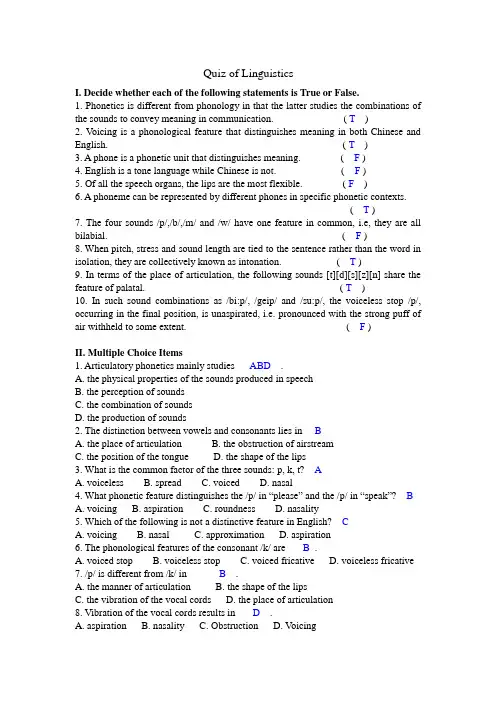
Quiz of LinguisticsI. Decide whether each of the following statements is True or False.1. Phonetics is different from phonology in that the latter studies the combinations of the sounds to convey meaning in communication. ( T )2. V oicing is a phonological feature that distinguishes meaning in both Chinese and English. ( T)3. A phone is a phonetic unit that distinguishes meaning. ( F )4. English is a tone language while Chinese is not. ( F )5. Of all the speech organs, the lips are the most flexible. ( F)6. A phoneme can be represented by different phones in specific phonetic contexts.( T )7. The four sounds /p/,/b/,/m/ and /w/ have one feature in common, i.e, they are all bilabial. ( F )8. When pitch, stress and sound length are tied to the sentence rather than the word in isolation, they are collectively known as intonation. ( T )9. In terms of the place of articulation, the following sounds [t][d][s][z][n] share the feature of palatal. ( T)10. In such sound combinations as /bi:p/, /geip/ and /su:p/, the voiceless stop /p/, occurring in the final position, is unaspirated, i.e. pronounced with the strong puff of air withheld to some extent. ( F )II. Multiple Choice Items1. Articulatory phonetics mainly studies___ABD__.A. the physical properties of the sounds produced in speechB. the perception of soundsC. the combination of soundsD. the production of sounds2. The distinction between vowels and consonants lies in __B_____A. the place of articulationB. the obstruction of airstreamC. the position of the tongueD. the shape of the lips3. What is the common factor of the three sounds: p, k, t? AA. voicelessB. spreadC. voicedD. nasal4. What phonetic feature distinguishes the /p/ in “please” and the /p/ in “speak”? BA. voicingB. aspirationC. roundnessD. nasality5. Which of the following is not a distinctive feature in English? CA. voicingB. nasalC. approximationD. aspiration6. The phonological features of the consonant /k/ are ___B_.A. voiced stopB. voiceless stopC. voiced fricativeD. voiceless fricative7. /p/ is different from /k/ in ______B__.A. the manner of articulationB. the shape of the lipsC. the vibration of the vocal cordsD. the place of articulation8. Vibration of the vocal cords results in ___D__.A. aspirationB. nasalityC. ObstructionD. V oicing9. Of the three branches of phonetics, the longest established, and until recently the most highly developed, is ___D__ phonetics.A. auditoryB. acousticC. articulatoryD. none of the above three10. In terms of the place of articulation, the following sounds [t][d][s][z][n] share the feature of ___A_.A. palatalB. alveolarC. bilabialD. dentalIII. Term Explanation1. phoneme A phoneme is a phonological unit; it is a unit that is of distinctive value.2. allophone The different phones which can represent a phoneme in different phonetic environments are called the allophone.3. phonology Phonology aims to discover how speech sounds in a language form patterns and how these sounds are used to convey meaning in linguistic communication.4. phonetic Phonetic is a general nature; it is interested in all the speech sounds used in all human languages.5. Supersegmental Features The phonemic features that occur above the level of the segments are called super segmental features.IV. Short-answer Questionspare and contrast phonetics and phonology.Both are concerned with the same aspect of language—the speech sound. But while both are related to the study of sounds, they differ in their approach and focus. Phonetic is a generl nature; it is interested in all the speech sounds used in all human languages. Phonology aims to discover how speech sounds in a language form patterns and how these sounds are used to convey meaning in linguistic communication.2.What is a phone? How is it different from a phoneme? How are allophones relatedto a phoneme?A phone is a phonetic unit or segment. The speech sounds we hear and produce during linguistic communication are all phone.A phoneme is a phonological unit; it is a unit that is of distinctive value. It is an abstract unit. It is not any particular sounds, but rather it is presented or realized by a certain phone in a certain phonetic context.The different phones which can represent a phoneme in different phonetic environment are called the allophones of that phoneme.。

The second assignmentExercise 7 on Page 967. I n the following sentence, the phrase “in the car” could be used (i) to show where the biting took place or (ii) to specify that it was the man in the car that was bitten. How would the tree diagrams for (i) and (ii) differ?The dog bit the man in the car.Exercise 2 < (2) (3) (4)>2.E xplain the semantic ambiguity of the following sentences by providing two or more sentences that paraphrase the multiple meanings. Examples:she can’t bear children can mean either she can’t give birth to children or she can’t tolerate children.(2) I s he really that kind?(3) W e bought her dog biscuits.(4) He saw that gasoline can explode.Exercise 55.S ome of the sets of terms below form semantic field. For each set :(1) I dentify the words that do not belong to the same semantic field as the others in the set.(2)I dentify the supe r ordinate term of the remaining semantic field, if there is one (it may be a word in the set) (3) Determine whether some terms are less marked than others, and justify your claim.a. acquire , buy , collect , hoard , win , inherit , stealb. whisper , talk , narrate , tell ,report , harangue ,scribble ,instruct , briefc. road , path , barn , way , street , freeway . avenue, thoroughfare , interstate , methodd. stench , smell , reek , aroma , bouquet , odoriferous , perfume , fragrance , scent , olfactory.。