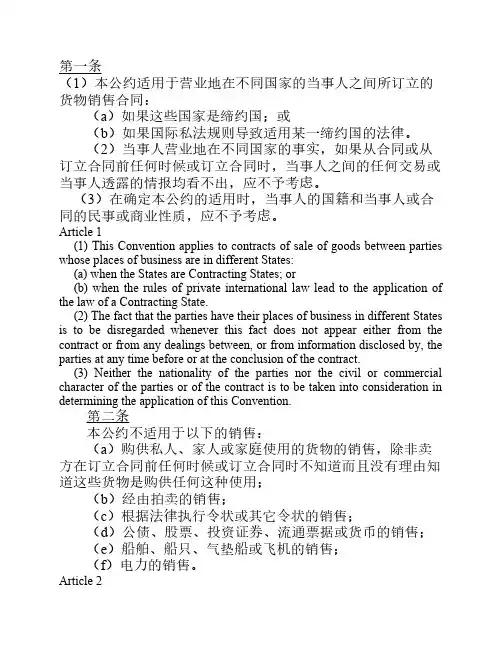
《联合国国际货物销售合同公约》英文
- 格式:docx
- 大小:24.71 KB
- 文档页数:2
《联合国国际货物销售合同公约》英文
The United Nations Convention on Contracts for the International Sale of Goods
(CISG) is a pivotal international treaty that provides a uniform framework for the sale of
goods between private businesses, excluding sales to consumers and sales of services, as
well as sales of certain specified types of goods. It aims to contribute to the removal of
legal barriers in international trade and promote the development of international trade.
The CISG has been recognized as one of the core legal instruments in international
trade law. It was adopted on April 11, 1980, in Vienna, and it came into force on January
1, 1988. As of today, it has been ratified by a significant number of countries around the
world, which reflects its global acceptance and applicability.
One of the key features of the CISG is its application to contracts for the sale of
goods between parties whose places of business are in different states when the states are
Contracting States or when the rules of private international law lead to the application of
the law of a Contracting State. This wide applicability makes the CISG an important tool
for businesses engaged in international trade.
The CISG governs the formation of the contract of sale and the rights and obligations
of the seller and the buyer arising from such a contract. It covers a range of issues
pertinent to the sale of goods contract, including but not limited to the obligations of the
seller, the obligations of the buyer, passing of risk, and remedies for breach of contract.
One of the fundamental principles of the CISG is the principle of good faith, which is
expected to be observed by both parties during the negotiation, formation, and
performance of the contract. This principle underlines the expectation of fair dealing and
honesty in the international trade context.
The convention also emphasizes the importance of the 'party autonomy' principle,
which allows the parties to exclude the application of the CISG or, subject to some
limitations, derogate from or vary the effect of any of its provisions. This flexibility is crucial as it respects the parties' freedom to contract and their ability to tailor their
agreements to their specific needs.
The CISG does not cover all aspects of the international sale of goods; for instance, it
does not deal with the validity of the contract or the effect which the contract may have
on the property in the goods sold. These matters are generally left to be resolved by
domestic law as determined by the rules of private international law.
In conclusion, the CISG serves as a comprehensive guide for international sales
contracts, providing a balanced framework that accommodates the diverse legal traditions
and social-economic realities of the contracting states. Its widespread adoption
underscores its effectiveness in facilitating international trade by creating a more
predictable and secure legal environment for the sale of goods across national borders.
The CISG continues to evolve through case law and scholarly interpretation, ensuring its
relevance in the dynamic field of international trade law.