外研版八年级英语上册教案 M1 Unit2教案
- 格式:doc
- 大小:55.60 KB
- 文档页数:7
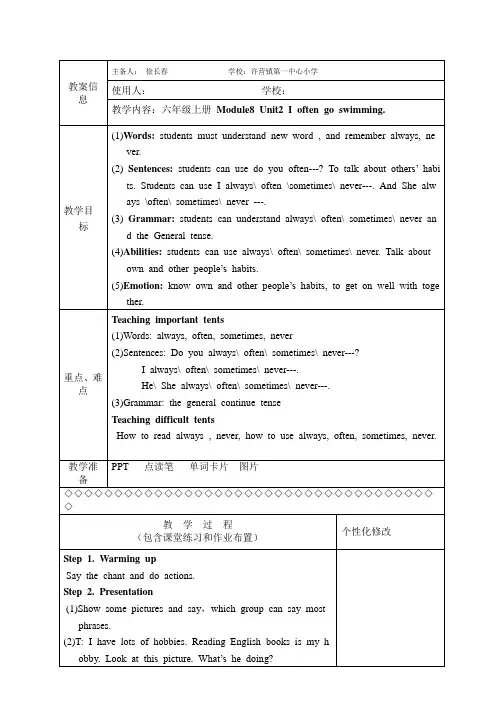
Unit 2 You should smile at her!
一、学习目标:
A.单词和短语:
pair, correct, spelling, word, practice, match, meaning, complete, sentence, dictionary,
grammar, letter, look up, mistake, make a mistake, understand-understood, advice, should,
possible, write down, notebook, forget-forgot, pronounce, aloud, radio, key, main, excellent,
agree, agree with sb., vocabulary, ask for, improve, basic, time, advise, shy, conversation,
quickly, natural, suggest, place
B.交际用语:
1. Ready?
2. That’s a good idea.
3. What else?
4. Thanks a lot!
5. Excellent!
6. We should always speak English in class.
7. Let’s try to speak English as much as possible.
8. Why not write down the mistakes in our notebooks?
9. It’s a good idea to spell and pronounce new words aloud.
10. How about listening to the radio?
11 It’s better not to translate.
12.It’s a good idea to check new words every day.
二. 教学目标
1. Function : Giving suggestions (English study)
2. Structure: Giving advice: 1) We/You should…
2) Let’s try to…
3) Why not…?
4) It’s a good idea to…
5) How about…?
6) Why don’t we/you…?
7) It’s better not to…
3. Skills: 1) Listening and understanding familiar topics (English study).
2) Talking about problems in English study and giving advice, conducting
conversations in several turns.
3) Reading and finding specific information about English study.
4) Drafting a letter asking for advice about English study, revising through pair
discussion.
4. Around the world: English online
5. Task: Writing your English study plan.
三、重点及难点:
Giving advice: 1) We/You should…2) Let’s try to…3) Why not…? 4) It’s a good idea to…5)
How about…? 6) Why don’t we/you…? 7) It’s better not to…
四、教学设计:
Unit 2 You should smile at her!
ⅠTeaching model
Reading and writing.
ⅡTeaching method
Top-down approach
ⅢTeaching aims
1. Listening and understanding familiar topics (English study).
2. Talking about problems in English study and giving advice, conducting conversations in
several turns.
3. Reading and finding specific information about English study.
4. Drafting a letter asking for advice about English study, revising through pair discussion.
ⅣTeaching Objectives
Key vocabulary: ask for, improve, basic, advise, shy, conversation, quickly, natural, suggest
ⅤTeaching aids
Recorder, OHP, video
ⅥTeaching Steps
Step 1 Warming-up
1. Free talking: How to learn English well?
1) We should always speak English in class.
2) Let’s try to speak English as much as possible.
3) Why not write down the mistakes in our notebooks?
4) Don’t forget to write down the correct answers next to the mistakes.
5) It’s a good idea to spell and pronounce new words aloud every day.
6) How about listening to the radio?
7) How about reading English stories?
8) Why don’t we try to find some English pen friends?
2. Review the text of Unit 1.
Step 2 Work in pairs.
Talk about problems you have with…
1. understanding English
2. speaking English
3. learning vocabulary
Step 3 Learn new words.
1. Show some pictures.
2. Talk something about the pictures.
3. Introduce the new words.
4. Read the words after the teacher.
Step 4 Reading.
1.Tell the students: There are three basic questions. The first question is about understanding
English films and songs. The second question is about speaking. The third question is about
vocabulary.
2. Play the recording and listen to the tape carefully.
3. Ask the students to read through the passage.
4. Read the passage and complete the table.
Advice from Diana
Li Hao
Wang Fan
Zhang Lei
4. Check with a partner.
5. Call back the answers from the whole class.
Keys:
1. Watching films and listening to songs are great ways to learn English! Watch and listen
several times, and guess the meaning of the new word. Each time you will learn something
new. Talk about the films or songs with your friends.
2. You can say: “Hello! How are you? Do you like China?”
These are good ways to start a conversation. And before you begin, you should smile at her!
Don’t be shy.
3. Write four or five words a day on pieces of paper and place them in your room. Read the
words when you see them, and try to use them.
6. Read the text together.