
Extended Range (10-30 Days) Heavy Rain Forecasting Study Based on a Nonlinear Cross-P
- 格式:pdf
- 大小:901.19 KB
- 文档页数:9

关于恶劣天气的英语单词Adverse Weather: Understanding and Preparing forNature's Extremes.Throughout history, humankind has faced the wrath of inclement weather, from torrential downpours to raging storms and blistering heat waves. These adverse weather events, often unpredictable and devastating, pose significant threats to communities and ecosystems alike. Understanding the causes, characteristics, and potential impacts of such weather phenomena is crucial for mitigating their destructive effects and ensuring public safety.Types of Adverse Weather.The term "adverse weather" encompasses a wide range of meteorological conditions that can have significant negative impacts. These can be broadly categorized into:Severe Storms:Thunderstorms: Intense thunderstorms, characterized by heavy rain, lightning, and thunder, can cause localized flooding, hail, and wind damage.Cyclones: Tropical cyclones, hurricanes, and typhoons are rapidly rotating storms that bring torrential rain, high winds, and storm surges, posing major threats to coastal areas.Blizzards: Severe snowstorms with strong winds and reduced visibility, often associated with winter weather systems.Excessive Precipitation:Floods: Incessant rainfall or rapid snowmelt can lead to overflowing rivers and streams, inundating low-lying areas with water and causing significant property damage and infrastructure disruption.Hailstorms: Hail, formed when raindrops freeze withinclouds, can range in size from small pellets to large, damaging hailstones.Extreme Temperatures:Heat Waves: Extended periods of unusually high temperatures can cause heat exhaustion, heat stroke, and exacerbate respiratory conditions.Cold Snaps: Severe cold spells, characterized by plummeting temperatures and icy conditions, can lead to hypothermia, frostbite, and disruption of daily life.Causes of Adverse Weather.The formation of adverse weather is often attributed to complex interactions within the Earth's atmosphere and oceans. Some of the primary factors contributing to such events include:Atmospheric Instability: When warm, moist air rises rapidly, it can cause thunderstorms and other convectivestorms.Atmospheric Fronts: Boundaries between different air masses with contrasting temperatures and densities can generate precipitation and severe weather.Ocean-Atmosphere Interactions: Warm ocean waters provide energy for the formation of tropical cyclones and hurricanes, while cold ocean currents can contribute to the severity of winter storms.Climate Change: Rising global temperatures are intensifying extreme weather events, leading to more frequent and stronger heat waves, droughts, floods, and storms.Impacts of Adverse Weather.The consequences of adverse weather can be far-reaching and devastating, affecting individuals, communities, and ecosystems:Human Impacts:Loss of Life and Injury: Severe storms, floods, and heat waves can cause direct casualties and injuries.Infrastructure Damage: High winds and flooding can damage buildings, roads, bridges, and power lines, disrupting transportation, communication, and essential services.Economic Losses: Adverse weather events can lead to business disruptions, crop failures, and tourism losses, resulting in substantial economic impacts.Environmental Impacts:Habitat Destruction: Floods, storms, and wildfires can destroy natural habitats, displacing wildlife anddisrupting ecosystems.Water Quality Degradation: Excessive precipitation and flooding can contaminate water sources with pollutants,posing risks to both aquatic life and human health.Deforestation: Severe storms and wildfires can trigger deforestation, leading to soil erosion, loss of biodiversity, and disruption of carbon sequestration.Preparing for Adverse Weather.Given the potential severity of adverse weather events, it is imperative that communities and individuals take proactive steps to prepare for and mitigate their impacts. Effective preparation strategies include:Monitoring Weather Forecasts: Stay informed about weather conditions and potential hazards through official weather sources.Developing Emergency Plans: Create a plan for evacuation, communication, and shelter in case of severe weather.Securing Property: Reinforce structures, clear debris,and elevate belongings to minimize damage from flooding and high winds.Stockpiling Emergency Supplies: Gather essential supplies such as non-perishable food, water, medications, and a first-aid kit.Evacuating When Necessary: If ordered to evacuate by authorities, do so promptly and follow designated evacuation routes.Conclusion.Adverse weather events, once rare and isolated occurrences, are becoming increasingly frequent and severe due to climate change and other factors. Understanding the causes, characteristics, and potential impacts of these weather phenomena is crucial for mitigating their destructive effects and ensuring the safety of communities and ecosystems. By monitoring weather forecasts, developing emergency plans, securing property, stockpiling supplies, and evacuating when necessary, we can enhance ourpreparedness and resilience to the challenges posed by adverse weather.。

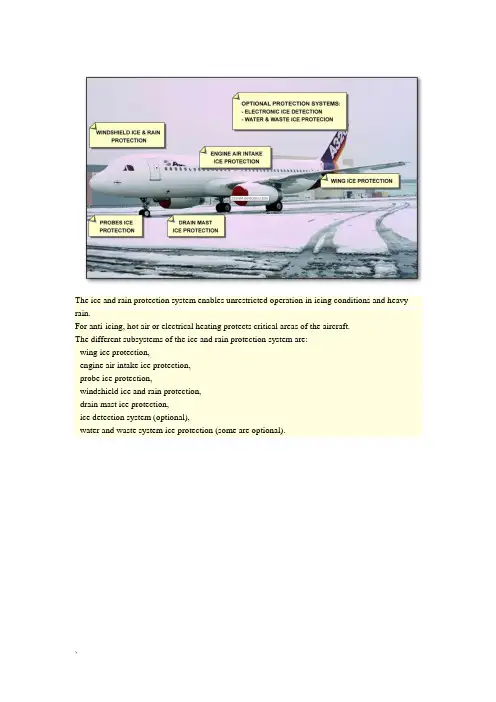
The ice and rain protection system enables unrestricted operation in icing conditions and heavy rain.For anti-icing, hot air or electrical heating protects critical areas of the aircraft.The different subsystems of the ice and rain protection system are:- wing ice protection,- engine air intake ice protection,- probe ice protection,- windshield ice and rain protection,- drain mast ice protection,- ice detection system (optional),- water and waste system ice protection (some are optional).Hot air from the pneumatic system is supplied for the anti-icing of the three outboard leading edge slats (3, 4 and 5) of each wing. Bleed air from the engines or the APU is supplied to each wing through a pressure regulating and shut off valve called Wing Anti-Ice (WAI) valve.A single P/BSW on the overhead ANTI ICE panel controls WAI supply to both wings. WAI must be manually selected by the crew and is available in flight only.Whenever WAI is selected, the engine idle is increased and the Takeoff/Go Around (TOGA) limit (max thrust) is decreased by the Full Authority Digital Engine Control (FADEC). This signal is sent to the FADEC through the Engine Interface Unit (EIU). WAI test limited to 30 seconds. Fortesting purposes, WAI can be selected on the ground but will be automatically limited to 30 seconds operation to prevent damage to the wing leading edge.Each engine air intake is protected from ice by an independent air bleed supply from the High Pressure (HP) compressor of that engine.The air is supplied through the engine air intake anti-ice valve.Engine anti-ice is manually selected by the crew and is available in flight or on the ground with the engine running. After circulating around the inlet, the air is ducted overboard.Note: In the event of an electrical power supply failure, this valve will automatically open when the engine is running.Whenever engine anti-ice is selected, the engine idle is increased and the TOGA limit (max thrust) is decreased by the FADEC. For V2500, the FADEC also turns on continuous ignition. This signal is sent to the FADEC through the EIU. The ignition is automatically on PW6000 and on V2500 engines. On CFM56 the IGN is not automatically on.Ice protection of the Angle Of Attack (AOA) sensors, pitot probes, static ports, and Total Air Temperature (TAT) probes is achieved by electrical heating.In order to give reliable information to the air data systems, the air data probes are heated automatically when at least one engine is running. The probes are arranged in three channels related to the three air data systems: CAPT, F/O and STBY (Air Data/Inertial Reference Unit (ADIRU) 1, 2, 3). The heating system for each channel is controlled by a Probe Heat Computer (PHC) 1, 2, 3.The PROBE/WINDOW HEAT P/BSW (normally in the AUTO position) may be used to select the probe heating ON with the engines shut down.Electrical heating is supplied for windshield anti-icing and cockpit side window de-fogging.The front windshields and side windows are heated automatically when at least one engine is running. The heating system for each side is controlled and monitored by a Window Heat Computer (WHC) 1, 2.The PROBE/WINDOW HEAT P/BSW (normally in the AUTO position) may be used to select the window heating ON with the engines shut down. The windows are protected against overheatby sensors and flight/ground logic. The sensors turn off the heat when the temperature reaches the limit and the windows are heated at a lower power on the ground than in flight.Rain removal from the windshield is ensured by tow independent wipers powered by DC motors. The wiper system is designed to work efficiently up to 200 knots.Each wiper is controlled by a rotary selector located on the overhead panel. "SLOW" or "FAST" speed can be selected. The selector switch can be optionally equipped with and "INTerMiTtent" position. During intermittent operation, the DC motor is assisted by a timer. When the selector is set to "OFF", the wiper stops in the parking position and is lifted off the aircraft structure, at the bottom part of the windshield.Do not operate the wipers in a dry windshield.Rain removal from the windshield is done by two independent wipers and by a rain repellent system in heavy rain. The wipers operate independently. The rain repellent is discharged onto the left or right windshield from a pressurized canister installed at the rear of the cockpit.There are two drain masts installed on the lower fuselage forward and aft sections.When the electrical system is powered, the waste water drain masts are also electrically heated. Two control units located in the cargo compartments control the heating of the forward and aft drain masts.An external visual ice indicator with an integral light is installed between the two windshields.The ice detection system (if installed) has two separate ice detectors located on the forward lower section of the fuselage. The ice detectors send an "ice detected" signal directly to the Flight Warning Computers (FWCs).It is also possible for the aircraft to have installed electrical heating systems for:- potable water supply lines,- waste water lines,- water servicing panels.These heating systems are controlled automatically by control units connected to temperature sensors. The control units control multiple heating elements and are installed in the cargo compartments.This section will highlight the control panels and indications for the ice and rain protection systems.The controls for the engine and wing anti-ice systems are located on the overhead ANTI ICE panel. The probes ice protection and windows anti-icing systems are controlled from the PROBE/WINDOW HEAT P/BSW.Each rain removal system is independently controlled by individual selectors on the overhead panel, on the left and right hand sides.A MEMO appears on the upper ECAM when engine anti-ice or WAI is selected. WAI valve position indication is available on the BLEED page when the system is selected.The optional electronic ice detection system sends warnings directly to the ECAM though the FWCs.Drain mast heating faults may be displayed either on the Flight Attendant Panel (FAP).When you work on the ice and rain protection system, make sure that you obey all Aircraft Manual Maintenance (AMM) safety procedures. This will prevent injury to persons and/or damage to the aircraft. Here is an overview of the main safety precautions related to the ice and rain protection system.Remove the protective covers from the probes before activating the probe ice protection system. Do not touch the probes during or immediately after operation. The probes are hot and can burn you.Do not touch the anti-ice ducts, slats 3, 4 and 5 and engine air intake lips until they are cool. Those items stay hot for some time after the engine shuts down.The probe heat system is a fail-safe system in order to keep the probes and static ports de-iced (in flight) in case of a PHC failure.The window heat system is designed in order to keep the windows defogged (in flight) in case of a WHC failure.If the PHC or WHC power Circuit Breakers (C/Bs) are pulled, the probe and window heat will come on. Pulling the EIU C/B will have the same result. The EIU controls the "engine running" signal for automatic operation. If any of these C/Bs are pulled, all of the heater C/Bs must also be pulled.。

第三套1 the greater the weight of the aircraft, the more intense will be the wake turbulence,particularly when it affect the aircraft has a short wing span than other general aircraftQ: what phenomenon does this statement refer to这个不会What phenomena does this statement refer to?Victor turbulenceWake turbulenceWeek turbulenceWeak turbulence2 Nicad battery are frequently used in turbo aircraftQ According to the statement, what type of aircraft is more likely to have a NiCad battery?没有题目According to the statement, what type of aircraft is more likely to havea NiCad battery?Rocket Aircraft.Supersonic Aircraft.A Glider.Aircraft with a propeller.3 scanning the sky for other aircraft is important in avoiding mid-air collision, particularly flyunder visual flight rulesQ: what is the reason for scan the sky for other aircraftWhat is the use to scan the sky for other aircraft, especially while flying under VFR?1..To look for other aircraft clearly.2.To prevent collisions in the air.3.To avoid military collisions.To avoid mid-air incursion.4 pilots are urged in own interests to request assistance from the emergency services as soon asthere is any doubt about the safe conduct in the sky.Q: when should pilot request assistance from emergency departmentWhen should pilots request assistance from emergency service?When they are urged to do so.When they have no interest in handling the flight.When they could handle the situation.When they are not sure of the flight safety.5 when flying in app in a strong gust headwind, the Vraf should be adjusted by half of the headwind and full gust speed.In windy conditions, how much should Vref be adjusted by during an approach?Full headwind and full gust.Full headwind and half gust.Half headwind and full gust.Only headwind.6 a flight direct to __are from the primary flight instrument are the Chevron indicator, or a pair of vertical horizontal bars, both Chevron and bar flight indicator are command the plane, which means by flying towards them, they will regain or maintain the flight progress.Q: what is the main topic in this statementWhat is the main topic in the statement?Flight Directors.Primary flight instruments.Horizontal bars.Chevron Indicators.(v型指示仪)7 AFR145 is currently on route from Paris to Heathrow , the aircraft was descending to 3000ft and requesting direct to TLA, air traffic control didn’t grant their request due to conflicting aircraft at 3000ftQ: why did air traffic control denied the request from AFR 145Why did Air Traffic Control deny the request of Air France 145?Military activityConflicting TrafficTerrainWeather conditions8 forecast condition in shanghai airport this morning, expect ceiling 900m, broken with 3000movercast, visibility 4000m, reducing in 1000m due to strong wind shower, wind 320 at 10meters per second, gust 15 meters per second.Q: which statement is not correctWhich statement is not correct?Ceiling is 900m brokenVisibility is reducing to 3000m overcastVisibility is 4000mThere are heavy rain showers9 the localizer transmitter is situated on the extended runway centerline, the localize beennormally found to centerline the runway and extends along the app path from 25 miles with 40 ILS channels, with a frequency range of 108.0 to 119.15 mhz to provide pilots with course guidanceQ: what is localizer used for这个不会What is localizer used for?Horizontal guidanceBoth longitudinal and lateral guidanceVertical guidanceLongitudinal guidance10 week, while taxing to the runway, we got a hydraulic low quantity warning, after confirmingwe are losing fluid, we stopped and call for a tug, unfortunately , we had to wait for nearly an hour before it came, by the time we finally changed the plane, we were 2 hours late.How did they get back to the gate?It took nearly an hour.They used a tug.They went back on one engine.They had to shut down.11 AFR 215, FL310 is not available at the moment, the alternative is FL 350 advise.Q: which statement is trueWhich statement is true?FL350 is not available.FL310 and FL350 are not available.FL310 is now available.FL350 is now available.12CCA412, heavy, cleared for takeoff, RW 23L, wind 220 at 15 knots.Q: which runway is CCA412 used to takeoffWhich runway is Air China 412 using to take off?1.15 right.2.23 left.3.15 left.23 right.13Speed bird 480, flames coming from your No. 3 engine on takeoff, please adviseRoger, declare an emergency , request immediate return.Q: why are they declaring emergencyWhy are they declaring an emergency?engine firemissed approachrequesting return to airportwarning light indication14CCA101, due traffic congestion, make a 360 turn left at your present position.Q: what is the aircraft expected to doWhat is the aircraft expected to doTo lose heightTo turn left at 360To lose timeTo speed up15CCA982, 22km from touch down, turn right heading 33o, cleared for ILS runway 36L, report established.Q: which of the following information is not true-15 Which of the following information is not true?Report established.Cleared for IGS runway 36L.3.22km from touchdown.Turn right heading 330.16 Speed bird 639, turn left heading 130 to offset your original track, the latest weather forcast reports CBs is building up on your route, fly with caution, after go round them, resume own navigation.Turn left heading 130 to detour the CB, speed bird 639.. What does the controller's instruction to BAW639 indicate?What does the controller's instruction to BAW639 indicate?It will turn left to resume its own navigation .It is expected to meet CBs on its original route.It will resume its own navigation after left turn.It will offset its path to encounter CBs.17United 755, ceiling 250 feet variable, visibility 2200 in fog, advise go around.United 755United 755, no contact minimum, overshooting.What is the reason for advised going around?Gear problem.Undershooting.Ceiling.Crosswind.18AFR 201, cancel landing clearance, runway 23L due to disable aircraft, change to RW 23R, cleared to land RW23R,AFR201, unable to land Rw23R due to braking problem. We need a longer runway.AFR201, go around immediately, turn left heading 140 to vector the ILS runway 23L, climb and maintain 4000ft, the runway will be available in 5 minutes.Why can't they land on R/W 23 R?They need a longer runwayThey can't extend their flapsThey have to go aroundR/W 23 L is blocked19United 350, we can’t hold any longer, we have a serious old passenger on board, United 350, leave the holding pattern, flight heading 050,Flight heading 050, united 350, request first aid after landingRoger, United 350‘What will be the immediate need after landing?1.A shuttle busA leader-vanMedical service4.A follow-me car20 United 655, we have a serious fuel leak, we are returningUnited 655, descend and maintain 3300m,Leaving 5400m to 3300m, United 655United 655, do you required emergency services upon landingAffirm, United 65520 What is the problem with the aircraft?Low enduranceFuel shortageFuel leakLack of fuel。