
Be动词的否定句和一般疑问句
- 格式:ppt
- 大小:468.00 KB
- 文档页数:4

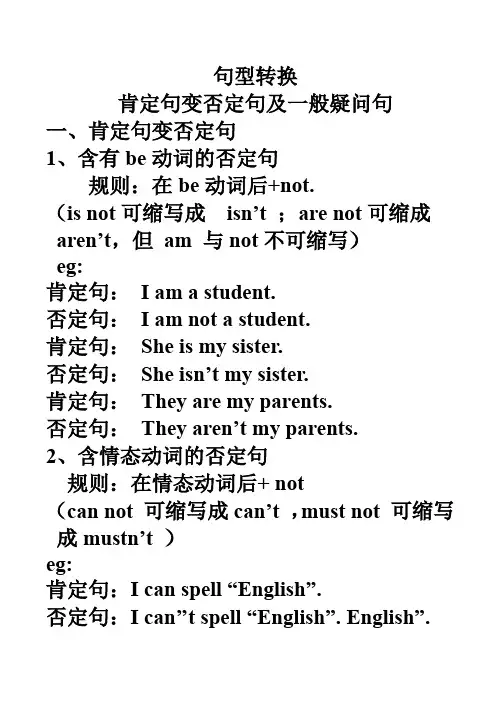
句型转换肯定句变否定句及一般疑问句一、肯定句变否定句1、含有be动词的否定句规则:在be动词后+not.(is not可缩写成isn’t ;are not可缩成aren’t,但am 与not不可缩写)eg:肯定句:I am a student.否定句:I am not a student.肯定句:She is my sister.否定句:She isn’t my sister.肯定句:They are my parents.否定句:They aren’t my parents.2、含情态动词的否定句规则:在情态动词后+ not(can not 可缩写成can’t ,must not 可缩写成mustn’t )eg:肯定句:I can spell “English”.否定句:I can’’t spell “English”.English”.肯定句:I must find it.否定句:I mustn’t find it.3、含有实义动词的句子的否定句构成(1)第三人称单数做主语。
(he、she、it或表示单个人或物的第三人称名词)规则:要在行为动词前加上助动词doesn’t,然后将动词恢复原形。
eg :肯定句:He has a soccer ball.否定句:He doesn’t have a soccer ball.(2)其它人称做主语规则:在行为动词前加don’t ,句子中的行为动词用原形。
eg:肯定句:They like bananas.否定句:They don’t like bananas.注:(1)在变否定句时,如遇some应变any Here are some books.Here aren’t any books.二、肯定句变一般疑问句1、含有be动词的句子变一般疑问句规则:把be动词提至句首,第一人称变第二人称,句末句号变问号。
(I/we变成youMy/our变成your)肯定句:I am a student.一般疑问句:Are you a student?肯定句:She is my sister.一般疑问句:Is she your sister?肯定句:They are my parents.一般疑问句:Are they your parents?2、含有情态动词的句子变一般疑问句规则:把情态动词提至句首,第一人称变第二人称,句末句号变问号。


be 动词在否定句和疑问句的用法be动词在否定句和疑问句中的用法如下:1.否定句:be动词与not连用,构成否定形式。
例如:He is not here.他不在这里。
解释:表达某人或某物不在某个地方。
2.疑问句:将be动词提前形成疑问句。
例如:Is he here?他在这里吗?解释:用来询问某人或某物是否在某个地方。
3.否定句:be动词加not构成否定疑问句。
例如:Isn't he here?他不在这里吗?解释:表达疑问之情态。
以下是24个双语例句:1. She is not happy.她不快乐。
2. Are you tired?你累了吗?3. He is not tall.他不高。
4. Is she your sister?她是你的姐姐吗?5. They are not at home.他们不在家。
6. Is it cold outside?外面冷吗?7. I am not ready yet.我还没准备好。
8. Are they friends?他们是朋友吗?9. We are not hungry.我们不饿。
10. Is he a doctor?他是医生吗?11. She is not wearing a dress.她没有穿裙子。
12. Are you busy?你忙吗?13. He is not a good student.他不是一个好学生。
14. Is she from Australia?她来自澳大利亚吗?15. They are not happy with the result.他们对结果不满意。
16. Is it your book?这是你的书吗?17. I am not sure about the answer.我不确定答案。
18. Are they siblings?他们是兄弟姐妹吗?19. We are not going to the party.我们不去参加派对。